
Uncategorized
New research on the massive thrust fault suggests the next big earthquake could be imminent.
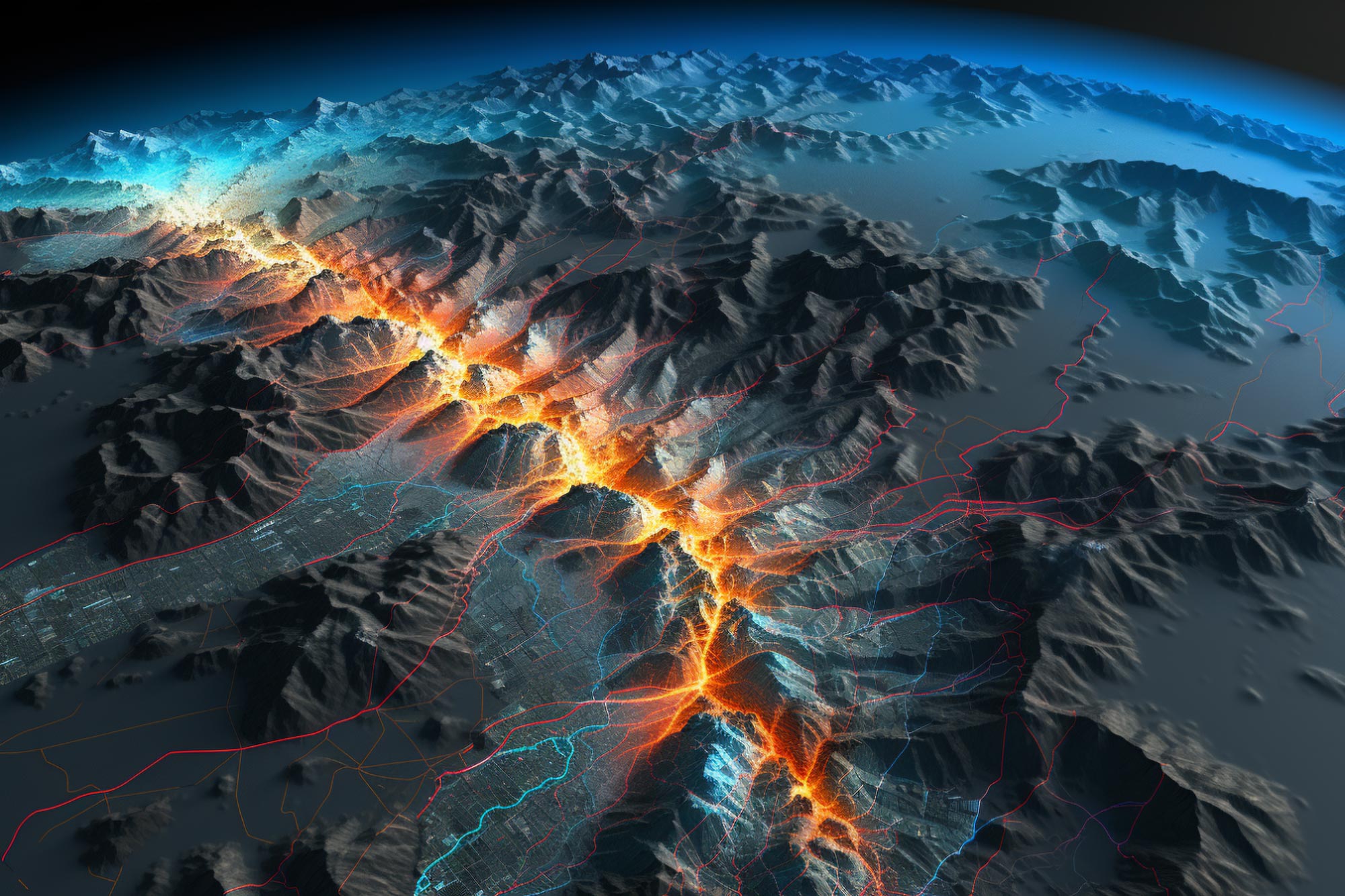
New research on the Cascadia subduction zone shows it has a fragmented fault structure, affecting earthquake predictions and preparedness strategies and potentially impacting building codes in vulnerable areas like Washington’s Olympic Peninsula. Copyright: SciTechDaily.com
Large-scale earthquakes and tsunamis have historically affected the western United States and Canada, and this impact is likely to continue in the future.
Off the southern coasts of British Columbia, Washington, Oregon, and northern California, there is a 600-mile-long strip where the Pacific Ocean floor gradually dives eastward beneath North America.
This area, called the Cascadia Subduction Zone, hosts a massive fault, a place where tectonic plates move against each other in a very dangerous way. The plates can periodically jam and build up stress over large areas — eventually releasing when they finally swing against each other.
The result: the world’s largest earthquakes, shaking the seafloor and land, generating tsunamis 100 feet or more high. Such a fault off Japan caused the 2011 Fukushima nuclear disaster. Similar areas exist off Alaska, Chile, and New Zealand, among other places. In Cascadia, large quakes are thought to occur about every 500 years, give or take a little. The last one occurred in 1700.
Research progress in understanding seismic activity
Scientists have long worked to understand the Cascadia subsurface and its mechanics, to determine where earthquakes are most likely to occur, how large they will be, and what warning signs they might produce. There is no such thing as predicting an earthquake; instead, scientists try to predict the probabilities of various scenarios, hoping to help authorities design building codes and warning systems to minimize damage when something does happen.
A newly published study promises to greatly enhance these efforts. A research vessel towing a suite of state-of-the-art geophysical instruments across nearly the entire region has produced the first comprehensive survey of several complex structures beneath the seafloor. These structures include the geometry of the descending oceanic plate and the overlying sediments, and the composition of the North American plate. The study was published recently in the journal Science Advances.
Schematic cross-section of the Cascadia subduction zone shows the ocean floor plate (light gray) moving beneath the North American continental plate, along with other features. Copyright: U.S. Geological Survey
“The models currently used by public agencies have been based on a limited set of low-quality, legacy data dating back to the 1980s,” said Susan Carbot, a marine geophysicist at Columbia University’s Lamont-Doherty Earth Observatory who led the research. “The megathrust has a more complex geometry than previously assumed. The study provides a new framework for assessing earthquake and tsunami hazards.”
Funded by the U.S. National Science Foundation, the data was collected during a 41-day cruise in 2021 by Lamont’s research vessel, the Marcus G. Langseth. Researchers on board the ship blasted powerful sonic pulses into the seafloor and read the echoes, which were then converted into images, similar to the way doctors create internal scans of the human body.
New insights into fault splitting and tsunami risk
Among their key findings: The megathrust fault zone is not just one continuous structure, but is divided into at least four parts, each of which is somewhat isolated from the movements of the others. Scientists have long debated whether past events, including the 1700 earthquake, ruptured the entire zone or just part of it—a key question, because the longer the rupture lasts, the bigger the quake.
The data show that the fragments are divided by buried features, including large faults, where opposite sides slide against each other perpendicular to the shore. This may help prevent one fragment from moving into the next. “We can’t say for sure that it means that individual fragments will break, or that the whole thing will break at once,” said Harold Tobin, a geophysicist at the University of Washington and co-author of the study. “But it does add to the evidence for fragmented ruptures.”
Undersea map of the Cascadia subduction zone, showing the depth of the rift between the eastward-moving Juan de Fuca zone and the North American plate. Yellow/orange indicates shallow depths; green is deeper; blue/purple is deeper. Diagonal black lines approximate divisions between different parts of the zone. The wavy red line to the right indicates the seaward edge of solid continental rock that appears to be causing the zone to split into these parts. Copyright: Modified from Carbotte et al., Science Advances, 2024
The images also suggest the reasons for this division: The rigid edge of the North American continental plate is made up of many different types of rock, formed at different times over tens of millions of years, some denser than others. This diversity in continental rock causes the incoming, more flexible oceanic plate to bend and twist to accommodate the pressure differences above it. In some places, parts dip at relatively steep angles, in others at shallow angles.
The researchers focused on one section in particular, which runs from southern Vancouver Island along Washington state, ending almost at the Oregon border. The subsurface terrain of the other sections is relatively rough, with oceanic features such as faults and subducting seamounts rubbing against the overlying plate — features that can erode the overlying plate and limit how far an earthquake can propagate within the section, and thus the size of the quake. By contrast, the section that runs from Vancouver to Washington is quite smooth. That means it could be more likely to rupture along its entire length at once, making it the most dangerous section.
Ongoing research and its implications for regional security
Here, too, the seafloor dips beneath the continental crust at a relatively shallow angle compared to other parts. In other parts, most of the earthquake-prone interface between the plates is offshore, but here the study found that the shallow angle of subduction means it likely extends directly under Washington’s Olympic Peninsula. That could amplify any shaking on the ground. “It takes a lot of study, but for places like Tacoma and Seattle, it could mean the difference between alarming and catastrophic,” Tobin said.
Funded by the USGS, a consortium of state and federal agencies and academic institutions has been studying the data since it became available to sort out its implications.
As for the tsunami risk, “that’s still a work in progress,” says Kelin Wang, a research scientist at the Geological Survey of Canada who was not involved in the study. Wang’s group is using the data to model seafloor features off Vancouver Island that might generate tsunamis. (Tsunamis generally occur when the deep seafloor moves up or down during an earthquake, sending a wave to the surface that concentrates its energy and gains height as it reaches shallow coastal waters.) Wang said his results will go to another group that models tsunamis themselves, and then to another group that analyzes hazards on land.
Practical assessments that could impact building codes or other aspects of preparedness could be published as early as next year, the researchers say. “There’s a lot more complexity here than previously thought,” Carbot said.
Reference: “Subducted plate structure and morphology of the massive thrust from deep seismic imaging associated with the Cascadia earthquake rupture fragmentation” by Susan M. Carbot, Brian Boston, Shushu Han, Brandon Shook, Jeffrey Beeson, J. Pablo Canales, Harold Tobin, Nathan Miller, Mladen Nedimovic, Anna Treho, Michelle Lee, Madeline Lucas, Hanchao Jian, Danqi Jiang, William Moser, Chris Anderson, Darren Good, Jaime Fernandez, Chuck Campbell, Antara Goswami, and Rajendra Galawat, June 7, 2024, Science Advances. DOI: 10.1126/sciadv.adl3198
The study was funded by the US National Science Foundation.
|
Sources 2/ https://scitechdaily.com/the-west-coast-is-at-risk-new-megathrust-fault-research-indicates-that-the-next-big-earthquake-could-be-imminent/ The mention sources can contact us to remove/changing this article |
What Are The Main Benefits Of Comparing Car Insurance Quotes Online
LOS ANGELES, CA / ACCESSWIRE / June 24, 2020, / Compare-autoinsurance.Org has launched a new blog post that presents the main benefits of comparing multiple car insurance quotes. For more info and free online quotes, please visit https://compare-autoinsurance.Org/the-advantages-of-comparing-prices-with-car-insurance-quotes-online/ The modern society has numerous technological advantages. One important advantage is the speed at which information is sent and received. With the help of the internet, the shopping habits of many persons have drastically changed. The car insurance industry hasn't remained untouched by these changes. On the internet, drivers can compare insurance prices and find out which sellers have the best offers. View photos The advantages of comparing online car insurance quotes are the following: Online quotes can be obtained from anywhere and at any time. Unlike physical insurance agencies, websites don't have a specific schedule and they are available at any time. Drivers that have busy working schedules, can compare quotes from anywhere and at any time, even at midnight. Multiple choices. Almost all insurance providers, no matter if they are well-known brands or just local insurers, have an online presence. Online quotes will allow policyholders the chance to discover multiple insurance companies and check their prices. Drivers are no longer required to get quotes from just a few known insurance companies. Also, local and regional insurers can provide lower insurance rates for the same services. Accurate insurance estimates. Online quotes can only be accurate if the customers provide accurate and real info about their car models and driving history. Lying about past driving incidents can make the price estimates to be lower, but when dealing with an insurance company lying to them is useless. Usually, insurance companies will do research about a potential customer before granting him coverage. Online quotes can be sorted easily. Although drivers are recommended to not choose a policy just based on its price, drivers can easily sort quotes by insurance price. Using brokerage websites will allow drivers to get quotes from multiple insurers, thus making the comparison faster and easier. For additional info, money-saving tips, and free car insurance quotes, visit https://compare-autoinsurance.Org/ Compare-autoinsurance.Org is an online provider of life, home, health, and auto insurance quotes. This website is unique because it does not simply stick to one kind of insurance provider, but brings the clients the best deals from many different online insurance carriers. In this way, clients have access to offers from multiple carriers all in one place: this website. On this site, customers have access to quotes for insurance plans from various agencies, such as local or nationwide agencies, brand names insurance companies, etc. "Online quotes can easily help drivers obtain better car insurance deals. All they have to do is to complete an online form with accurate and real info, then compare prices", said Russell Rabichev, Marketing Director of Internet Marketing Company. CONTACT: Company Name: Internet Marketing CompanyPerson for contact Name: Gurgu CPhone Number: (818) 359-3898Email: [email protected]: https://compare-autoinsurance.Org/ SOURCE: Compare-autoinsurance.Org View source version on accesswire.Com:https://www.Accesswire.Com/595055/What-Are-The-Main-Benefits-Of-Comparing-Car-Insurance-Quotes-Online View photos

 |
 |
 |