
Uncategorized
A case for a landslide monitoring programme
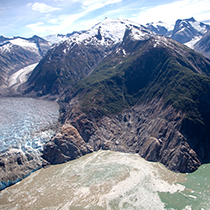
On the evening of August 9, 2025, passengers aboard the Hanse Explorer finished taking selfies and videos of the South Suir Glacier, and the ship headed back down the fjord. Twelve hours later, a landslide from the nearby mountain unexpectedly collapsed into the fjord, generating the second-largest tsunami in recorded history.
We conduct earthquake and tsunami research at the Alaska Earthquake Center, and one of us works as a seismologist for the state of Alaska. In a new study with our colleagues, we detail how this landslide sent water and debris 1,580 feet (481 meters) high on the other side of the fjord — higher than the top floor of the Taipei 101 skyscraper — and then continued down the Tracy Arm. The force of the water has stripped the walls of the fjord to bare rock.
Note: This article is republished from The Conversation under a Creative Commons license. Read the original article.
It was after five in the morning on a dreary day, and fortunately, there were no ships nearby. In the following months, some cruise lines began avoiding Tracy Arm. However, the circumstances that led to this event are not unique to this fjord.
Landslides are common in Alaska’s coastal mountains where rapid uplift caused by tectonic forces and long-term ice loss converge with erosive forces from rainfall and moving glaciers. But a curious pattern has emerged in recent years: Multiple large landslides have occurred precisely at the end of a retreating glacier.
Although the mechanisms are still not well understood, these mountains appear to become unstable when the ice disappears. When a landslide hits the water, the momentum of millions of tons of rock is transformed into tsunami waves.
This same phenomenon is spreading from Alaska to Greenland and Norway, with sometimes fatal consequences. Across the Arctic, countries are trying to adapt to this growing threat. The options are not attractive: either avoid vast areas of coastline, or live with risks that are not well understood. We believe there is a clear role for warning systems, but only if scientists have a better understanding of where and when landslides occur.
Indications of a possible landslide
The Tracy Arm landslide is a powerful example.
The landslide occurred in August, when warm ocean waters and heavy rains were encouraging glaciers to retreat and slopes to collapse. The glacier below the landslide zone had experienced rapid calving — large chunks of ice broke off and fell into the water — and had retreated more than a third of a mile in the previous two months. Heavy rain was falling. Rain gets into cracks in the mountain and pushes it closer to collapse by increasing the water pressure in the cracks.
Most provocative are the thousands of small seismic tremors that emanated from the slide zone in the days before the mountainside collapsed.
We believe that this combination of signs would have been sufficient to issue phased alerts to any vessels in the vicinity and homes and businesses that could have been damaged by the tsunami at least a day before the failure – had a monitoring program been in place.
Elevated alerts are used for everything from terrorism and nuclear plant safety to avalanches and volcanic unrest. It does not eliminate risks, but it makes it easier for people to safely live with risks.
For example, although people are still killed in avalanches, warning systems have played an integral role in making winter travel to remote areas safer for more people. The collapse at Tracy Arm shows what can be caused by landslides.
What might an alert system look like?
We believe that the combination of weather and rapid retreat of glaciers in early August 2025 was likely enough to trigger an alert notifying people that the risk may be temporarily elevated in a general area. On a yellow-orange-red scale, this would be a yellow alert.
In the hours leading up to the landslide, the dramatic increase in seismic events and the apparent transition to what is known as seismic seismicity — a continuous “buzz” of seismic energy — was enough to deliver a time-sensitive warning to a given area.
These observations, recorded as a byproduct of regional seismic monitoring, prompted an “orange” alert indicating immediate concern. It can be said that the signs were sufficient to recommend that boats and ships be kept away from the fjord.
Our research over the past few years has shown that once a large landslide occurs, it is possible to detect and measure the event within a few minutes. In this amount of time, seismic waves in the surrounding area can indicate the approximate size of the landslide and whether it occurred near open water.
Monitoring software that can quickly communicate this will be able to issue a red alert, indicating an event is in progress.
NOAA’s Tsunami Warning Program has spent decades fine-tuning the rapid dissemination of messages. The warning system would have provided little assistance to ships in the immediate vicinity, but could have provided perhaps 10 minutes of warning to those who survived the horrific tsunami further away.
No landslide monitoring system yet operates on this scale in the United States. Building one will require cooperation between state and federal agencies, and enhanced surveillance and communications networks. Even then, it’s not fail-proof.
Understand risks, not remove them
Alert systems do not completely eliminate risks, but they are a better option than no warning at all. Over time, they also build awareness as communities and visitors become accustomed to thinking about these risks.
Many of the most attractive places on Earth come with great risks. Among them are the Arctic fjords. The same processes that create this danger—receding glaciers, steep terrain, and dynamic geology—are also what make these landscapes so attractive. The combination of glaciers, ice-choked waters and steep mountains is exactly what attracts people to these places. People will continue to visit and experience them.
The question is not whether these places should be avoided completely, but how we help people make more informed decisions. We believe that robust geophysical and meteorological monitoring, coupled with new research and communication channels, is the first step.
On August 9th, visitors unknowingly passed through an area that was on the cusp of failure. The alert system may have given tourism businesses and people in the area the information they needed to make more informed choices and avoid being caught off guard.
Discover more interactive content in the Tracy Arm Landslide ArcGIS Story Map, part of a series of such stories designed by the University of Alaska Fairbanks Geophysical Institute.
|
Sources 2/ https://earthquake.alaska.edu/case-landslide-monitoring-program The mention sources can contact us to remove/changing this article |
What Are The Main Benefits Of Comparing Car Insurance Quotes Online
LOS ANGELES, CA / ACCESSWIRE / June 24, 2020, / Compare-autoinsurance.Org has launched a new blog post that presents the main benefits of comparing multiple car insurance quotes. For more info and free online quotes, please visit https://compare-autoinsurance.Org/the-advantages-of-comparing-prices-with-car-insurance-quotes-online/ The modern society has numerous technological advantages. One important advantage is the speed at which information is sent and received. With the help of the internet, the shopping habits of many persons have drastically changed. The car insurance industry hasn't remained untouched by these changes. On the internet, drivers can compare insurance prices and find out which sellers have the best offers. View photos The advantages of comparing online car insurance quotes are the following: Online quotes can be obtained from anywhere and at any time. Unlike physical insurance agencies, websites don't have a specific schedule and they are available at any time. Drivers that have busy working schedules, can compare quotes from anywhere and at any time, even at midnight. Multiple choices. Almost all insurance providers, no matter if they are well-known brands or just local insurers, have an online presence. Online quotes will allow policyholders the chance to discover multiple insurance companies and check their prices. Drivers are no longer required to get quotes from just a few known insurance companies. Also, local and regional insurers can provide lower insurance rates for the same services. Accurate insurance estimates. Online quotes can only be accurate if the customers provide accurate and real info about their car models and driving history. Lying about past driving incidents can make the price estimates to be lower, but when dealing with an insurance company lying to them is useless. Usually, insurance companies will do research about a potential customer before granting him coverage. Online quotes can be sorted easily. Although drivers are recommended to not choose a policy just based on its price, drivers can easily sort quotes by insurance price. Using brokerage websites will allow drivers to get quotes from multiple insurers, thus making the comparison faster and easier. For additional info, money-saving tips, and free car insurance quotes, visit https://compare-autoinsurance.Org/ Compare-autoinsurance.Org is an online provider of life, home, health, and auto insurance quotes. This website is unique because it does not simply stick to one kind of insurance provider, but brings the clients the best deals from many different online insurance carriers. In this way, clients have access to offers from multiple carriers all in one place: this website. On this site, customers have access to quotes for insurance plans from various agencies, such as local or nationwide agencies, brand names insurance companies, etc. "Online quotes can easily help drivers obtain better car insurance deals. All they have to do is to complete an online form with accurate and real info, then compare prices", said Russell Rabichev, Marketing Director of Internet Marketing Company. CONTACT: Company Name: Internet Marketing CompanyPerson for contact Name: Gurgu CPhone Number: (818) 359-3898Email: [email protected]: https://compare-autoinsurance.Org/ SOURCE: Compare-autoinsurance.Org View source version on accesswire.Com:https://www.Accesswire.Com/595055/What-Are-The-Main-Benefits-Of-Comparing-Car-Insurance-Quotes-Online View photos

 |
 |
 |