
Politics
The world must decide how to govern AI while the decision is ours
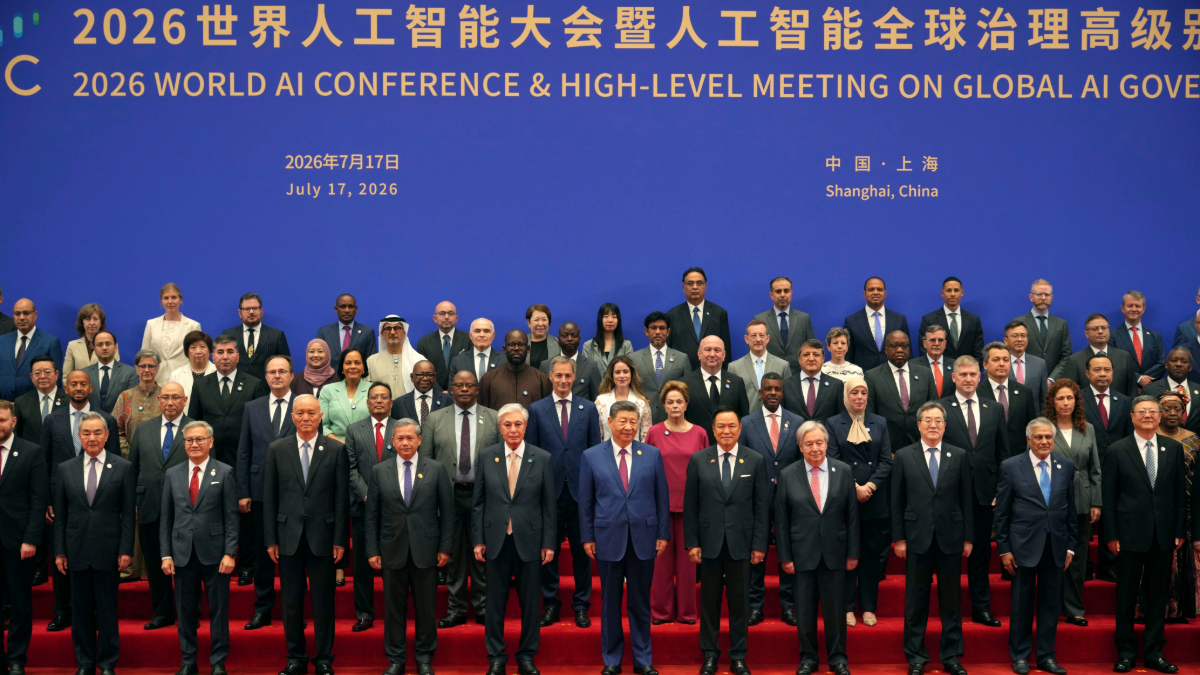
Chinese President Xi Jinping, center, takes a group photo with other participants before the opening ceremony of the World AI Conference in Shanghai, Friday, July 17, 2026. (AP Photo/Ng Han Guan, Pool)
Seventy years separate two documents that say more about artificial intelligence than any model it has ever produced. The first is the proposal which convened, for the summer of 1956, the Dartmouth College Conference who gave its name to the domain. The second was published more recently, on July 13, and contains only four sentences. This is the statement “We must act now» organized by Stanford Digital Economy Lab and signed by more than 200 economists and AI researchers, including 16 Nobel Prize winners. The first document was brimming with confidence. The second exudes urgency. Between one and the other, technology has traveled a path that its creators had not anticipated and arrived at a destination that its heirs admit to not understanding.
It is worth re-reading the original proposal to measure distance. John McCarthy, Marvin Minsky, Nathaniel Rochester, and Claude Shannon applied for funding to bring together 10 researchers for 2 months, based on the hypothesis that “every aspect of learning or any other characteristic of intelligence can in principle be described with such precision that a machine can be designed to simulate it.” They believed that significant progress was possible in this summer alone. The concerns they listed were all technical. How to make machines use language, form abstractions, improve. Nowhere does the question appear of what would happen to human labor, income distribution, or economic power if the project succeeded. Not through negligence. The political economy of machines was simply not part of the problem these men thought they were solving.
The trajectory that followed methodically punished optimism. The field experienced its first winter in the 1970s, when promises far exceeded capacity to deliver and funding dried up. It was reborn with expert systems, froze again in the late 1980s, changed its nature with machine learning, accelerated with deep neural networks from 2012 and exploded with transformer architecture, which made possible the launch of OpenAI’s ChatGPT in 2022. In each previous cycle, the mismatch was the same: the technology promised more than it could deliver. The current cycle has reversed the sign. For the first time, installed capacity exceeds our understanding of its consequences.

Organizers and some participants of the 1956 Dartmouth AI Workshop, gathered in front of Dartmouth Hall. Source: The Minsky family
It is precisely this reversal that the Stanford letter inscribes in its telegraphic formulation. The text claims that AI could become radically more powerful over the next 10 years and drive economic transformation »bigger than the industrial revolution“, but compressed into a considerably shorter time frame. It recognizes both the risks of large-scale job losses and the possible increase in living standards and concludes that governments and industry must put in place, now, the incentives, safeguards and institutions capable of directing technology to complement human beings rather than replace them. Yoshua Bengio, Turing Prize winner and one of the signatories, added in a separate statement that choices must be collective and democratic rather than “letting market forces play out and risk leaving most citizens behind”.
The context surrounding the publication explains the haste. In October 2025, Amazon announced the elimination of around 14,000 jobsmonths after its CEO acknowledged that some tasks would be reassigned to generative AI and agents. Recent US graduates facing the tightest job market in yearsand a study The same Stanford group identified a 16% relative decline in employment among workers aged 22 to 25 in occupations most exposed to generative AI, while employment among experienced professionals remains stable. The transformation announced by the letter is not a research hypothesis. This is already showing up in the race-leading country’s employment statistics.
There are, however, three absences in the document that deserve as much attention as its presences. The first is that of those responsible. Signatories include executives and co-founders of boundary-pushing companies, including Anthropic, OpenAI and Google. It’s an ambiguous gesture. It can be read as the lucidity of those who know the power of what they are building, but also as the subcontracting of the problem to “governments and institutions” while the commercial race continues at full speed. The letter calls for safeguards without saying who pays for them, calls for institutions without saying who controls them and calls for immediate action from everyone without assigning specific obligations to anyone. The diagnosis is collective; responsibility, diffuse.
The second absence is geographical. The text speaks of “our economy” in the singular, as if the transformation had to be equitably distributed across the planet. It won’t. The IT infrastructure, pioneering models and revenues of the new economy are concentrated in a handful of companies in two countries. In contrast, job losses will be global and will hit with particular force those economies that export precisely the services that AI agents are learning to provide. For the countries of the South, the risk does not only lie in the technological unemployment described in the letter; it participates in the transformation only on the cost side, providing data, energy, minerals and consumer markets, while the promised productivity gains accumulate on the balance sheets of those who control the infrastructure. The institutions demanded by the letter, if they arise only in Washington and its allied forums, will organize the transition for club members and let everyone deal with the consequences.
Nothing illustrates this imbalance better than the calendar, which brings the third absence. The Stanford letter is signed primarily by members of institutions in the United States and Europe. While Western experts were publishing it, China was finalizing preparations to open, on July 17 in Shanghai, the new edition of the World Conference on Artificial Intelligence, which this year brought together a keynote speech by Chinese President Xi Jinping himself and a high-level meeting on global AI governance with representatives from dozens of countries. The event featured over 1,000 exhibitors, 3,000 cutting-edge technologies and 300 products. making their world debutall are part of an industry that surpassed 1 trillion yuan in 2025 and is forecast to grow more than 30% in 2026. At the start of the conference, China and 28 other countries established the World AI Cooperation Organization (WAICO) to address issues related to global AI governance with a Southern view and a multilateral approach.
At the same time, the United States is building its AI governance the same way it builds most things today: through executive power and corporate plans, without a treaty, without a charter, and without a vote. Over five weeks in June and July 2026, the leaders of the country’s three leading AI companies released what amounts to a tiered governance regime, and the proposals fit together like floors of the same building. Dario Amodei from Anthropic designed hard domestic layermodeled on the FAA: mandatory third-party testing of each model above a threshold calculation for four risks (cybersecurity, biological weapons, loss of control and automated R&D) with legal authority to block versions and fines imposed on revenues. Demis Hassabis from Google DeepMind designed the operational layeron the model FINRA: A organization funded by the industry itself which would receive frontier models up to 30 days before publication, with submissions first voluntary, then mandatory once proven robust. Sam Altman from OpenAI designed the exterior facadeon the model of IAEA: an international forum led by Washington that would set global standards and condition access to technology on compliance with them. The specialists’ letter demonstrates the demand for these initiatives by calling on institutions without naming them; the three manifestos moved to fill this gap with institutions preconceived by the regulated.
Meanwhile, Washington was raising the building faster than manifestos could describe. The June decree, which withdrew a border model from the world market with a simple stroke of a pen, has already produced Golden Eaglea vulnerability exchange center managed by the Treasury with LPCC and the Department of Defense, using pioneering models – notably the Anthropic Myth – to protect critical infrastructure; the same order schedules for the month of August process of revising frontier models before their publication to trusted partners, thus transforming the central clause of the manifesto into state policy. What is the result? an analyst called an involuntary prior licensing regime: a de facto governance architecture, merged with the security apparatus, in which the regulator is invited to become a shareholder regulated bodies, and none of them have been passed or ratified by any legislature, not even the U.S. Congress.
The juxtaposition of the two scenes sums up the moment. On the one hand, a four-sentence manifesto that calls for institutions without building them, signed by those who continue to push technological boundaries while admitting that they cannot control the consequences. On the other, a state that treats AI as public policy, shows measurable results and offers the world, in the same week, exactly the governance platform that the letter is missing. Read in this context, the Stanford letter is less a program of action than an admission of a void. And voids, in geopolitics, don’t stay empty for long.
Participants at the 1956 Dartmouth Conference got the timetable wrong but chose the right direction. The machine that simulates certain aspects of intelligence exists. What they could not predict, because it was not a question of time, was that the decisive challenge would not be building it, but deciding who appropriates the value it generates and who bears the cost of what it destroys. The 2026 letter has the merit of placing this issue at the center of the agenda with the authority of 16 Nobel Prize winners. He has the limit of not saying who is the subject of the action he demands. Seventy years after the summer of 1956, the bill for this two-month experiment came due for everyone. It is up to each country to decide whether it wants to negotiate payment terms or simply receive it ready-made, issued in dollars and written in English.
|
Sources 2/ https://www.techpolicy.press/the-world-must-decide-how-to-govern-ai-while-the-decision-is-still-ours/ The mention sources can contact us to remove/changing this article |
What Are The Main Benefits Of Comparing Car Insurance Quotes Online
LOS ANGELES, CA / ACCESSWIRE / June 24, 2020, / Compare-autoinsurance.Org has launched a new blog post that presents the main benefits of comparing multiple car insurance quotes. For more info and free online quotes, please visit https://compare-autoinsurance.Org/the-advantages-of-comparing-prices-with-car-insurance-quotes-online/ The modern society has numerous technological advantages. One important advantage is the speed at which information is sent and received. With the help of the internet, the shopping habits of many persons have drastically changed. The car insurance industry hasn't remained untouched by these changes. On the internet, drivers can compare insurance prices and find out which sellers have the best offers. View photos The advantages of comparing online car insurance quotes are the following: Online quotes can be obtained from anywhere and at any time. Unlike physical insurance agencies, websites don't have a specific schedule and they are available at any time. Drivers that have busy working schedules, can compare quotes from anywhere and at any time, even at midnight. Multiple choices. Almost all insurance providers, no matter if they are well-known brands or just local insurers, have an online presence. Online quotes will allow policyholders the chance to discover multiple insurance companies and check their prices. Drivers are no longer required to get quotes from just a few known insurance companies. Also, local and regional insurers can provide lower insurance rates for the same services. Accurate insurance estimates. Online quotes can only be accurate if the customers provide accurate and real info about their car models and driving history. Lying about past driving incidents can make the price estimates to be lower, but when dealing with an insurance company lying to them is useless. Usually, insurance companies will do research about a potential customer before granting him coverage. Online quotes can be sorted easily. Although drivers are recommended to not choose a policy just based on its price, drivers can easily sort quotes by insurance price. Using brokerage websites will allow drivers to get quotes from multiple insurers, thus making the comparison faster and easier. For additional info, money-saving tips, and free car insurance quotes, visit https://compare-autoinsurance.Org/ Compare-autoinsurance.Org is an online provider of life, home, health, and auto insurance quotes. This website is unique because it does not simply stick to one kind of insurance provider, but brings the clients the best deals from many different online insurance carriers. In this way, clients have access to offers from multiple carriers all in one place: this website. On this site, customers have access to quotes for insurance plans from various agencies, such as local or nationwide agencies, brand names insurance companies, etc. "Online quotes can easily help drivers obtain better car insurance deals. All they have to do is to complete an online form with accurate and real info, then compare prices", said Russell Rabichev, Marketing Director of Internet Marketing Company. CONTACT: Company Name: Internet Marketing CompanyPerson for contact Name: Gurgu CPhone Number: (818) 359-3898Email: [email protected]: https://compare-autoinsurance.Org/ SOURCE: Compare-autoinsurance.Org View source version on accesswire.Com:https://www.Accesswire.Com/595055/What-Are-The-Main-Benefits-Of-Comparing-Car-Insurance-Quotes-Online View photos

 |
 |
 |