
Uncategorized
An earthquake that occurred 2,500 years ago suddenly changed the course of the Ganges River
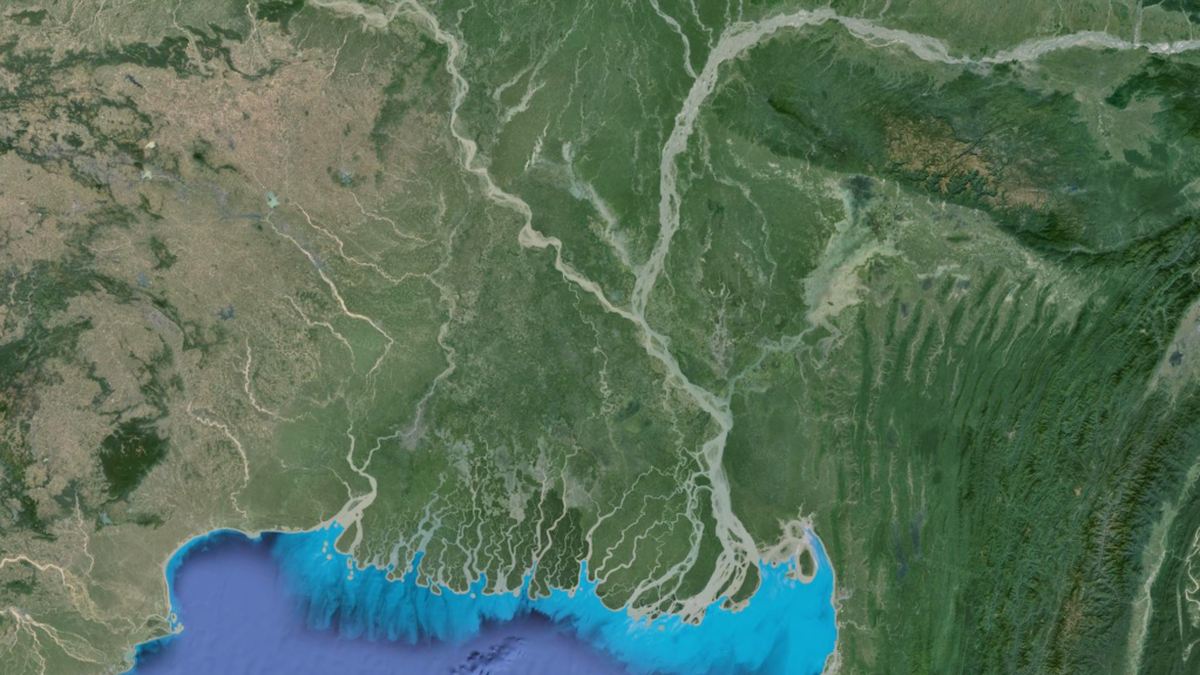
In 2018, geochronologist Elizabeth Chamberlain, an assistant professor at Wageningen University Research in the Netherlands, and her team were in Bangladesh to study the flow of river channels in the Ganges Delta. They were exploring a roughly 2-kilometre-wide “paleochannel”—a well-preserved archive of the river’s ancient course made of mud and sand—about 45 kilometres south of the modern Ganges. Today, the area is used for rice farming.
Based on geological measurements in the area, the researchers found that the Ganges River suddenly changed course — or split — about 2,500 years ago, leaving behind the ancient channel.
During their fieldwork, the team also found two large sand dams about a kilometer east of the ancient channel. These dams form when earthquakes disturb the riverbed and cause sediment to flow as if it were a liquid. Scientists call this process liquefaction.
When Dr. Chamberlain’s team spotted these sand dams, they had a hunch that they were looking at “a major event—the kind that scientists rarely record and study,” she told a reporter for this article. They were right: These sand dams hold the first evidence that earthquakes can move rivers. In their paper, published in June 2024 in Nature Communications, the team reported that a magnitude 7 to 8 earthquake was responsible for changing the course of the Ganges River more than 2,000 years ago.
The study’s findings call for urgent prediction of major earthquakes that could cause flooding of rivers such as the Ganges, said Till Hannebuth, a professor of marine science at Coastal Carolina University in the United States. Educating policymakers and the public about the risks is crucial so they can better prepare for such events in the future, he added.
How Earthquakes Move Rivers
The sand dams and their composition, which consist of “fine sand” and “clay clay,” the researchers wrote in their paper, provided compelling evidence of a large, ancient earthquake. The team hypothesized that if this earthquake did indeed trigger the Ganges eruption, the timing of the earthquake and the timing of the eruption should coincide.
To determine when these two events occurred, Dr. Chamberlain used a technique called optically stimulated luminescence (OSL) dating. This method estimates how long mineral grains (any mineral particle smaller than a few millimeters in size, such as quartz grains in sand or clay) have been buried by measuring the amount of natural radiation they store.
The researchers extracted mineral samples from sand dams and ancient channels and treated the grains in these samples with light and heat. “As the buried grains absorb low doses of natural radiation, energy builds up in their crystals,” Dr. Chamberlain explained. This is because natural radioactivity forces electrons in minerals to escape their atoms and become trapped in the crystal structure — or space between atoms — of the minerals.
“The stored energy increases over time. By estimating how much energy is stored in the grains, and measuring how much radiation is around them, we can tell how long the grains have been buried,” Dr. Chamberlain said.
To estimate the amount of energy stored, the researchers shine blue light on the grains, causing the trapped electrons to escape the crystal structure and return to the atoms. When they do, they emit a photon of light. A photomultiplier tube captures the photons and counts them, measuring the trapped energy.
Dating samples from the ancient channel using OSL suggested that the uplift occurred about 2,500 years ago. When the authors used this technique to date samples from the sand dams and the surrounding sand and clay, they found that the dams formed at about the same time, strengthening their hypothesis that the earthquake triggered the uplift.
But one piece of the puzzle remains: Where did the quake originate? The researchers speculated in their paper that the quake originated either in the Indo-Burmese mountain ranges or in the Shillong Hills, the sites where the Indian and Eurasian tectonic plates meet. But “its impact was enormous” regardless of the origin, they wrote in their paper.
Future risks
“This discovery that large earthquakes can trigger large river overturns suggests that the impact of large earthquakes can be more destructive than previously thought,” said Vamsi Janti, a sedimentologist and associate professor at the University of California, Santa Barbara.
“This is because landslides have caused some of the most severe floods in human history, and the cascading effects of earthquakes and floods can be severe in densely populated areas such as the Ganges, Meghna and Brahmaputra deltas,” Dr. Ganti adds. A 2011 analysis estimated that 630 million people live in the delta.
The risk is being exacerbated by human activities and climate change, said Dr. Hannebuth, a geologist at Coastal Carolina University. According to him, rivers like the Ganges are now more vulnerable to erosion due to two factors: “rapid subsidence,” the sinking of land near the river banks due to “extensive embankments,” and rising sea levels caused by climate change and extreme weather events.
Dr. Hannebuth added that future research should focus on finding out how often such earthquakes occur and how such large earthquakes can be predicted. He added that policymakers and the people of the Ganges Delta should prepare for the risk of such earthquakes. Such preparation, he said, requires India, Bangladesh and Myanmar to work “closely together in terms of research, monitoring, preparedness and coordination of support.”
“Geological and climatic issues of this magnitude do not care about political boundaries.”
Sayantan Datta is a science journalist and faculty member at Kriya University. They tweet at @queersprings.
|
Sources 2/ https://www.thehindu.com/sci-tech/science/earthquake-2500-years-ago-abruptly-changed-ganga-river-course/article68488930.ece The mention sources can contact us to remove/changing this article |
What Are The Main Benefits Of Comparing Car Insurance Quotes Online
LOS ANGELES, CA / ACCESSWIRE / June 24, 2020, / Compare-autoinsurance.Org has launched a new blog post that presents the main benefits of comparing multiple car insurance quotes. For more info and free online quotes, please visit https://compare-autoinsurance.Org/the-advantages-of-comparing-prices-with-car-insurance-quotes-online/ The modern society has numerous technological advantages. One important advantage is the speed at which information is sent and received. With the help of the internet, the shopping habits of many persons have drastically changed. The car insurance industry hasn't remained untouched by these changes. On the internet, drivers can compare insurance prices and find out which sellers have the best offers. View photos The advantages of comparing online car insurance quotes are the following: Online quotes can be obtained from anywhere and at any time. Unlike physical insurance agencies, websites don't have a specific schedule and they are available at any time. Drivers that have busy working schedules, can compare quotes from anywhere and at any time, even at midnight. Multiple choices. Almost all insurance providers, no matter if they are well-known brands or just local insurers, have an online presence. Online quotes will allow policyholders the chance to discover multiple insurance companies and check their prices. Drivers are no longer required to get quotes from just a few known insurance companies. Also, local and regional insurers can provide lower insurance rates for the same services. Accurate insurance estimates. Online quotes can only be accurate if the customers provide accurate and real info about their car models and driving history. Lying about past driving incidents can make the price estimates to be lower, but when dealing with an insurance company lying to them is useless. Usually, insurance companies will do research about a potential customer before granting him coverage. Online quotes can be sorted easily. Although drivers are recommended to not choose a policy just based on its price, drivers can easily sort quotes by insurance price. Using brokerage websites will allow drivers to get quotes from multiple insurers, thus making the comparison faster and easier. For additional info, money-saving tips, and free car insurance quotes, visit https://compare-autoinsurance.Org/ Compare-autoinsurance.Org is an online provider of life, home, health, and auto insurance quotes. This website is unique because it does not simply stick to one kind of insurance provider, but brings the clients the best deals from many different online insurance carriers. In this way, clients have access to offers from multiple carriers all in one place: this website. On this site, customers have access to quotes for insurance plans from various agencies, such as local or nationwide agencies, brand names insurance companies, etc. "Online quotes can easily help drivers obtain better car insurance deals. All they have to do is to complete an online form with accurate and real info, then compare prices", said Russell Rabichev, Marketing Director of Internet Marketing Company. CONTACT: Company Name: Internet Marketing CompanyPerson for contact Name: Gurgu CPhone Number: (818) 359-3898Email: [email protected]: https://compare-autoinsurance.Org/ SOURCE: Compare-autoinsurance.Org View source version on accesswire.Com:https://www.Accesswire.Com/595055/What-Are-The-Main-Benefits-Of-Comparing-Car-Insurance-Quotes-Online View photos

 |
 |
 |