
Uncategorized
Scientists study the fault that helped shape Colorado's Rocky Mountains, and the ancient earthquakes that once shook it.
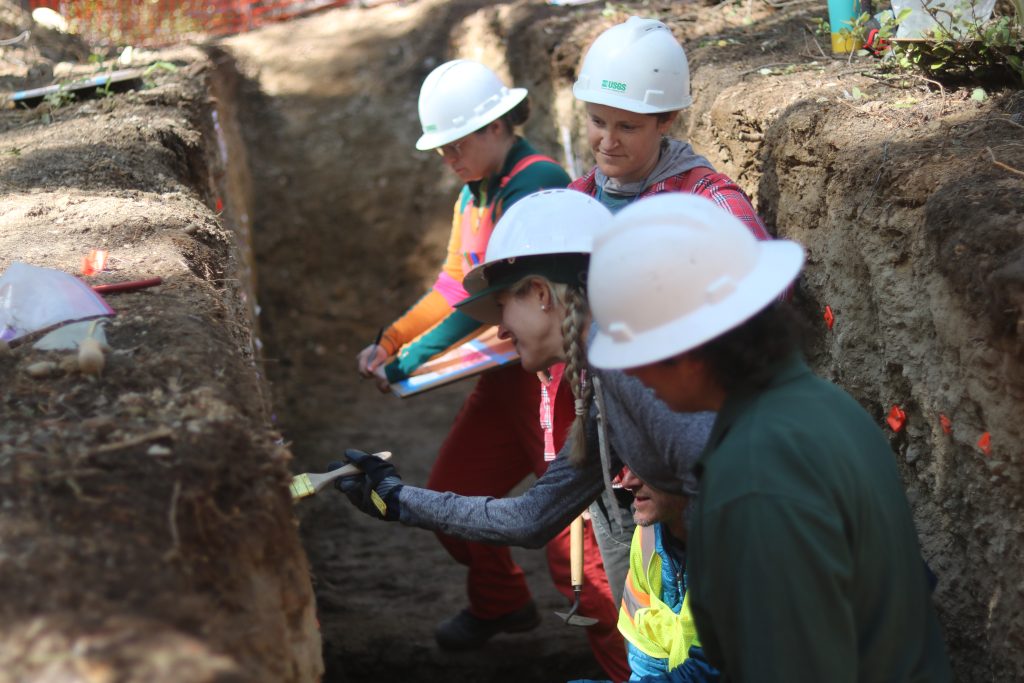
A group of paleoseismologists — or scientists who study ancient earthquakes — work in a trench off the Rainbow Lake Trail near Frisco on Friday, Sept. 6, 2024. The scientists are investigating the Gor Range fault in an attempt to understand when the last earthquake occurred there. Ryan Spencer/Summit Daily News
While it's often said that mountains don't move, Colorado's Rocky Mountains are actually the result of a slow dance that has been happening beneath the Earth's surface for hundreds of millions of years.
The state's mountains contain thousands of faults, where two blocks of rock break and move relative to each other, usually slowly, but sometimes suddenly, causing earthquakes.
On Friday, September 6, a team of scientists from the U.S. Geological Survey excavated and studied the interior of a newly dug trench off the Rainbow Lake Trail near Frisco, looking for evidence of mountain movement.
“The big question is, when was the last big earthquake on the Jor Range fault? When was the last big earthquake that broke the Earth's surface? That's what we're looking at,” says geologist Alex Hatem.
The trench, marked with yellow caution tape and signs indicating “open pit,” was dug perpendicular to the Gore Range fault, which runs along the eastern side of the Gore Range and the Tenmile Range.
“There are several different types of faults, and this one is called a normal fault,” Hatem said. “It’s a slope fault, so one side moves down relative to the other. So it lifts mountains and deepens valleys.”
Signs indicate an “open hazard” near the site of a trench dug by U.S. Geological Survey scientists. Scientists are studying the Gor Range fault and an ancient earthquake that may have occurred here. Ryan Spencer/Summit Daily News
A version of the Gore Range fault has been intermittently active for hundreds of millions of years, helping build first the ancient Rockies and then the modern Rockies, according to the U.S. Geological Survey.
The fault pushed the rock blocks over each other as the rocks compressed together to form the Rocky Mountains. Then, about 30 million years ago, scientists say, the compression between the rock blocks turned into extension, and ever since, the Gore Fault has been pulling two rock blocks apart, opening up the Blue River Valley.
“This particular fault doesn’t contribute much to the uplift of the Gore Range and the Tenmile Range, and there’s probably very little slippage of the fault contributing to this uplift and the depth of the valley,” Hatem said. “But before this was a normal fault as the valley deepened, these were all compression faults. That’s what builds the beautiful Rockies as we know them and those peaks. This particular fault isn’t as active as the faults that once built the mountains.”
A scientist investigating the Jor Range fault uses a tool to map a layer in the Earth's interior on Friday, Sept. 6, 2024. Scientists are trying to estimate when the last earthquake occurred in the area. Ryan Spencer/Summit Daily News
U.S. Geological Survey scientists on Friday, Sept. 6, 2024, made detailed observations of the layers inside a trench they dug near the Gore Fault. Once the trench is filled in, the scientists will have to refer to their drawings for reference. Ryan Spencer/Summit Daily News
On Friday, Sept. 6, 2024, U.S. Geological Survey scientists puzzle over different layers of sediment in a trench near the Rainbow Lake Trail. They are trying to figure out when the last earthquake along the Gore Ridge fault occurred. Ryan Spencer/Summit Daily News
An assortment of tools hangs from a tree near the Rainbow Lake Trail near Frisco on Friday, Sept. 6, 2024. Scientists with the U.S. Geological Survey are trying to gain a better understanding of the Gor Range fault. Ryan Spencer/Summit Daily News
Scientists work in a trench off the Rainbow Lake Trail near Frisco on Friday, Sept. 6, 2024. Scientists are trying to gain a better understanding of the Gor Range fault. Ryan Spencer/Summit Daily News
Show captionsHide captions
The USGS maintains the US National Seismic Hazard Model, which predicts potential future earthquakes across the country, and is always collecting more information about active faults to make the model more accurate.
Although destructive earthquakes are rare in Colorado, smaller quakes do occur every year. According to the Colorado Geological Survey, more than 700 earthquakes of magnitude 2.5 or greater have been recorded in the state since 1867. The largest known earthquake in Colorado occurred on November 7, 1882, and was estimated to have measured 6.6 magnitude.
Since the Gore Fault is the closest active fault to the Front Range and the Denver metro area, scientists are particularly interested in the Gore Range Fault “because of the human aspect,” and “just to see what’s in our backyard, really,” Hatem said.
The approximate location of the Jor Range fault has been known for decades, but it has been difficult to map under the dense vegetation, Hatem said. But new observations using light detection and ranging technology, often called lidar and similar to radar, have allowed for better mapping of the fault.
Lidar has helped scientists identify slopes, or raised areas of land that indicate where the ground slipped during an earthquake, that line the surface, providing evidence of a fault below.
“The fault goes for miles underground, and it’s about 15 kilometers deep, so what we see on the surface is a representation of what we see below,” Hatem said. “Earthquakes happen at depths of 5 to 10 to 15 kilometers, so (to form a slope) they have to be big enough to slide to the surface.”
Inside the trench, Hatem and a group of three other paleoseismologists used a variety of tools to scrape the soil to examine different layers. The lidar gave the scientists a better idea of the exact location of the Gur fault. But it’s the data that can be collected beneath the surface that will tell scientists when the last earthquake on the Gur fault occurred.
“There are many different layers in this trench, but we can piece some of them together based on how they were deposited and their relative importance to understanding the story of the fault here,” Hatem said.
Scientists studying the Jor Range Fault use white flags on Friday, Sept. 6, 2024, to indicate the outline of a layer in the Earth's interior near the Jor Range Fault. Scientists notice a “disturbance” in the layer where the flags slope downward on the left side of this image, a possible sign of an ancient earthquake. Ryan Spencer/Summit Daily News
Hatem said scientists plan to take samples from layers that lie on the fault line, as well as layers that are not on the fault line, so they can estimate when the earthquake occurred. The earthquake will be newer than the oldest layer that lies on the fault line and older than the newest layer that is not on the fault line.
Along the walls of the trench, scientists mapped the layers beneath the surface using different colored flags. In the middle of the trench, a row of white flags suddenly dropped, indicating a possible earthquake.
When did the quake happen? Scientists don’t know yet. They’ll continue working in the trench, making observations, taking samples and collecting data, for a few more weeks before returning to the lab. It could take a year or so for them to have results.
“We're digging this trench to learn more about the activity, when this earthquake happened and what these features really are,” Hatem said. “We think these represent fault scarps, but we have to keep digging to understand what these features really are.”
|
Sources 2/ https://www.summitdaily.com/news/scientists-are-studying-a-fault-that-helped-shape-the-colorado-rocky-mountains-and-the-ancient-earthquakes-that-once-shook-them/ The mention sources can contact us to remove/changing this article |
What Are The Main Benefits Of Comparing Car Insurance Quotes Online
LOS ANGELES, CA / ACCESSWIRE / June 24, 2020, / Compare-autoinsurance.Org has launched a new blog post that presents the main benefits of comparing multiple car insurance quotes. For more info and free online quotes, please visit https://compare-autoinsurance.Org/the-advantages-of-comparing-prices-with-car-insurance-quotes-online/ The modern society has numerous technological advantages. One important advantage is the speed at which information is sent and received. With the help of the internet, the shopping habits of many persons have drastically changed. The car insurance industry hasn't remained untouched by these changes. On the internet, drivers can compare insurance prices and find out which sellers have the best offers. View photos The advantages of comparing online car insurance quotes are the following: Online quotes can be obtained from anywhere and at any time. Unlike physical insurance agencies, websites don't have a specific schedule and they are available at any time. Drivers that have busy working schedules, can compare quotes from anywhere and at any time, even at midnight. Multiple choices. Almost all insurance providers, no matter if they are well-known brands or just local insurers, have an online presence. Online quotes will allow policyholders the chance to discover multiple insurance companies and check their prices. Drivers are no longer required to get quotes from just a few known insurance companies. Also, local and regional insurers can provide lower insurance rates for the same services. Accurate insurance estimates. Online quotes can only be accurate if the customers provide accurate and real info about their car models and driving history. Lying about past driving incidents can make the price estimates to be lower, but when dealing with an insurance company lying to them is useless. Usually, insurance companies will do research about a potential customer before granting him coverage. Online quotes can be sorted easily. Although drivers are recommended to not choose a policy just based on its price, drivers can easily sort quotes by insurance price. Using brokerage websites will allow drivers to get quotes from multiple insurers, thus making the comparison faster and easier. For additional info, money-saving tips, and free car insurance quotes, visit https://compare-autoinsurance.Org/ Compare-autoinsurance.Org is an online provider of life, home, health, and auto insurance quotes. This website is unique because it does not simply stick to one kind of insurance provider, but brings the clients the best deals from many different online insurance carriers. In this way, clients have access to offers from multiple carriers all in one place: this website. On this site, customers have access to quotes for insurance plans from various agencies, such as local or nationwide agencies, brand names insurance companies, etc. "Online quotes can easily help drivers obtain better car insurance deals. All they have to do is to complete an online form with accurate and real info, then compare prices", said Russell Rabichev, Marketing Director of Internet Marketing Company. CONTACT: Company Name: Internet Marketing CompanyPerson for contact Name: Gurgu CPhone Number: (818) 359-3898Email: [email protected]: https://compare-autoinsurance.Org/ SOURCE: Compare-autoinsurance.Org View source version on accesswire.Com:https://www.Accesswire.Com/595055/What-Are-The-Main-Benefits-Of-Comparing-Car-Insurance-Quotes-Online View photos

 |
 |
 |