
Uncategorized
Knowledge block of the day: Earthquakes
Look at key events, concepts, terms, quotes or phenomena every day and brush up on your knowledge. Here's your nugget of knowledge for today.
(Importance: Earthquakes are important geophysical phenomena as they are included in the UPSC CSE syllabus. They include various topics like disaster management and geography, including plate tectonics and seismic zones. Additionally, they highlight preparedness, mitigation strategies and vulnerability of India to earthquakes.)
Why in the news?
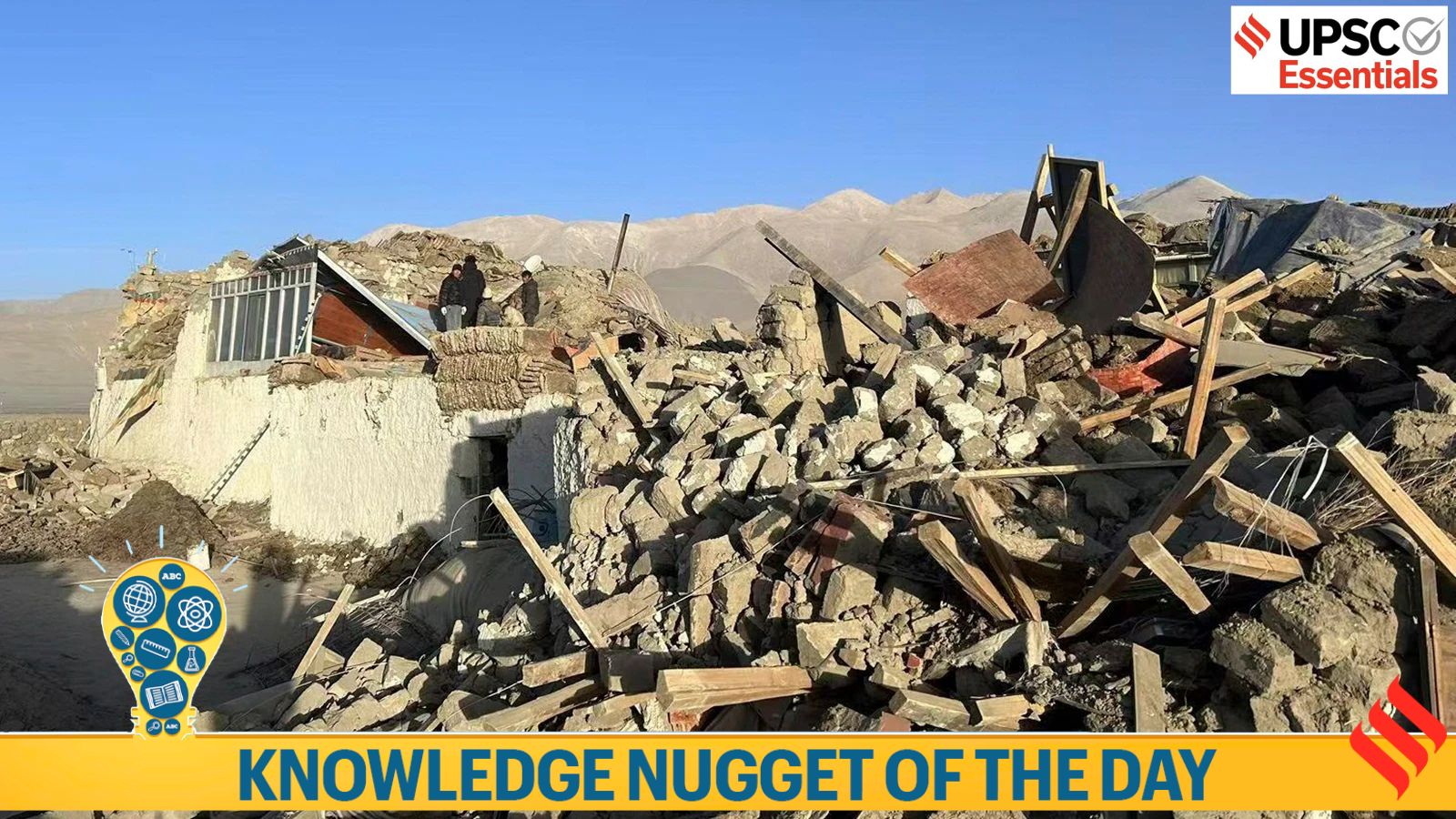
An earthquake measuring about 7 on the Richter scale struck Tibet on January 7, killing about 100 people and destroying about 1,000 homes. The epicenter of the earthquake was about 75 kilometers northeast of Mount Everest and near Nepal, but no major damage was reported there. This earthquake was the strongest in the region since the catastrophic April 2015 earthquake in Nepal, which killed nearly 10,000 people.
Key takeaways:
1. According to the U.S. Geological Survey (USGS), 10 earthquakes with a magnitude of at least 6 have occurred in the area affected by Tuesday over the past century. This frequency is due to the unique movements of the tectonic plates that make up the Earth's crust.
2. An earthquake is an intense shaking of the ground resulting from movement beneath the Earth's surface. It occurs when two masses of land suddenly slide past each other, according to the US Geological Survey. This releases stored “elastic strain” energy in the form of seismic waves, which propagate through the Earth and cause the ground to shake.
3. The outer surface of the Earth, the crust, is divided into tectonic plates. The edges of plates are called plate boundaries, and they are formed by faults. Tectonic plates are constantly moving at a slow pace, sliding over and colliding with each other. Because the edges of the plates are so rough, they stick together while the rest of the plate continues to move. An earthquake occurs when a plate moves a sufficient distance and its edges separate from a fault.
4. The location below the Earth's surface where the earthquake begins is called the epicenter, and the location directly above it on the Earth's surface is called the epicenter.
Why is the Himalayan region seismically active?
1. The Himalayan mountain range began forming about 40 to 50 million years ago when the Eurasian and Indian tectonic plates began to collide. Since both plates had similar densities, their collision caused the ground to lift, creating the mountains we see today.
2. Over time, the continuous expansion of the Eurasian plate caused it to sink under the Indian plate, a process that continues today.
3. According to the USGS, “Earthquakes in the Himalayan region result mainly from continental collision of the Indian and Eurasian plates, which are converging at a relative rate of 40-50 mm/year.”
4. At least five earthquakes with a magnitude greater than 7 have struck the Hindu Kush region since 1950. “This region has a strange tectonic configuration,” seismologist Sankar Kumar Nath previously told The Indian Express. While the Indian plate is subducting under the Himalayas, a phenomenon that occurs along the Himalayan mountain range, the Eurasian plate is subducting under the Pamir Mountains. In addition, there are many other fault lines. This is the meeting point of many seismic forces.
5. It is worth noting that the Western Himalayas are known to be one of the most dangerous seismic areas in the world. For a long time, scientists have warned that the larger region, which extends 2,500 kilometers from the Hindu Kush to Arunachal Pradesh, is vulnerable to a major earthquake with a magnitude of more than 8.0.
6. A large amount of energy has accumulated along fault lines due to the constant interaction between tectonic plates. This energy can only be released in the form of a large earthquake.
The most earthquake-prone countries in the world
1. Many Asian countries are highly prone to earthquakes, with China and Indonesia experiencing the greatest amount of seismic activity. Japan records the highest number of earthquakes in the world when considering relative frequency.
2. Indonesia stands out as the most earthquake-prone country, with 2,212 earthquakes of magnitude 4 or greater. This number places Indonesia above both Mexico and the Philippines, according to the United States Geological Survey (USGS).
3. In an analysis of the world's most destructive earthquakes, China overtakes Indonesia, as reported by the US government's National Oceanic and Atmospheric Administration (NOAA). NOAA data highlights the impact of seismic activity around the world, highlighting the countries most affected by these catastrophic events over a period of nearly three decades.
Source: NOAA, accessible via Statista (Note: Earthquake data provided cover the period 1990 to January 2, 2024. This information is based on events that meet at least one of the following criteria: damages exceeding $1 million, death toll 10 or more, Or with a magnitude of 7.5 or greater.)
Beyond Block: A Theory of Plate Tectonics
The Earth's surface is divided into 7 major plates and several secondary plates. They move a few centimeters a year, riding up layers of semi-molten rock beneath the Earth's crust. When plates move, they break apart or collide, unleashing powerful movements known as earthquakes.
Types of panel borders
Slip along a fault
Types of earthquake waves
1. When an earthquake occurs, it generates seismic waves that cause the tremors we experience. There are two main types of seismic waves: body waves and surface waves. Body waves consist of P and S waves, and are called body waves because they can travel through the Earth's interior, rather than being confined near the surface.
2. A primary or “P” wave is a type of sound wave that travels through rocks. In a P wave, rock particles are alternately compressed and expanded, a process known as compressions and expansions. This is why P waves are also referred to as compressional waves. They are able to travel through solids, liquids and gases. Notably, P waves can travel through the Earth's liquid outer core.
3. In a secondary or “S” wave, rock particles slide past each other, creating shear waves – hence, S waves are also known as shear waves. S waves cannot travel through liquids or gases, which means they do not propagate through the ocean or outer core.
4. Surface waves were given this name due to their tendency to be confined near the Earth’s surface, in contrast to their transmission through the Earth’s interior, such as P and S waves. There are two main types of surface waves: Love waves, which are shear waves trapped near the surface, and Rayleigh waves, which exhibit particle motions similar to the motions of water molecules in ocean waves.
(Sources: Understanding the earthquake, Tibet earthquake leaves 95 dead, List of countries hit by the largest earthquakes, Türkiye earthquake)
For your queries and suggestions write to [email protected]
Subscribe to our UPSC Newsletter and stay updated with the latest news from the past week.
Stay updated with the latest UPSC articles by joining our Telegram channel – Indian Express UPSC Hub, follow us on Instagram and X.
Discover the benefits of our subscription!
Stay informed with access to our award-winning journalism.
Avoid misinformation through reliable and accurate reporting.
Make smarter decisions with insights that matter.
Choose your subscription package
|
Sources 2/ https://indianexpress.com/article/upsc-current-affairs/upsc-essentials/knowledge-nugget-of-the-day-earthquake-upsc-himalayas-tibet-earthquake-9769096/ The mention sources can contact us to remove/changing this article |
What Are The Main Benefits Of Comparing Car Insurance Quotes Online
LOS ANGELES, CA / ACCESSWIRE / June 24, 2020, / Compare-autoinsurance.Org has launched a new blog post that presents the main benefits of comparing multiple car insurance quotes. For more info and free online quotes, please visit https://compare-autoinsurance.Org/the-advantages-of-comparing-prices-with-car-insurance-quotes-online/ The modern society has numerous technological advantages. One important advantage is the speed at which information is sent and received. With the help of the internet, the shopping habits of many persons have drastically changed. The car insurance industry hasn't remained untouched by these changes. On the internet, drivers can compare insurance prices and find out which sellers have the best offers. View photos The advantages of comparing online car insurance quotes are the following: Online quotes can be obtained from anywhere and at any time. Unlike physical insurance agencies, websites don't have a specific schedule and they are available at any time. Drivers that have busy working schedules, can compare quotes from anywhere and at any time, even at midnight. Multiple choices. Almost all insurance providers, no matter if they are well-known brands or just local insurers, have an online presence. Online quotes will allow policyholders the chance to discover multiple insurance companies and check their prices. Drivers are no longer required to get quotes from just a few known insurance companies. Also, local and regional insurers can provide lower insurance rates for the same services. Accurate insurance estimates. Online quotes can only be accurate if the customers provide accurate and real info about their car models and driving history. Lying about past driving incidents can make the price estimates to be lower, but when dealing with an insurance company lying to them is useless. Usually, insurance companies will do research about a potential customer before granting him coverage. Online quotes can be sorted easily. Although drivers are recommended to not choose a policy just based on its price, drivers can easily sort quotes by insurance price. Using brokerage websites will allow drivers to get quotes from multiple insurers, thus making the comparison faster and easier. For additional info, money-saving tips, and free car insurance quotes, visit https://compare-autoinsurance.Org/ Compare-autoinsurance.Org is an online provider of life, home, health, and auto insurance quotes. This website is unique because it does not simply stick to one kind of insurance provider, but brings the clients the best deals from many different online insurance carriers. In this way, clients have access to offers from multiple carriers all in one place: this website. On this site, customers have access to quotes for insurance plans from various agencies, such as local or nationwide agencies, brand names insurance companies, etc. "Online quotes can easily help drivers obtain better car insurance deals. All they have to do is to complete an online form with accurate and real info, then compare prices", said Russell Rabichev, Marketing Director of Internet Marketing Company. CONTACT: Company Name: Internet Marketing CompanyPerson for contact Name: Gurgu CPhone Number: (818) 359-3898Email: [email protected]: https://compare-autoinsurance.Org/ SOURCE: Compare-autoinsurance.Org View source version on accesswire.Com:https://www.Accesswire.Com/595055/What-Are-The-Main-Benefits-Of-Comparing-Car-Insurance-Quotes-Online View photos

 |
 |
 |