
Uncategorized
America's bold plan for an earthquake-resistant city of San Francisco
Video narrated and hosted by Fred Mills. This video contains a paid promotion for Masterworks.
San Francisco is one of the most instantly recognizable cities in the world.
Once you catch a glimpse of the bold red paint on the iconic Golden Gate Bridge and the infamous Alcatraz Island alone in the bay, you'll know it couldn't be anywhere else.
It is a beehive, not only for tourists, but for producers and directors looking for a filming location for their next film. More than 20 million people travel to San Francisco each year to savor its delights but dig beneath the surface, and as we talk a lot, you'll see that activity is a common theme.
This city and California more broadly is an earthquake hotspot.
San Francisco is located along the west coast of America in the Bay Area, and is located on the North American tectonic plate. It lies on the boundary of the Pacific Plate and is partially bisected by the San Andreas Fault Line. It's part of an area that has earned a suitably sinister nickname: the Ring of Fire.
Above: The Ring of Fire is a seismic hotspot, seeing more seismic activity than anywhere else in the world.
More than 80% of the world's seismic events occur along the Horseshoe, and if you listen to the research, you'll know that America's West Coast could experience another major earthquake in the coming years.
But how do you prepare for an event that you cannot accurately predict? This is America's bold plan to make San Francisco earthquake-resistant.
History of earthquakes in San Francisco
San Francisco is no stranger to seismic activity. Aside from experiencing regular small-scale earthquakes, it has had its fair share of devastating earthquakes as well.
In 1989, the city was exposed to a devastating earthquake measuring 6.9 degrees. More than 60 people were killed and buildings sustained billions of dollars in damage.
Turn the clock back to 1906, and this area was recovering from a larger 7.9 magnitude earthquake. To call it devastating would be an understatement—80% of the city was reduced to rubble or burned, leading many people to abandon the wood-frame construction common throughout America.
Instead, they turned to concrete but that comes with its own set of problems. It is strong and durable but not particularly flexible. If it is not properly designed to allow some movement as the ground shakes, it can become a real risk of collapse during an earthquake.
If we could accurately predict when a major earthquake would occur, the risks to residents would be limited, but it is not that simple. According to the USGS, we should think of earthquake forecasts like weather forecasts. Outcomes are treated as probabilities, providing a percentage chance over a given period of time.
There are several ways we collect data to tell us what's going on beneath the surface.
When working over long timescales, we know how quickly fault lines move, which means geologists can venture out to field fault lines and trenches. As they dig deeper, they see further back in time, and in some places, they can see evidence of earthquakes dating back 1,000 years or more. That's why we know how often large faults rupture and cause earthquakes.
There are GPS stations attached to the Earth as well, which show how fast the tectonic plates are moving relative to each other. This gives us an idea of how much energy is slowly being stored and will eventually be released. Earthquakes also tend to 'cluster' and come in groups which means monitoring tremors can be very useful.
None of this offers guarantees, because probabilities can inherently change, but with everything we know right now, the USGS says there's a 95% chance that San Francisco will experience a devastating earthquake in the next 100 years. There is a 72% chance that it will come within the next 30 years and have a magnitude of 6.7 or greater.
Although this seems a difficult prospect, the city will be better prepared this time.
Game-changing research
Nearly 500 miles down America's West Coast, the University of California San Diego has one of the most impressive equipment anywhere in the world for testing earthquake resilience.
It's called the Shaking Table, and in 2022, it underwent a $17 million upgrade.
Above: An overhead view of UC San Diego's outdoor shaker table, one of the largest anywhere in the world.
It is one of the largest outdoor shaking tables in the world and can reproduce the full 3D ground movements that occur during an earthquake.
This means it can move in all six degrees of freedom – up, down, left to right, pitch, roll and yaw. Just like an earthquake.
It has no issues with payload either, being able to lift and shake structures weighing up to 2,000 metric tons, roughly equivalent to the weight of eight Statues of Liberty.
Not only that, it can speed up to 4G. For context, the astronauts encounter the 3GS during a rocket launch.
To really put that schedule to the test, the Tallwood Project was created. It is the tallest full-scale structure ever built and tested on an earthquake simulator, and is made of wood.
Massive log buildings are created by joining layers of wood and are becoming more popular in the United States. And it's not just family homes. In 2022, the California building code was updated to allow high-rise buildings with wood frames.
This is why seismic testing, such as the Talwood project, is critical to the development of structural developments.
It is about 36 meters high and is built of overlapping timbers. It includes a shake wall side system which is essentially a solid wood slab fixed to the ground with steel cables, and has significant tensile forces. Under these lateral forces, the planks rock back and forth, and the cables pull the building back into place. It is then equipped with hundreds of sensors to record performance during testing.
Above: The Tallwood Project is the tallest full-scale structure ever built and tested on a seismic simulator.
And while San Francisco moved toward concrete construction in the early 1900s, that doesn't mean you won't find wood frames. In the 1920s and 1930s, the Golden State couldn't get enough of what were called soft-storey buildings.
Built over several floors, they are characterized by timber frames, large openings for shop windows or first-floor parking, wide doors, and the absence of shear walls.
They are not completely vibration proof.
In 2013, a law was passed to change that – “soft-storey” buildings are now required to complete retrofits. About 6,000 of them have been or are being upgraded in San Francisco using technology tested and developed at sites like UC San Diego.
And it's not just soft floors, the city has added concrete buildings to its range. In 2024, the search for structures at risk of collapse due to ground shaking began. It's called the Concrete Building Safety Program, or CBSP, and it's part of a comprehensive earthquake safety plan.
Many of the city's most iconic sites have already undergone a facelift such as City Hall and the War Memorial Veterans Building.
Although this may not be cheap, it may save lives.
There are a few ways you can seismically retrofit a building:
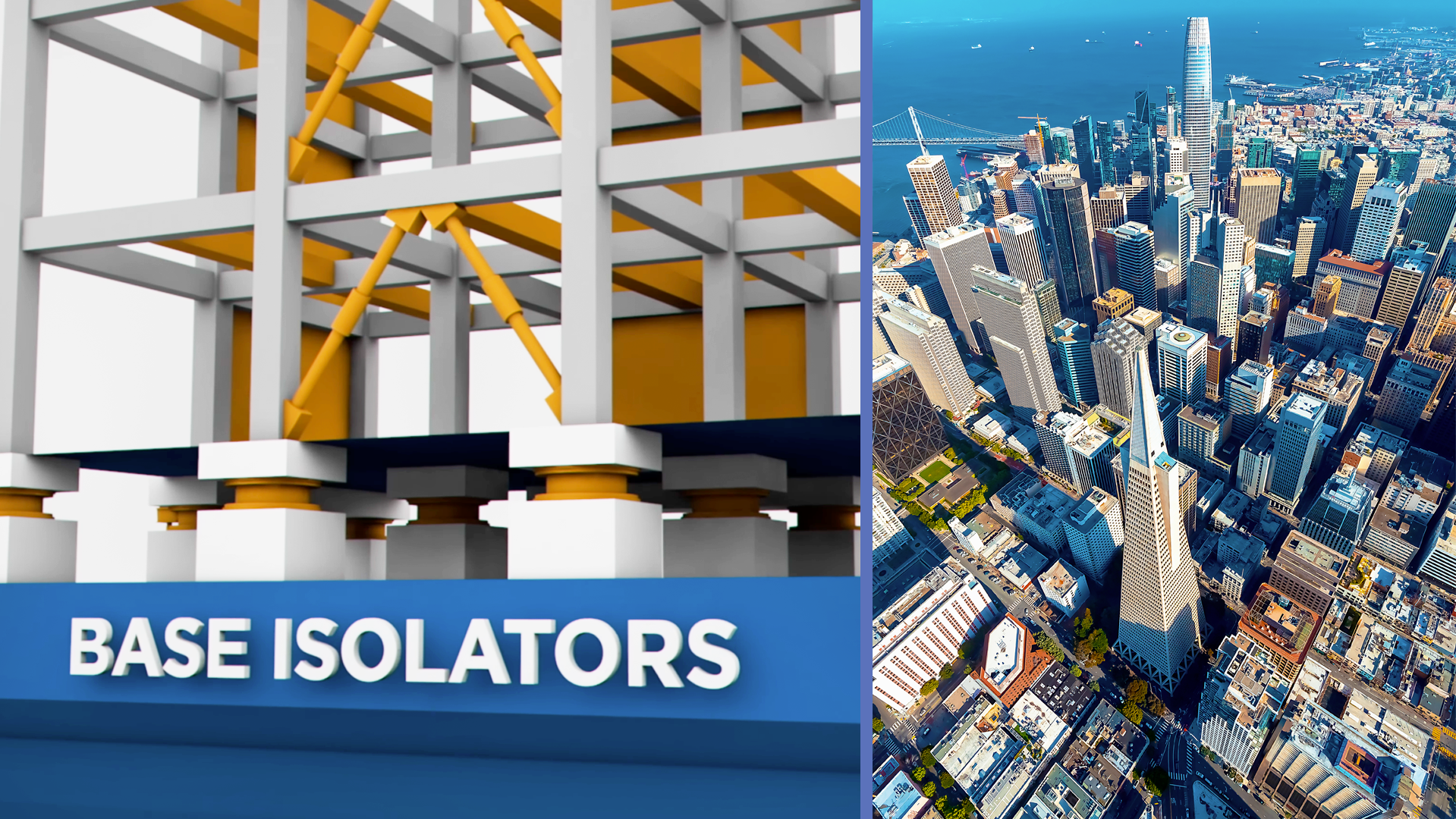
You can reinforce structural support with steel braces, frames, columns and beams. Shear walls can be added between floors to absorb and distribute lateral energy. Push or helical piers can be added to foundations to improve ground stabilization. Dampers can be installed. Roof and floor membranes can be reinforced to improve load distribution. You can install base isolators – a process in which you separate the building from the ground using shock absorbers or bearings. This allows the foundations to move while keeping the building itself safe. San Francisco Airport is earthquake resistant
This retrofit is currently underway at one of the largest and busiest sites in the Bay Area: San Francisco Airport (SFO).
The international port terminal building is already one of the largest isolated structures in the world and other facilities are awaiting upgrade.
Harvey Milk Terminal 1 will reopen in 2024 after a $2.4 billion rebuilding. It has been equipped with a range of features to make the space more modern and sustainable, along with an extensive seismic retrofit.
It's a process being followed at Terminal 3, where work has begun on a $2.6 billion renovation, explains Derek Homer, project manager at SFO:
“Seismic codes in 1975 were significantly different than they are today, and this allows for more drift within our building structure. This means more movement, so with a large earthquake, the risk of failure or damage to the facility increases.”
Above: San Francisco Airport spent billions on upgrading Terminals 1 and 3, including seismic retrofitting.
As one of the Gulf region's major travel hubs, it is important that the airport not only remains operational throughout the earthquake, but that it keeps people safe.
Building 1 and Building 3 at SFO used what is called a steel moment frame system but the details and connections were not up to scratch. This wasn't the only challenge the project engineers faced either.
An earthquake that strikes one area could have a completely different impact if it occurred elsewhere. For example, areas like San Francisco with deep, soft sediments amplified the shaking.
“The airport was built on top of a little bay clay that was 100 feet deep before you got to any real bedrock. The concern during major seismic activity is liquefaction of that soil which might have more stability, so the old terminal was eventually rebuilt.” This Station 1 project was built using another steel moment frame system but is now more flexible with contact details and writing.”
San Francisco Airport cannot be closed for renovations. This meant that building completely new structures from the ground up was not realistic. This excludes basic insulators. To add them to an existing structure, engineers would need to essentially cut all the legs off the buildings and place each one on a sliding pad to allow the whole thing to slide.
Obviously, this is difficult to achieve in a huge airport, which is still operational and full of people.
Instead, steel torque frames have been given a dose of rigidity to provide long-term stability.
Usually when we talk about earthquakes, we refer to them by their size but engineers don't generally look at projects in the same terms. When calculating which structural styles will or will not withstand a seismic event, this is not necessarily the “volume” they are looking for. Instead, the sites are designed to withstand any ground movement specific to an area, as Derek Homer explains:
“Our team works with our geotechnical engineers to conduct a soil analysis to understand the potential movement and acceleration of the soil in a seismic event. Using this information, the team then designs the entire structure to analyze how it would perform in a seismic event of that nature.”
We can't predict when an earthquake will happen, but predicting where it will happen is a little easier. That's why a lot of money is spent preparing in case this happens. And yes, waiting for an earthquake that may or may not come seems like a scary prospect.
But residents can take confidence in the fact that if that happens, San Francisco will be better prepared than ever.
This video and article contains a paid promotion for Masterworks, you can skip their waitlist here.
Video narrated and hosted by Fred Mills. Additional footage and photos provided by UC San Diego, San Francisco International Airport, USGS, Andreas Praefke, Warner Bros., ABC News, CBS News, University of Utah Seismic Stations, KRON 4, SFgovTV, duncan_idaho_2007 / CC BY-SA 2.00, Europeana / CC BY-SA 3.0, New Zealand Museum Te Papa Tongarewa / CC BY-SA 4.0, Mangoman88 / CC BY-SA 3.0, KPIX.
You're welcome to share our content to inspire others, but please be kind and abide by our rules.
|
Sources 2/ https://www.theb1m.com/video/americas-bold-plan-to-earthquake-proof-san-francisco The mention sources can contact us to remove/changing this article |
What Are The Main Benefits Of Comparing Car Insurance Quotes Online
LOS ANGELES, CA / ACCESSWIRE / June 24, 2020, / Compare-autoinsurance.Org has launched a new blog post that presents the main benefits of comparing multiple car insurance quotes. For more info and free online quotes, please visit https://compare-autoinsurance.Org/the-advantages-of-comparing-prices-with-car-insurance-quotes-online/ The modern society has numerous technological advantages. One important advantage is the speed at which information is sent and received. With the help of the internet, the shopping habits of many persons have drastically changed. The car insurance industry hasn't remained untouched by these changes. On the internet, drivers can compare insurance prices and find out which sellers have the best offers. View photos The advantages of comparing online car insurance quotes are the following: Online quotes can be obtained from anywhere and at any time. Unlike physical insurance agencies, websites don't have a specific schedule and they are available at any time. Drivers that have busy working schedules, can compare quotes from anywhere and at any time, even at midnight. Multiple choices. Almost all insurance providers, no matter if they are well-known brands or just local insurers, have an online presence. Online quotes will allow policyholders the chance to discover multiple insurance companies and check their prices. Drivers are no longer required to get quotes from just a few known insurance companies. Also, local and regional insurers can provide lower insurance rates for the same services. Accurate insurance estimates. Online quotes can only be accurate if the customers provide accurate and real info about their car models and driving history. Lying about past driving incidents can make the price estimates to be lower, but when dealing with an insurance company lying to them is useless. Usually, insurance companies will do research about a potential customer before granting him coverage. Online quotes can be sorted easily. Although drivers are recommended to not choose a policy just based on its price, drivers can easily sort quotes by insurance price. Using brokerage websites will allow drivers to get quotes from multiple insurers, thus making the comparison faster and easier. For additional info, money-saving tips, and free car insurance quotes, visit https://compare-autoinsurance.Org/ Compare-autoinsurance.Org is an online provider of life, home, health, and auto insurance quotes. This website is unique because it does not simply stick to one kind of insurance provider, but brings the clients the best deals from many different online insurance carriers. In this way, clients have access to offers from multiple carriers all in one place: this website. On this site, customers have access to quotes for insurance plans from various agencies, such as local or nationwide agencies, brand names insurance companies, etc. "Online quotes can easily help drivers obtain better car insurance deals. All they have to do is to complete an online form with accurate and real info, then compare prices", said Russell Rabichev, Marketing Director of Internet Marketing Company. CONTACT: Company Name: Internet Marketing CompanyPerson for contact Name: Gurgu CPhone Number: (818) 359-3898Email: [email protected]: https://compare-autoinsurance.Org/ SOURCE: Compare-autoinsurance.Org View source version on accesswire.Com:https://www.Accesswire.Com/595055/What-Are-The-Main-Benefits-Of-Comparing-Car-Insurance-Quotes-Online View photos

 |
 |
 |