
Uncategorized
Cebu was rocked by an M5.7 earthquake: an aftershock preceding the M6.9 earthquake
To read this article in Filipino (Google automatically translates), click here.
We need your help. Writing this substack is a labor of love, but we also need to keep the lights on! To support this effort—and access more than three hundred posts in our archive—become a paid subscriber. If you use our Substack as part of a group, or to teach, consider an educational or enterprise subscription. Every paid subscription makes a real difference!
Since not everyone can pay, you can still read all our new posts for free for thirty days, or get them via email when you become a free subscriber.
If you've recently lost your job or are a student or researcher and don't have the ability to pay, let us know and we'll upgrade your subscription to paid at no cost.
Please refer to the Philippine Institute of Volcanology and Seismology (PHIVOLCS) for the latest information on this earthquake.
A 5.7 magnitude earthquake struck Cebu today: a large aftershock of the deadly M6.9 earthquake that occurred on September 30. This is the largest aftershock of the sequence so far. The earthquake occurred at 1:06 a.m. local time on October 13 (10/12/2025 UTC).
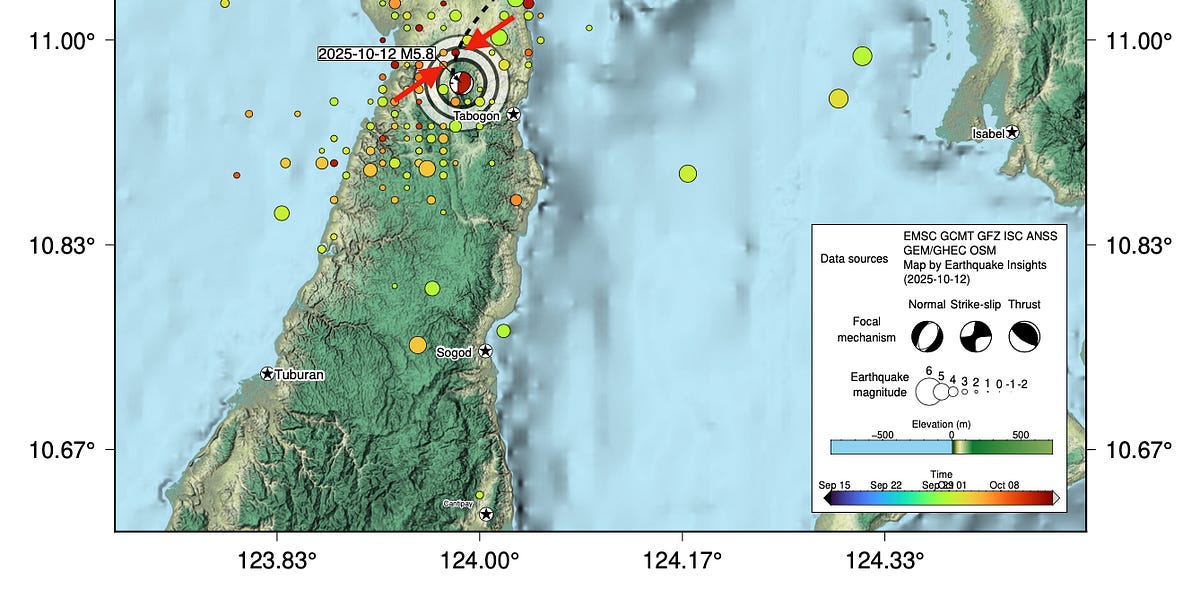
Figure 1: Earthquakes since September 15, 2025 in northern Cebu, Philippines. Earthquakes are colored over time. The mainshock (M6.9) and largest aftershock (M5.7) are marked. Earthquakes are also displayed on the right on a timeline and appear below the map in a time series.
Since the main shock occurred, the Philippine Institute of Volcanology and Seismology (PHIVOLCS) has been busy. Through a quick field investigation, they discovered the fault they believe was responsible for the earthquake: the newly named Bogo Bay Fault. From what we can tell, this fault is aligned with a straight extension of the coast in the Gulf (and is presumably responsible for this straightening).
Figure 2: A screenshot from Google Earth showing the straight section of shoreline that appears identical to the newly mapped Bogo Bay fault.
We also have some preliminary satellite images that help visualize the rupture and its effects, also from PHIVOLCS. The images below are from the Japanese ALOS-2 satellite, which is particularly adept at measuring large deformations of the Earth. The upper image shows the displacement in the satellite's direction of view (northeast). The area southeast of the fault (red) has moved about 2 meters to the southwest, a reasonable value for an earthquake of this magnitude. The area northwest of the fault (blue) has moved northeast. Less movement is observed in the second image, which shows displacement in the northwest direction. This makes sense: this is a strike-slip fault, so we wouldn't expect to see much movement toward or away from the fault itself.
Guided by satellite imaging and field mapping, PHIVOLCS mapped the bend of the fault toward the southwest and then south. This is interesting, because it means that slip on the fault must cause stress around this curved region, as the lateral slip crust becomes increasingly restricted. This is called compressional bending of the strike-slip fault.
In fact, the recent M5.7 aftershock is a thrust event, corresponding to northwest-southeast pressure.
Figure 4: Earthquake sequence map, with the fault traced from the PHIVOLCS satellite image and extending offshore toward the main epicenter. At the southwestern end of the fault path, movements should cause stress, as seen in the M5.7 aftershock.
Although the magnitude of this earthquake was much smaller than the main shock, it may have caused similar shaking intensity in some areas close to the epicenter. USGS PAGER estimates that a maximum shaking intensity of VII (very strong) may have been felt by more than 100,000 people. PHIVOLCS indicates lower intensity (maximum V: moderate) – we are not sure whether this reflects a difference in methodology, or a more precise assessment by PHIVOLCS based on reports.
Large, rare aftershocks are a normal part of the seismic sequence. The basic rule for aftershock sequences is called Bath's Law: In a typical sequence, the largest aftershock will be 1.2 units smaller than the mainshock. So, in this case, M5.7 is exactly what we should expect.
In general, we also expect the rate of aftershocks to decrease by 1/time. In other words, if there are N/10 aftershocks on the first day after the earthquake, this rate should decrease to N/10 on day 10, and N/100 on day 100; This is the famous Omori-Otsu law of aftershock decay.
Unfortunately, these “laws” are not really laws at all, but rather observations that represent typical behavior. Not many earthquake sequences have M-1.2 aftershocks – likewise, many earthquakes will have larger aftershocks, or even trigger triggering events larger than the original mainshock. So, while the most likely scenario is that aftershocks will continue to reduce in frequency over time, there is also less likelihood of larger events occurring. People in the affected area should remain aware of this potential for further events, and follow guidance provided by PHIVOLCS and regional authorities.
Hubbard, J. and Bradley, K. (2025). Devastating M7.4 subduction earthquake shakes Mindanao, Philippines. Earthquake visions. https://earthquakeinsights.substack.com/p/damaging-m74-subduction-earthquake
|
Sources 2/ https://earthquakeinsights.substack.com/p/cebu-shaken-by-m57-earthquake-aftershock The mention sources can contact us to remove/changing this article |
What Are The Main Benefits Of Comparing Car Insurance Quotes Online
LOS ANGELES, CA / ACCESSWIRE / June 24, 2020, / Compare-autoinsurance.Org has launched a new blog post that presents the main benefits of comparing multiple car insurance quotes. For more info and free online quotes, please visit https://compare-autoinsurance.Org/the-advantages-of-comparing-prices-with-car-insurance-quotes-online/ The modern society has numerous technological advantages. One important advantage is the speed at which information is sent and received. With the help of the internet, the shopping habits of many persons have drastically changed. The car insurance industry hasn't remained untouched by these changes. On the internet, drivers can compare insurance prices and find out which sellers have the best offers. View photos The advantages of comparing online car insurance quotes are the following: Online quotes can be obtained from anywhere and at any time. Unlike physical insurance agencies, websites don't have a specific schedule and they are available at any time. Drivers that have busy working schedules, can compare quotes from anywhere and at any time, even at midnight. Multiple choices. Almost all insurance providers, no matter if they are well-known brands or just local insurers, have an online presence. Online quotes will allow policyholders the chance to discover multiple insurance companies and check their prices. Drivers are no longer required to get quotes from just a few known insurance companies. Also, local and regional insurers can provide lower insurance rates for the same services. Accurate insurance estimates. Online quotes can only be accurate if the customers provide accurate and real info about their car models and driving history. Lying about past driving incidents can make the price estimates to be lower, but when dealing with an insurance company lying to them is useless. Usually, insurance companies will do research about a potential customer before granting him coverage. Online quotes can be sorted easily. Although drivers are recommended to not choose a policy just based on its price, drivers can easily sort quotes by insurance price. Using brokerage websites will allow drivers to get quotes from multiple insurers, thus making the comparison faster and easier. For additional info, money-saving tips, and free car insurance quotes, visit https://compare-autoinsurance.Org/ Compare-autoinsurance.Org is an online provider of life, home, health, and auto insurance quotes. This website is unique because it does not simply stick to one kind of insurance provider, but brings the clients the best deals from many different online insurance carriers. In this way, clients have access to offers from multiple carriers all in one place: this website. On this site, customers have access to quotes for insurance plans from various agencies, such as local or nationwide agencies, brand names insurance companies, etc. "Online quotes can easily help drivers obtain better car insurance deals. All they have to do is to complete an online form with accurate and real info, then compare prices", said Russell Rabichev, Marketing Director of Internet Marketing Company. CONTACT: Company Name: Internet Marketing CompanyPerson for contact Name: Gurgu CPhone Number: (818) 359-3898Email: [email protected]: https://compare-autoinsurance.Org/ SOURCE: Compare-autoinsurance.Org View source version on accesswire.Com:https://www.Accesswire.Com/595055/What-Are-The-Main-Benefits-Of-Comparing-Car-Insurance-Quotes-Online View photos

 |
 |
 |