
Uncategorized
Is an earthquake about to rock the AI economy?
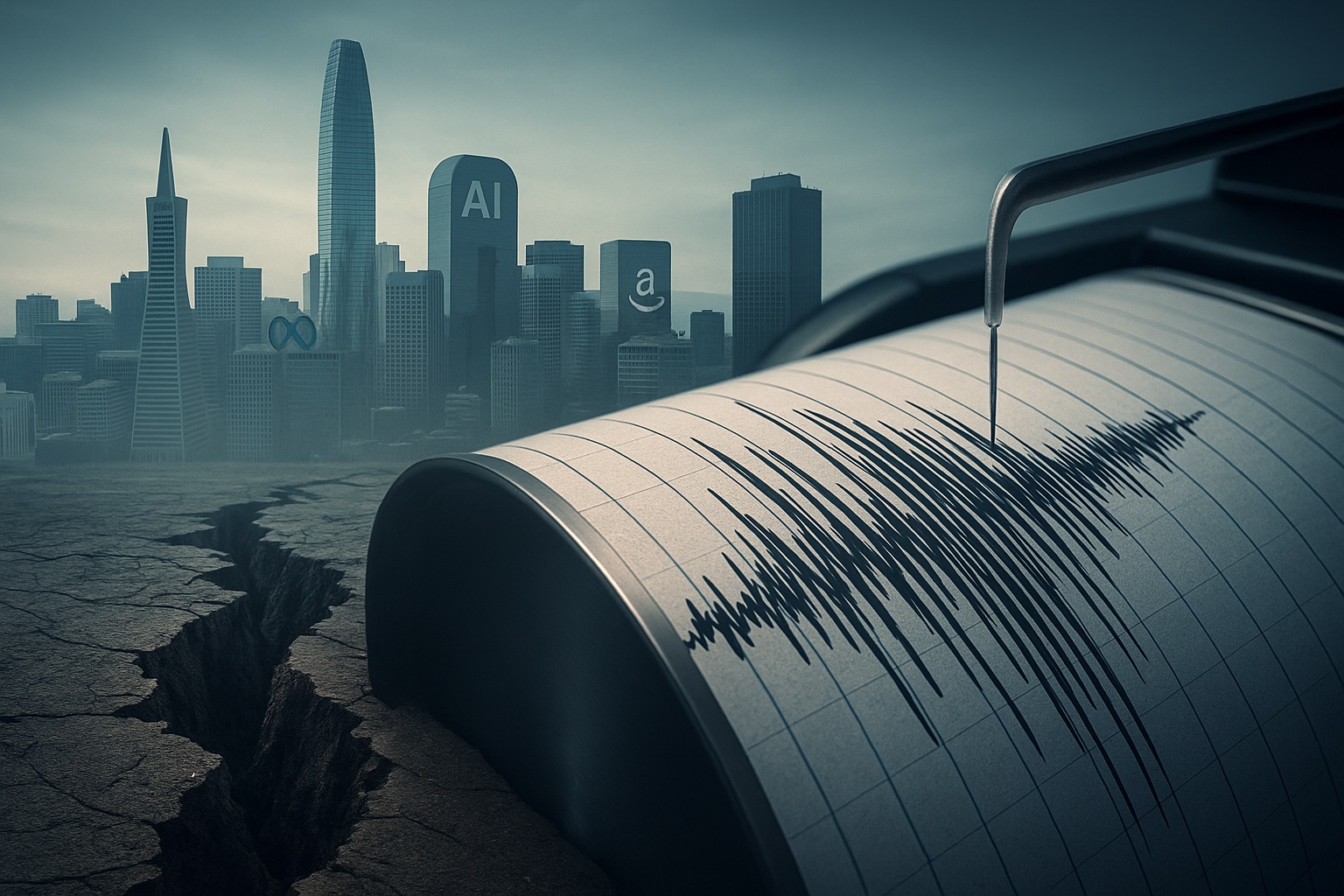
As investment in AI rises and capital flows into data centers and infrastructure, fault lines are forming beneath the surface – echoing the dot-com bubble and raising questions about whether the AI economy is built on solid ground or on the hype of speculation.
Earthquakes occur when pressure builds up on deep fault lines until the ground can no longer contain the pressure. The surface appears calm, but underneath, opposing forces clash together until a sudden rupture reshapes everything above. The same dynamic is now shaping the AI economy, as hype and capital race over fundamentals. The tremors are already becoming evident, and ironically we saw the same thing twenty-five years ago. Now, history is about to repeat itself.
In the late 1990s, the Internet promised a transformative future, but its early boom expanded more rapidly than the underlying infrastructure or business models could support. Today's AI acceleration shows a similar gap between what is artificially inflated by excitement and investment and what is intelligently based on economics, capabilities and human experience.
Increased AI links create seismic pressure
One of the most obvious fault lines lies in credit markets. AI infrastructure is being financed through an unprecedented wave of bond issuance. Tens of billions flowed into data centers, GPU clusters, power expansion, and cooling systems. Investors are betting that demand for artificial intelligence will eventually justify this massive expansion, but the ground is far from stable.
The Wall Street Journal notes that companies like Microsoft, Meta, and Amazon are spending big on AI infrastructure, while also signaling to investors that costs should eventually come down — a promise that doesn't yet have a clear path toward fulfillment. This rise in debt behaves like tectonic pressures that build up beneath the surface, lying dormant until a shift in interest rates, adoption, or energy availability triggers a sudden rupture.
Buttarazzo: The Epstein Files: The Empire of Willful Blindness (November 22, 2025)
Despite a recent $25 billion bond sale, Alphabet carries a much lower relative debt load than its Big Tech peers. This gives it the flexibility to add some leverage without taking on too much risk. Among its peers, the company has the highest cash balance net of debt. CreditSights estimates that Alphabet's total debt plus lease obligations is just 0.4 times its pre-tax earnings, versus 0.7 times for Microsoft and Meta.
Usage is exploding, but productivity is not
A recent Washington Post investigation reveals another deep tension. Tools like ChatGPT now attract nearly 800 million users weekly, yet business adoption and measurable productivity gains remain uneven. Many companies that use AI continue to lose money.
In order to sustain today's infrastructure expansion, it is estimated that the industry may need an additional $650 billion in annual revenue by 2030 – an extraordinary jump. Below the surface, capital is flowing faster than value is being created.
Read: Buttarazzo: 'What I predicted 15 years ago has come to fruition': ACA calculations were wrong (November 17, 2025)
Even Google CEO Sundar Pichai recently warned that investing in artificial intelligence shows “elements of irrationality,” suggesting excessive speculation in the dot-com bubble. He warned that if the bubble bursts, no company — not even Google — would be safe.
The illusion of stability: “Fake it till you make it.”
Geologists describe seismic slip as slow movement along a fault that makes the surface appear stable while pressure intensifies below. Many AI companies are mimicking this phenomenon. They hold back customers at a loss, subsidize usage, and create the illusion of momentum even as their economics deteriorate.
As The Wall Street Journal reported in its in-depth examination of “fake it until you make it” business models, companies often hide fragility through rapid user growth that is not financially sustainable. AI is particularly vulnerable because each user query consumes expensive computing and energy. Growth without revenue becomes the corporate equivalent of building towers on soft soil.
When infrastructure trumps reality
Earthquakes also strike when tectonic plates move faster than the surrounding rocks can adapt. Today, AI infrastructure is expanding faster than real demand can support it. Power grids, land availability, chip supplies, and cooling capabilities are all lagging far behind the pace of AI ambition. Utilities are under pressure as demand for AI energy surges, with cities and energy providers scrambling to keep up.
Read: Buttarazzo and Knopp: Why we believe the stories we tell ourselves: The anchor, the compass, and the inner storm (November 19, 2025)
The physical footprint of AI is expanding on the assumption that commercial returns will catch up. If they don't, the fault becomes a seismic hazard.
Even the strongest infrastructure collapses if the underlying rock is weak. AI faces a talent shortage that is too large to ignore. There is a shortage of engineers, reliability experts, data center specialists, and cybersecurity specialists. Without skilled labor to absorb this pressure, AI capabilities will outpace the humans needed to deploy and manage it. Talent shortages act like brittle layers of rock, and will crack under pressure.
MicroStrategy: A shocker worth watching
Small tremors often precede major earthquakes. One of them is MicroStrategy (now trading as a strategy). Once crashed during the tech crash of 2000, the company reinvented itself as a highly leveraged Bitcoin bet. Its stock premium over its bitcoin holdings recently fell to a multi-year low, a sign of tension beneath the surface.
In 2000, MicroStrategy was one of the first companies to go down for erroneous earnings (resulting in huge SEC fines). Now, in the past week, Strategy's stock has fallen hard, and many have once again criticized Michael Saylor for his evangelism.
MicroStrategy is important for AI because the same investors and capital structures that supported the speculative rise are now ensuring the AI boom. BlackRock, which owns roughly 5% of MicroStrategy, is also a major player in financing AI data center expansion through its AI infrastructure partnership with Nvidia, Microsoft, and others. If MicroStrategy cracks, it could lead to a confidence shock that is reflected directly in AI bond markets.
Strengthen the foundation before moving the ground
The AI ecosystem faces interconnected pressures: rising borrowing costs, tightening project financing, energy shortages, supply chain bottlenecks, talent gaps, and speculative bets tied to the same capital pool. These forces behave as a vast network of fine faults. If they transformed together, the rupture could be much stronger than any of them alone.
But earthquakes are only destructive when structures are weak. Through transparency, disciplined financial planning, smarter workforce development, realistic expectations, and stronger governance, the AI economy can strengthen its foundations before the pressure gets out of control.
Artificial intelligence will define the coming decades. The question is whether we build its future on a solid foundation or on the illusions and fault lines we have seen before.
|
Sources 2/ https://americanbazaaronline.com/2025/11/30/is-an-earthquake-about-to-rock-the-ai-economy-470776/ The mention sources can contact us to remove/changing this article |
What Are The Main Benefits Of Comparing Car Insurance Quotes Online
LOS ANGELES, CA / ACCESSWIRE / June 24, 2020, / Compare-autoinsurance.Org has launched a new blog post that presents the main benefits of comparing multiple car insurance quotes. For more info and free online quotes, please visit https://compare-autoinsurance.Org/the-advantages-of-comparing-prices-with-car-insurance-quotes-online/ The modern society has numerous technological advantages. One important advantage is the speed at which information is sent and received. With the help of the internet, the shopping habits of many persons have drastically changed. The car insurance industry hasn't remained untouched by these changes. On the internet, drivers can compare insurance prices and find out which sellers have the best offers. View photos The advantages of comparing online car insurance quotes are the following: Online quotes can be obtained from anywhere and at any time. Unlike physical insurance agencies, websites don't have a specific schedule and they are available at any time. Drivers that have busy working schedules, can compare quotes from anywhere and at any time, even at midnight. Multiple choices. Almost all insurance providers, no matter if they are well-known brands or just local insurers, have an online presence. Online quotes will allow policyholders the chance to discover multiple insurance companies and check their prices. Drivers are no longer required to get quotes from just a few known insurance companies. Also, local and regional insurers can provide lower insurance rates for the same services. Accurate insurance estimates. Online quotes can only be accurate if the customers provide accurate and real info about their car models and driving history. Lying about past driving incidents can make the price estimates to be lower, but when dealing with an insurance company lying to them is useless. Usually, insurance companies will do research about a potential customer before granting him coverage. Online quotes can be sorted easily. Although drivers are recommended to not choose a policy just based on its price, drivers can easily sort quotes by insurance price. Using brokerage websites will allow drivers to get quotes from multiple insurers, thus making the comparison faster and easier. For additional info, money-saving tips, and free car insurance quotes, visit https://compare-autoinsurance.Org/ Compare-autoinsurance.Org is an online provider of life, home, health, and auto insurance quotes. This website is unique because it does not simply stick to one kind of insurance provider, but brings the clients the best deals from many different online insurance carriers. In this way, clients have access to offers from multiple carriers all in one place: this website. On this site, customers have access to quotes for insurance plans from various agencies, such as local or nationwide agencies, brand names insurance companies, etc. "Online quotes can easily help drivers obtain better car insurance deals. All they have to do is to complete an online form with accurate and real info, then compare prices", said Russell Rabichev, Marketing Director of Internet Marketing Company. CONTACT: Company Name: Internet Marketing CompanyPerson for contact Name: Gurgu CPhone Number: (818) 359-3898Email: [email protected]: https://compare-autoinsurance.Org/ SOURCE: Compare-autoinsurance.Org View source version on accesswire.Com:https://www.Accesswire.Com/595055/What-Are-The-Main-Benefits-Of-Comparing-Car-Insurance-Quotes-Online View photos

 |
 |
 |