
Uncategorized
'No seismic monitoring': New pipeline in British Columbia could lead to disaster, experts warn | Canada
When a 2002 earthquake struck a remote area of Alaska, the shock was the strongest ever recorded in the interior of the state. But, miraculously, the oil pipeline that crossed directly over the fault line was unharmed.
The engineers behind the design of the 800-mile system were prepared. Given the high likelihood of seismic activity along the route, which bisected the Denali Fault, they built sections where the pipeline rests on railway sleepers, allowing it to sway and shear without breaking.
“It worked because they could determine how and where to build: they could put their hands right on the fault,” said Edwin Nissen, a seismologist at the University of Victoria. “The problem for Canada is that there is nothing like this in British Columbia, where a pipeline has been proposed. There has not been a detailed study like the one they did on the pipeline in Alaska, and as a result, there is a lot that we don't know.”
The Trans Alaska Pipeline constructed using very long support beams shows where it intersects above the Denali Fault. Image: RGB Ventures/SuperStock/Alamy
Canadian Prime Minister Mark Carney gave his government's blessing last week for an oil pipeline that will cross Alberta and British Columbia and end in the Pacific Ocean. But amid intense debate over the project's political, environmental and economic impacts, experts warn that the multibillion-dollar project faces enormous — and poorly understood — geological risks.
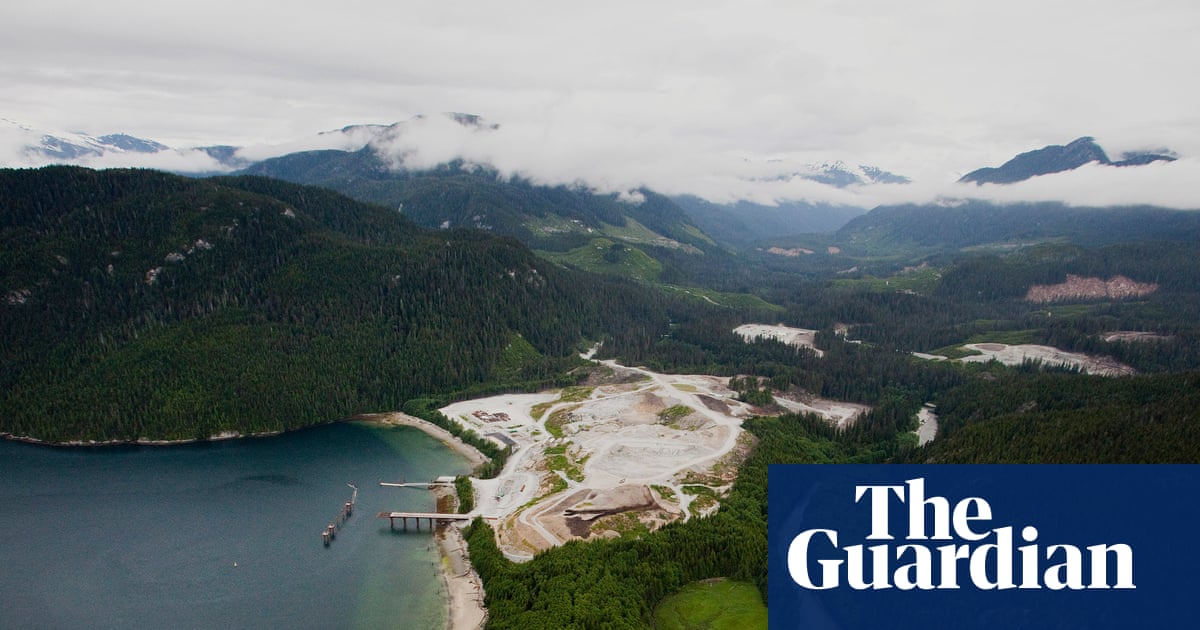
While no route has been officially proposed for a heavy oil pipeline, and no company has stepped forward to build it, the most efficient route from Edmonton, Alberta, would always pass through the Rocky Mountain Trench and along sparsely populated northern British Columbia before ending at the Douglas Channel, a winding landscape of deep fjords. The project has already faced strong First Nations opposition over concerns that the Carney government will lift a five-decade ban on oil tankers in the region.
Until now, much of the public debate has focused on the enormous risks posed by a marine disaster, but Nissen warns that the geography of the scene itself presents new and troubling risks.
Nissen and his research team argue that at least two seismic faults, including the Rocky Mountain Trench that most Canadian geologists believe is “extinct” or long dormant, are still active and “could host large earthquakes that damage the surface.” He also says that tectonics in mountainous areas along the Pacific coast are “not well understood.”
“This part of the world, where we're talking about a pipeline, is very poorly equipped and, as a result, we know very little about it,” he said. A large earthquake – or even smaller quakes that trigger landslides – can unleash an environmental disaster.
A large crack on the Tok Katuf Highway, caused by a 7.9 magnitude earthquake on November 3, 2002 in Alaska. Photo: Getty Images
The challenge for Canada is that the vast majority of its seismographs are highly concentrated along the country's southern border, where the bulk of the population lives.
“Where pipelines might be built, there's basically no earthquake monitoring. There's no landslide monitoring. And we don't have the equipment that can actually map small earthquakes along these faults,” he said. “Science funding in Canada is very weak compared to America. We don't have the resources to deploy seismic stations and GPS stations. It's expensive work, and we don't have the money.”
David Eby, British Columbia's premier, has emerged as a sharp critic of the project, expressing frustration at being left out of discussions between Ottawa and Alberta even though the road would pass through his province.
“Alberta's oil sands will get most of the profits from this pipeline, but all the risks fall on British Columbia and especially First Nations along the west coast,” Nissen said. “In a way, it's like the 2008 global financial crisis: profit was private, bailouts favored the big banks, and risks were essentially subsidized by all taxpayers.”
A full moon helps illuminate the Alaska Pipeline under the dim glow of the aurora borealis on November 19, 2002 near Milne Point, Alaska. Photo: Getty Images
While the risks of building in seismically active areas can be reduced through engineering, the process is “enormously expensive” if the “underlying science” has not yet been completed.
“What's going on in these areas? Where are the faults? What's the risk of an earthquake in each one of them? We'd better ask these questions — and we've answered them even before the conversation about the pipeline started,” he said. “Black swan events are inherently unlikely, but they are something we have to take into account. Because when these huge landslides, massive earthquakes and tsunamis happen, they often catch professionals like me by surprise.”
In 1958, an earthquake in a remote Alaskan Gulf triggered a landslide that triggered a massive tsunami, with the wave reaching a height of about 553 meters – nearly twice the height of The Shard in London.
A wave of such “extraordinarily terrifying surge” would not have been possible without the natural geography of the fjord, where, unlike an ocean, energy cannot dissipate easily, said Dan Sugar, a geomorphologist at the University of Calgary.
The challenge for the pipeline across British Columbia is that the landscape surrounding a potential terminal is eerily similar to that of much of Alaska's southeastern coast, where the massive Lituya Bay tsunami occurred.
The most likely location for a terminal where large oil tankers could load crude oil for transport to Asia is in the Douglas Channel, an increasingly busy shipping route through the fjord.
Sugar said the Canadian Geological Survey recently did “fantastic”, high-resolution sonar mapping that revealed nearly 100 previous landslides in the Douglas Channel. He added that while some were small, a handful were “really huge” and could be “catastrophic, not just for the tanker, but potentially for any towns or other infrastructure in the fjord.”
While these events are scattered over tens of thousands of years, with enough data and time, scientists can calculate a recurrence interval, giving a rough idea of how frequently these landslides occur.
“When we design or make decisions about facilities that have a lifespan of decades, we need to take into account the geophysical risks that may exist — even if those risks are relatively small,” he said. He points to the Greenland government, which recently announced it would “discourage” all maritime traffic in the fjord due to the risk of tsunamis caused by landslides.
“We don't tend to take a very long view of history. Our politicians tend to think in four-year time frames. But nature doesn't care about that. Geology certainly doesn't care about that. The disasters of the past teach us that ecosystems can take many decades to recover from what may unfold in just a few minutes.”
|
Sources 2/ https://www.theguardian.com/world/2025/dec/03/british-columbia-pipeline-expert-warning-risks The mention sources can contact us to remove/changing this article |
What Are The Main Benefits Of Comparing Car Insurance Quotes Online
LOS ANGELES, CA / ACCESSWIRE / June 24, 2020, / Compare-autoinsurance.Org has launched a new blog post that presents the main benefits of comparing multiple car insurance quotes. For more info and free online quotes, please visit https://compare-autoinsurance.Org/the-advantages-of-comparing-prices-with-car-insurance-quotes-online/ The modern society has numerous technological advantages. One important advantage is the speed at which information is sent and received. With the help of the internet, the shopping habits of many persons have drastically changed. The car insurance industry hasn't remained untouched by these changes. On the internet, drivers can compare insurance prices and find out which sellers have the best offers. View photos The advantages of comparing online car insurance quotes are the following: Online quotes can be obtained from anywhere and at any time. Unlike physical insurance agencies, websites don't have a specific schedule and they are available at any time. Drivers that have busy working schedules, can compare quotes from anywhere and at any time, even at midnight. Multiple choices. Almost all insurance providers, no matter if they are well-known brands or just local insurers, have an online presence. Online quotes will allow policyholders the chance to discover multiple insurance companies and check their prices. Drivers are no longer required to get quotes from just a few known insurance companies. Also, local and regional insurers can provide lower insurance rates for the same services. Accurate insurance estimates. Online quotes can only be accurate if the customers provide accurate and real info about their car models and driving history. Lying about past driving incidents can make the price estimates to be lower, but when dealing with an insurance company lying to them is useless. Usually, insurance companies will do research about a potential customer before granting him coverage. Online quotes can be sorted easily. Although drivers are recommended to not choose a policy just based on its price, drivers can easily sort quotes by insurance price. Using brokerage websites will allow drivers to get quotes from multiple insurers, thus making the comparison faster and easier. For additional info, money-saving tips, and free car insurance quotes, visit https://compare-autoinsurance.Org/ Compare-autoinsurance.Org is an online provider of life, home, health, and auto insurance quotes. This website is unique because it does not simply stick to one kind of insurance provider, but brings the clients the best deals from many different online insurance carriers. In this way, clients have access to offers from multiple carriers all in one place: this website. On this site, customers have access to quotes for insurance plans from various agencies, such as local or nationwide agencies, brand names insurance companies, etc. "Online quotes can easily help drivers obtain better car insurance deals. All they have to do is to complete an online form with accurate and real info, then compare prices", said Russell Rabichev, Marketing Director of Internet Marketing Company. CONTACT: Company Name: Internet Marketing CompanyPerson for contact Name: Gurgu CPhone Number: (818) 359-3898Email: [email protected]: https://compare-autoinsurance.Org/ SOURCE: Compare-autoinsurance.Org View source version on accesswire.Com:https://www.Accesswire.Com/595055/What-Are-The-Main-Benefits-Of-Comparing-Car-Insurance-Quotes-Online View photos

 |
 |
 |