
Uncategorized
The “impossible” earthquake that occurred beneath Utah was real after all
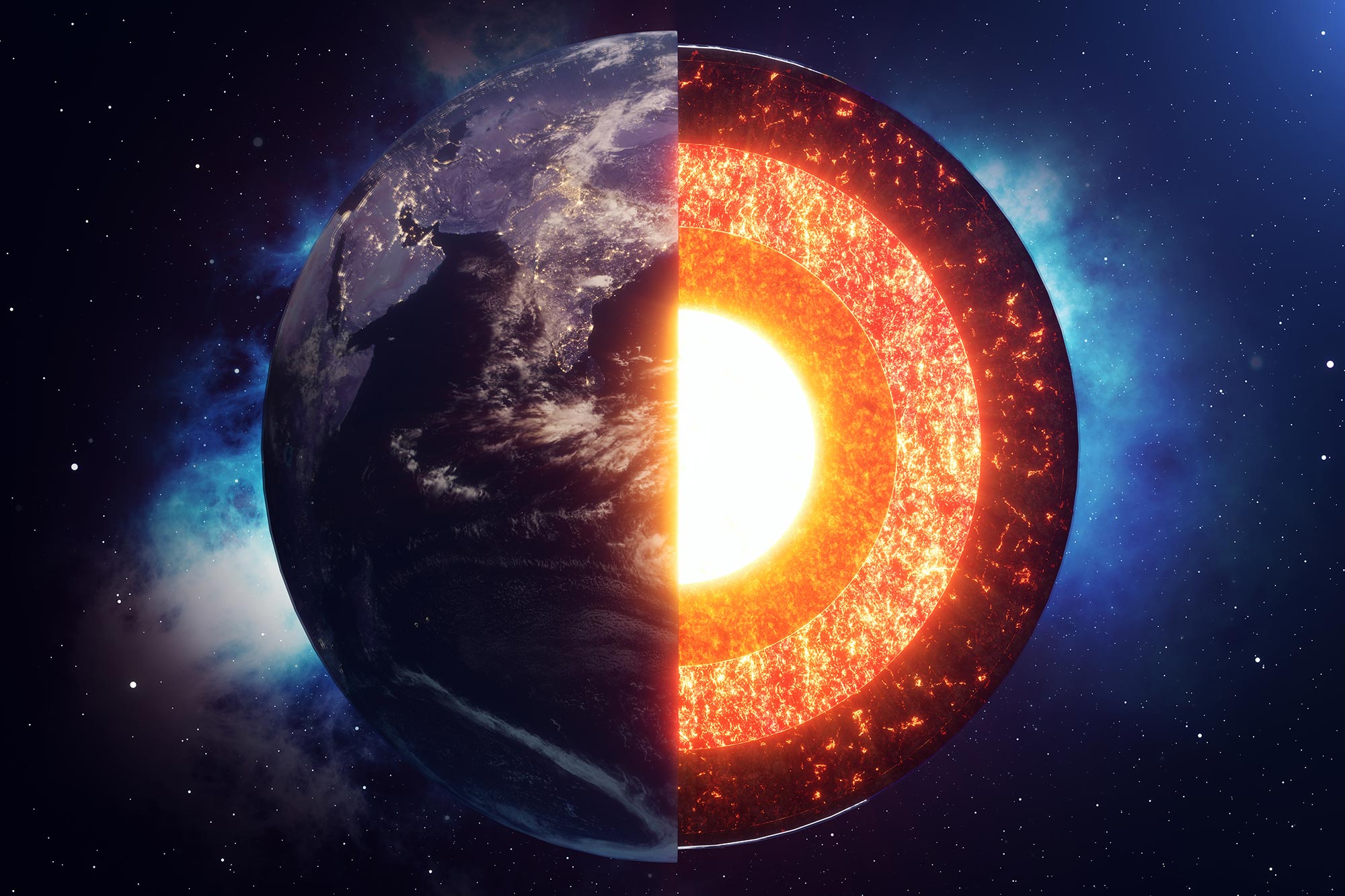
A mysterious Utah earthquake recorded in 1979 has been confirmed as part of a rare type of deep mantle earthquake occurring far beneath North America. This surprising discovery challenges long-standing ideas about where earthquakes can form and points to geological forces hidden deep within the Earth. Credit: Stock
Scientists have confirmed that a rare, “impossible” earthquake has occurred deep within Utah, revealing a hidden source of seismic activity within the Earth’s mantle.
Nearly five decades after a puzzling earthquake occurred deep in northern Utah, scientists have confirmed that the event was real and part of a rare class of earthquakes that occur much deeper underground than researchers previously thought.
The unusual earthquake occurred in the early hours of February 24, 1979, below the town of Randolph, near Utah’s border with Idaho and Wyoming. Although the earthquake’s magnitude reached 3.8, no one reported feeling it. The seismic data collected at that time also seemed highly unusual.
George Zandt, then a postdoctoral researcher in seismology at the University of Utah, took a close look at the recordings. His analysis suggests that the quake originated at a depth of about 90 kilometers below sea level, far beneath the Earth’s crust and deep within the upper mantle.
At the time, such a depth seemed almost impossible for a subcontinental earthquake.
“The deep depth explained why people didn’t feel it at the surface,” said Zandt, who later spent most of his career at the University of Arizona’s School of Geology. “I have done some other analyzes that have convinced me of the reality of the deep abyss, but it has been difficult to convince others of a very anomalous mantle earthquake occurring in an area where there should be none.”
Map of the Wyoming Craton area. Yellow stars are continental mantle earthquakes (CMEs) from 1979 to 2023. Orange stars are six recently identified CMEs that occurred between 2007 and 2010. The white stars are four suspected CME earthquakes identified by the U of T seismic stations in 2025, and the red star is the location of the 2025 Macer earthquake. The thick black line indicates the approximate boundary of the lithospheric keel in the Wyoming Craton. Credit: Revisiting a decades-old seismic mystery at the University of Utah seismic stations
Although Zandt published a summary of the event in the journal Earthquake Notes, the results attracted little attention. That changed last year when a new group of seismologists from the University of Utah revisited the 1979 data along with records of eight other suspected deep earthquakes that occurred in northern Utah and southwestern Wyoming.
The team, led by geology professor Keith Cooper, confirmed that all nine earthquakes originated beneath the Earth’s crust. Their findings provided strong evidence for the existence of so-called continental mantle earthquakes (CMEs), a rare type of earthquake that occurs within the Earth’s mantle rather than its crust.
The evidence grew stronger on September 10, 2025, when another deep earthquake struck near Macer in Utah’s Uinta Basin. The 4.1 magnitude event occurred at a depth of 68 kilometers.
This position placed it more than 20 kilometers below the Mohorovicić discontinuity, known as the Moho, which marks the boundary between the Earth’s crust and mantle. In a subsequent study published in The Seismic Record, researchers described the Messer earthquake as a “typical continental mantle event.”
Earthquakes in an unpredictable environment
This discovery is surprising because the rocks at these depths are exposed to extreme temperatures and pressures. Scientists generally expect mantle rocks to deform slowly over long periods rather than suddenly breaking apart in an earthquake.
“This is an example of an earthquake that forms under very unusual conditions, such as high temperature and high pressure, and almost all the material at that depth will flow out,” says Cooper, director of seismic stations at the University of Utah and a former student of Zandt’s. “It’s like candy. It’s candy on long time scales, like millions of years.” “However, you can still see it in the rocks that have made their way back to the surface; you can see how they have expanded.”
Zandt came out of retirement to collaborate on the research and is listed as a co-author of the study.
A different type of earthquake
To determine where earthquakes start, seismologists compare the arrival times of different types of seismic waves recorded at monitoring stations. Small differences in travel time help reveal the depth and location of the earthquake source.
The University of Utah’s seismic stations have preserved decades of seismic records, creating a valuable archive for researchers. Graduate student Sean Hutchings used those records to study known deep earthquakes and identify several additional events that had previously been classified as shallower crustal earthquakes.
The results point to a type of earthquake that behaves very differently from familiar earthquakes.
“It’s kind of a mystery in terms of basic physics. How could these things happen?” Cooper said. “Another reason it’s important is that we have no idea how big they are. With crustal earthquakes, we can measure what we think their maximum size will be. We measure faults that we can map close to the surface. We can measure the length of a fault segment and that tells us how big it is, which helps us estimate the seismic hazard.”
Unlike conventional earthquakes, these deep mantle events occur alone. The researchers found no evidence of foreshocks or aftershocks that usually accompany crustal earthquakes.
The Wyoming Craton may hold the answer
The earthquakes also appear to be centered near the western edge of the Wyoming Craton, an exceptionally ancient and ancient section of Earth’s lithosphere that lies beneath parts of Wyoming and neighboring states. The region is associated with very high temperatures, often exceeding 700 degrees Celsius.
Cooper compares cratons to icebergs. Instead of floating in the water, these ancient structures extend deep into the Earth’s mantle like the keel of a ship.
The Wyoming Craton lies on the border between the tectonically active western United States and the more stable interior of the North American continent. Over time, erosion and geological processes changed its structure, leaving the lithosphere thinner toward Idaho and Utah. This is where deep earthquakes are observed.
“On a scale of millions of years, the mantle collides with the cardboard and then flows around it,” Cooper said. “It’s this interaction where the mantle flow is diverted around this solid cratonian root that causes the strain rate to increase, the deformation to increase, and it also creates additional stresses. We think it’s this interaction between the keel of the glacier and the surrounding medium that leads to these earthquakes.”
The research was published on April 10 in The Seismic Record under the title “The September 10, 2025 4.1 earthquake in northeastern Utah, US: a typical continental mantle event,” and on May 5, 2025 in Geophysical Research Letters under the title “Upper-mantle earthquakes along the margin of the Wyoming craton.”
References:
“The 10 September 2025 Mw 4.1 earthquake in northeastern Utah, USA: a typical continental mantle event” by Keith D. Cooper, and Sean J. Hutchings, Rilo Burlaco, Katherine Weeden, Valerie Springer, Rigobert Tepe, and Guanying Pang, 10 April 2026, Seismic Record.DOI: 10.1785/0320260006
“Upper mantle earthquakes along the margin of the Wyoming Craton” by Sean J. Hutchings, Keith D. Koper, Relu Burlacu, Qicheng Zeng, Fan-Chi Lin and George Zandt, 3 May 2025, Geophysical Research Letters.DOI: 10.1029/2024GL114073
Co-authors include Sean J. Hutchings, Fan Zhi Lin, Qicheng Zheng, Rilo Burlaco, Katherine Weeden, and Valerie Springer of the Department of Geology and Geophysics at the University of Utah. This work was supported by the State of Utah, the U.S. Department of Energy, and the U.S. Geological Survey.
Don’t miss a single breakthrough: join the SciTechDaily newsletter. Follow us on Google and Google News.
|
Sources 2/ https://scitechdaily.com/the-impossible-earthquake-beneath-utah-was-real-after-all/ The mention sources can contact us to remove/changing this article |
What Are The Main Benefits Of Comparing Car Insurance Quotes Online
LOS ANGELES, CA / ACCESSWIRE / June 24, 2020, / Compare-autoinsurance.Org has launched a new blog post that presents the main benefits of comparing multiple car insurance quotes. For more info and free online quotes, please visit https://compare-autoinsurance.Org/the-advantages-of-comparing-prices-with-car-insurance-quotes-online/ The modern society has numerous technological advantages. One important advantage is the speed at which information is sent and received. With the help of the internet, the shopping habits of many persons have drastically changed. The car insurance industry hasn't remained untouched by these changes. On the internet, drivers can compare insurance prices and find out which sellers have the best offers. View photos The advantages of comparing online car insurance quotes are the following: Online quotes can be obtained from anywhere and at any time. Unlike physical insurance agencies, websites don't have a specific schedule and they are available at any time. Drivers that have busy working schedules, can compare quotes from anywhere and at any time, even at midnight. Multiple choices. Almost all insurance providers, no matter if they are well-known brands or just local insurers, have an online presence. Online quotes will allow policyholders the chance to discover multiple insurance companies and check their prices. Drivers are no longer required to get quotes from just a few known insurance companies. Also, local and regional insurers can provide lower insurance rates for the same services. Accurate insurance estimates. Online quotes can only be accurate if the customers provide accurate and real info about their car models and driving history. Lying about past driving incidents can make the price estimates to be lower, but when dealing with an insurance company lying to them is useless. Usually, insurance companies will do research about a potential customer before granting him coverage. Online quotes can be sorted easily. Although drivers are recommended to not choose a policy just based on its price, drivers can easily sort quotes by insurance price. Using brokerage websites will allow drivers to get quotes from multiple insurers, thus making the comparison faster and easier. For additional info, money-saving tips, and free car insurance quotes, visit https://compare-autoinsurance.Org/ Compare-autoinsurance.Org is an online provider of life, home, health, and auto insurance quotes. This website is unique because it does not simply stick to one kind of insurance provider, but brings the clients the best deals from many different online insurance carriers. In this way, clients have access to offers from multiple carriers all in one place: this website. On this site, customers have access to quotes for insurance plans from various agencies, such as local or nationwide agencies, brand names insurance companies, etc. "Online quotes can easily help drivers obtain better car insurance deals. All they have to do is to complete an online form with accurate and real info, then compare prices", said Russell Rabichev, Marketing Director of Internet Marketing Company. CONTACT: Company Name: Internet Marketing CompanyPerson for contact Name: Gurgu CPhone Number: (818) 359-3898Email: [email protected]: https://compare-autoinsurance.Org/ SOURCE: Compare-autoinsurance.Org View source version on accesswire.Com:https://www.Accesswire.Com/595055/What-Are-The-Main-Benefits-Of-Comparing-Car-Insurance-Quotes-Online View photos

 |
 |
 |