
Uncategorized
The San Andrea and Cascadia faults can combine to produce cascading seismic catastrophes
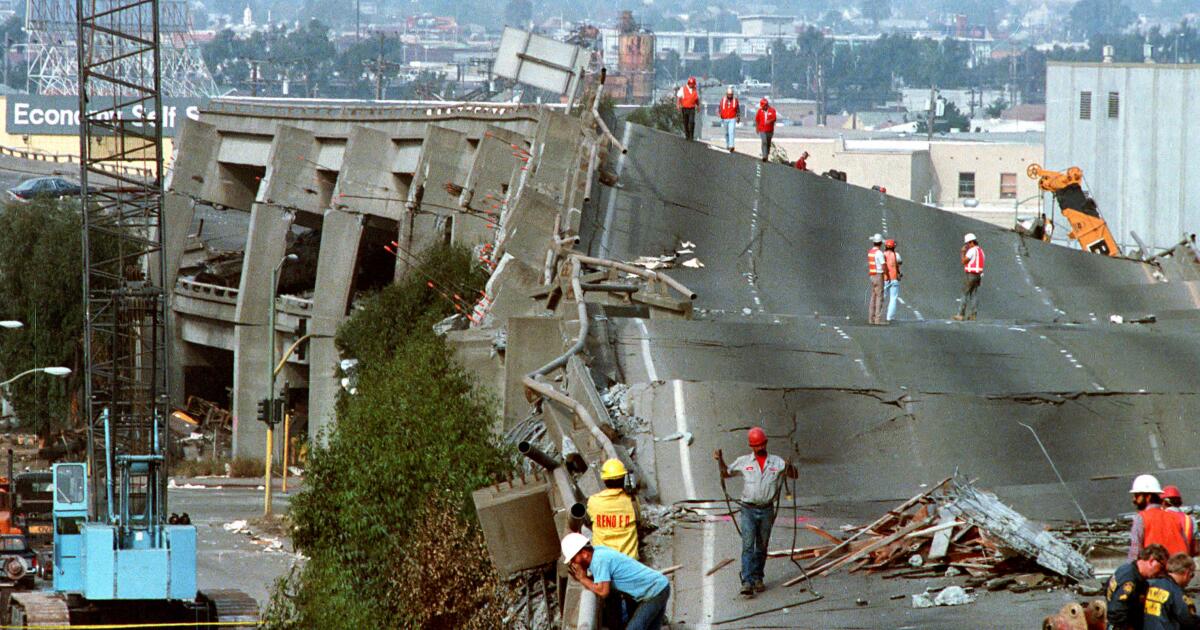
They are two of the most destructive generators of large earthquakes on the West Coast: the San Andreas Fault in California and the Cascadia Subduction Zone off the northern coast of California, Oregon, Washington and British Columbia.
The public has often believed that these danger zones are separate entities.
But what if they were capable of cascading disasters?
This is the alarming possibility described in a groundbreaking new study recently published in the journal Geosphere.
The authors point out that over thousands of years, large earthquakes occurring in the Cascadia subduction zone were followed by large earthquakes on the northern San Andreas fault.
In 1700, the Cascadia area earthquake is believed to have had a magnitude of about 9.0. Based on archaeological evidence, the villages sank and had to be abandoned, according to the USGS. This earthquake was so strong, entire parts of the Pacific coast fell by as much as 5 feet. In the Pacific Northwest, Native American stories told of “how the prairie became an ocean” and canoes were thrown into trees.
The study indicates that the Cascadia earthquake was followed by the North San Andreas earthquake from Cape Mendocino toward San Francisco, with a magnitude of about 7.9.
The San Andreas Fault appears along the Elkhorn Scarp pressure ridge.
(David McNew/Getty Images)
“What this suggests is that the San Andreas earthquake occurred very soon after the Cascadia earthquake,” said Jason R. Patton, an engineering geologist with the California Geological Survey and co-author of the study.
Evidence suggests that the San Andreas Fault in 1700 ruptured in an earthquake within hours to days of the Cascadia earthquake. “It could have taken minutes, but we can't pinpoint it,” said the study's lead author, Chris Goldfinger, a paleontologist at Oregon State University and professor emeritus of marine geology.
Goldfinger said the supposed hit of the earthquakes may not have been “just a black swan chance in a million.” “This is the case most of the time. The only exception in the last 2,500 years was 1906, and that was the only event” in which a large earthquake on the northern San Andreas fault was not preceded by a large earthquake in the Cascadia subduction zone, according to an analysis of the available data.
The massive Cascadia earthquake followed by the North San Andreas earthquake also likely occurred sometime between 1425 and 1475; Between 1175 and 1225; And between 825 and 475 BC, according to Goldfinger.
The Cascadia Subduction Zone, capable of producing an earthquake measuring 9 on the Richter scale, is located off the coast of northern California, Oregon, Washington and British Columbia.
(John Wesley Powell Center for Analysis and Synthesis/USGS)
The implications of the authors' conclusion are significant. Emergency managers have long feared a repeat of the 1906 San Francisco earthquake or the 1700 Cascadia earthquake and tsunami.
A repeat of the 1906 earthquake could kill thousands of people and cause hundreds of billions of dollars in property damage, according to one estimate.
A magnitude 9 earthquake on the Cascadia subduction zone could create tsunami wave heights that would wash away coastal cities, destroy U.S. 101 and cause $70 billion in damage over a large swath of the Pacific coast. More than 100 bridges will be lost, power lines will fall, and coastal towns will be cut off. Residents would have just 15 minutes to flee to higher ground, and up to 10,000 people would die, according to a scenario published more than a decade ago. Seaports can suffer severe damage.
The San Andreas Fault passes through the Juniper Hills.
(Myung Jae-chun/Los Angeles Times)
It is certain that the findings of the study are hypotheses. Patton said scientists won't know for sure whether the large Cascadia quakes trigger large earthquakes north of the San Andreas unless they do in the future.
But the implications of the study suggest that a large earthquake in the Cascadia subduction zone could rupture the northern San Andreas fault in a large quake minutes to hours later, or perhaps months or years later, Goldfinger said.
Just “one of these major events is going to take away the resources of the entire state trying to respond to it,” Goldfinger said. “So if you have two of those, you have to double it.”
Another key finding is the conclusion that most past earthquakes on the northern San Andreas Fault probably started around Cape Mendocino and then trended toward San Francisco. Such a scenario would lead to worse tremors in San Francisco than in 1906, when the epicenter was around the Golden Gate Strait and then moved away from the city.
The key to the study was examining plots of land that scientists had picked up from a ship collecting samples from deep within the seafloor. Earthquakes trigger landslides under the sea, leaving deposits called “turbidites” that get buried over time.
Normally, scientists would expect an earthquake to result in a familiar pattern — coarse sand at the bottom, indicating massive landslides triggered by a massive quake, and fine alluvial deposits on top, with lighter material settling out, Goldfinger said.
But scientists have been stuck on a mystery for decades.
In only one area off the coast of California — around Noyo Valley, near the San Andreas Fault, but about 50 miles from the Cascadia subduction zone — the seafloor samples appeared upside down, with fine alluvial deposits on the bottom, and coarse sand grains on top. Scientists had no way to explain this, a mystery that was “very disturbing,” Goldfinger said.
It will take more than 15 years before a possible answer emerges.
Under this interpretation, fine alluvial sediments were first deposited from a remote earthquake in the Cascadia subduction zone. The Cascadia earthquake was about 50 miles from Noyo Canyon, so with that distance, the level of ground shaking was weaker, “and… the first thing that would settle would be fine-grained deposits,” Goldfinger said.
This was quickly followed by an earthquake on the much closer San Andreas Fault, triggering stronger tremors and causing coarse grains of sand to fall on top of the alluvial layer laid down by the quake, according to Goldfinger.
When researchers came up with this possible explanation, “suddenly, it made sense,” Goldfinger said.
Scientists have found more evidence in recent years to confirm the existence of an earthquake north of the San Andreas in 1700 — around the time of the Cascadia earthquake.
For example, there is evidence of a massive earthquake on the northern San Andreas Fault from around Cape Mendocino to San Francisco in 1700, including clues found in Lake Merced near the San Francisco Zoo, Goldfinger said, as well as at other sites north of the city.
Coincidentally, another group of scientists using a completely different methodology — ring patterns and other observations of ancient redwood trees on the coast — has published a recent study suggesting that the last major earthquake in the northern San Andreas before 1906 was around the year 1700.
That was “a good confirmation of what we're proposing,” Goldfinger said.
It has been proven before that earthquakes can trigger other earthquakes. Scientists believe the 6.1 magnitude Joshua Tree earthquake on April 22, 1992, triggered aftershocks that continued to migrate north. Ultimately, it triggered a 7.3-magnitude Landers earthquake on June 28 in the Mojave Desert — powerful enough to shake Denver — and hours later, a 6.3-magnitude quake in Big Bear.
Anytime a major earthquake occurs, the crust around the torn fault compresses and expands, Patton said. In some places, this seismic pressure is relieved; In other cases, it gets worse — putting seismic faults in that area closer to potentially failing and triggering another major earthquake.
Goldfinger and Patton were among the co-authors of a 2008 research article published in the Bulletin of the Seismological Society of America that found that a large earthquake in the Cascadia subduction zone slightly worsens seismic stress in the northern part of the San Andreas Fault.
|
Sources 2/ https://www.latimes.com/california/story/2025-10-07/what-could-trigger-a-massive-quake-on-californias-san-andreas-fault The mention sources can contact us to remove/changing this article |
What Are The Main Benefits Of Comparing Car Insurance Quotes Online
LOS ANGELES, CA / ACCESSWIRE / June 24, 2020, / Compare-autoinsurance.Org has launched a new blog post that presents the main benefits of comparing multiple car insurance quotes. For more info and free online quotes, please visit https://compare-autoinsurance.Org/the-advantages-of-comparing-prices-with-car-insurance-quotes-online/ The modern society has numerous technological advantages. One important advantage is the speed at which information is sent and received. With the help of the internet, the shopping habits of many persons have drastically changed. The car insurance industry hasn't remained untouched by these changes. On the internet, drivers can compare insurance prices and find out which sellers have the best offers. View photos The advantages of comparing online car insurance quotes are the following: Online quotes can be obtained from anywhere and at any time. Unlike physical insurance agencies, websites don't have a specific schedule and they are available at any time. Drivers that have busy working schedules, can compare quotes from anywhere and at any time, even at midnight. Multiple choices. Almost all insurance providers, no matter if they are well-known brands or just local insurers, have an online presence. Online quotes will allow policyholders the chance to discover multiple insurance companies and check their prices. Drivers are no longer required to get quotes from just a few known insurance companies. Also, local and regional insurers can provide lower insurance rates for the same services. Accurate insurance estimates. Online quotes can only be accurate if the customers provide accurate and real info about their car models and driving history. Lying about past driving incidents can make the price estimates to be lower, but when dealing with an insurance company lying to them is useless. Usually, insurance companies will do research about a potential customer before granting him coverage. Online quotes can be sorted easily. Although drivers are recommended to not choose a policy just based on its price, drivers can easily sort quotes by insurance price. Using brokerage websites will allow drivers to get quotes from multiple insurers, thus making the comparison faster and easier. For additional info, money-saving tips, and free car insurance quotes, visit https://compare-autoinsurance.Org/ Compare-autoinsurance.Org is an online provider of life, home, health, and auto insurance quotes. This website is unique because it does not simply stick to one kind of insurance provider, but brings the clients the best deals from many different online insurance carriers. In this way, clients have access to offers from multiple carriers all in one place: this website. On this site, customers have access to quotes for insurance plans from various agencies, such as local or nationwide agencies, brand names insurance companies, etc. "Online quotes can easily help drivers obtain better car insurance deals. All they have to do is to complete an online form with accurate and real info, then compare prices", said Russell Rabichev, Marketing Director of Internet Marketing Company. CONTACT: Company Name: Internet Marketing CompanyPerson for contact Name: Gurgu CPhone Number: (818) 359-3898Email: [email protected]: https://compare-autoinsurance.Org/ SOURCE: Compare-autoinsurance.Org View source version on accesswire.Com:https://www.Accesswire.Com/595055/What-Are-The-Main-Benefits-Of-Comparing-Car-Insurance-Quotes-Online View photos

 |
 |
 |