
Uncategorized
An ancient magma chamber fueled the 2024 Noto earthquake in Japan
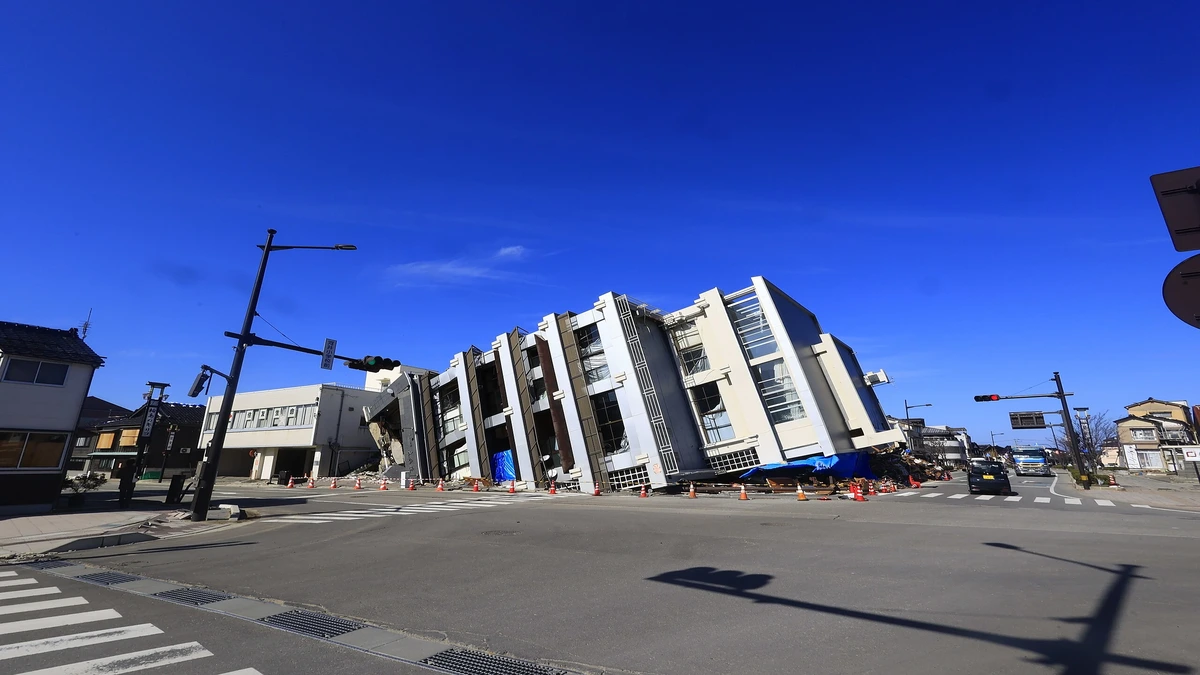
The buried remains of the fire created the strongest inland earthquake in Japan in decades
A dense mass of ancient magma, solidified under Japan's Noto Peninsula, may have played a crucial role in amplifying the M7.6 earthquake that struck on January 1, 2024. Researchers from Tohoku University report that the 15-million-year-old solid rock acted as a stress trap and rupture barrier, concentrating energy in the fragile crust above it.
The quake occurred at 16:10 JST (07:10 UTC) and reached the Japan Meteorological Agency's maximum intensity level of Shindo 7. The JMA measured a local magnitude (Mj) of 7.6 and a depth of 16 km (10 miles), while moment magnitude estimates place it near 7.5 Mj.
More than 1,200 buildings were damaged and water levels on parts of the coast rose by about 1 meter (3.3 feet), making it one of the most devastating inland earthquakes in Japan in recent memory. However, the area, known for its tranquil hills and hot springs, is far from any active volcano or major plate boundary, leaving scientists searching for a deeper cause.
The new study, published in the journal Science Advances in October 2025, suggests that a hidden magma body — once molten and now a mass of dense crystalline rock — was the missing piece. According to seismic imaging, it lies directly below the fault system that ruptured, extending approximately 10-15 kilometers (6-9 miles) wide and reaching about 15 kilometers (9 miles) underground.
Imaging the invisible: How scientists found buried magma
To investigate the origins of the quake, the team used advanced 3D seismic tomography combined with Japan's dense seismic monitoring network. The data revealed an unusually high-velocity region beneath the rupture zone, where seismic waves travel much faster than the surrounding crust.
Such high velocities usually indicate the presence of embedded igneous material rather than loose sediment. The researchers concluded that this structure represents an intrusion of magma dating back to the Miocene era, which cooled and solidified during a period of intense volcanic activity about 15 million years ago, when the Sea of Japan was opening up.
Tomography images show that this ancient magma body has remained very intact and solid. Unlike the crushed rock surrounding it, the object resists deformation and fluid movement. This rigidity allows it to store pressure for long periods, creating the ideal conditions for sudden release once its edges fail.
Maps of aftershocks confirm this relationship. Clusters of smaller earthquakes define the boundaries of the high-velocity zone, indicating that the main shock exploded along its boundaries and then propagated outward into weaker crust. The geometry matches the rupture level of the main event and the distribution of subsequent aftershocks determined by the Japan National Seismic Network.
The three-year swarm that heralds disaster
Before the main shock in 2024, the region had been turbulent for years. Starting in late 2019, the northeastern Noto Peninsula experienced a swarm of earthquakes that generated more than 10,000 small tremors. The activity gradually migrated upward from a depth of about 15 kilometers (9 miles) to a depth of 5 kilometers (3 miles).
Geophysicists had suspected that the swarm was driven by deep crustal fluids rising from the lower crust or mantle. Each minor earthquake was a minor adjustment as these fluids tried to escape through the fractures. But the swarm repeatedly stopped at a certain depth, the same depth at which the solidified magma body was located.
The new analysis connects these points. The magma body appears to have acted as a hydraulic and mechanical barrier, blocking the fluid path. Pressure builds up underneath, just like water pressure on a dam. Over three years, pressure built up around the edges of the barrier until it could no longer contain the forces.
When the edge of the magma body finally ruptured on January 1, 2024, it released the stored pressure in one violent explosion. This failure triggered successive fault slips that propagated across the fragile crust, creating a large-scale earthquake that was detected at the surface.
Ancient magma and modern pressure: how to remember geology
Today the Noto Peninsula shows no active volcanic activity, but geological records reveal that the area was once a magma corridor. About 15 million years ago, the back-arc extension of the Sea of Japan produced widespread volcanic and plutonic activity across northern Honshu.
As this volcanic system cooled, it left behind bodies of dense igneous rock covered by sedimentary crust. Over geological time, tectonic pressure replaced extension, turning these once molten areas into solid inclusions that deformed differently from their surroundings.
These contradictions can trap tension and modify faulty behavior. In Noto's case, the presence of a powerful, impermeable magma mass changed how fluids and stress accumulated, delaying rupture but ultimately increasing its release. The researchers point out that these fossil magma bodies are not rare, yet their seismic role is often overlooked.
Understanding this long-term memory of the Earth's crust could reshape how scientists assess earthquake risk. Even in areas far from active volcanoes, remnants of ancient magma may still influence when and how major earthquakes occur.
Asaichi Street in Wajima City, Ishikawa Prefecture was damaged by fire caused by the 2024 Noto Peninsula earthquake. Photographed on February 17, 2024. Source: Hurohukidaikon Why this discovery is important for risk science
Recognizing the role of solidified magma bodies could transform seismic hazard analysis in Japan and other intraplate regions. Traditional models focus on fault geometry and regional stress, but rarely include variations in crustal composition.
If ancient magma seeps can act as pressure traps, identifying them becomes vital. High-velocity anomalies, detected through seismic or magnetic surveys, can identify hidden areas where large earthquakes are likely to occur. Incorporating such data into hazard maps would allow engineers and planners to improve building codes and land use guidelines.
The three-year swarm that preceded the Noto event also provides a practical lesson. Persistent seismic swarms, which repeatedly stop at constant depths, may indicate blockage of fluid paths and serve as early warning signals for future major shocks. Improved swarm monitoring, combined with subsurface imaging, could one day provide more reliable forecasts.
Globally, the same principle might apply in Italy, Iceland, or East Africa, where extinct volcanic systems lie beneath active rift zones. By linking geological history with modern geophysics, scientists can better predict where Earth's deep memory might resurface.
Unanswered questions and next steps
While the evidence for a high-velocity magma body beneath Noto is strong, many uncertainties remain. The exact shape and composition of the structure were inferred from seismic data, and have not been confirmed by drilling. Sampling future wells or magnetic imaging can improve their geometry and physical properties.
The role of fluids also remains partly speculative. Although swarm migration and ground uplift indicate fluid movement, direct geochemical sampling is still lacking. Determining the sources and pressures of fluids would help clarify how they interact with solid magma bodies.
Another question concerns causality. The study suggests that rupture of the magma body contributed to the main shock, but regional tectonic pressure alone could have eventually triggered a large earthquake. The magma body likely intensified the event rather than directly causing it.
The researchers plan to continue monitoring post-earthquake deformation and gas emissions around the peninsula. Any long-term rise or gas anomaly can provide additional evidence of fluid redistribution following barrier failure.
A deeper look into Earth's memory
The 2024 Noto Peninsula earthquake reveals how the planet's ancient volcanic geometry still shapes modern seismic behavior. What was once molten fire beneath the Miocene crust now governs how that crust breaks.
For scientists, the discovery is a reminder that Earth doesn't forget easily. Solidified magma, which has cooled for millions of years, still has the ability to reshape the surface in an instant. Understanding these hidden interactions between ancient rocks and current pressure may be the key to predicting future disasters more accurately.
References:
1 Rupture of ancient, solidified magma that impeded previous swarm migrations led to the 2024 Noto earthquake – Ryota Takagi et al. – Scientific Progress – October 15, 2025 – DOI: 10.1126/sciadv.adv5938 – Open Access
|
Sources 2/ https://watchers.news/epicenter/ancient-magma-chamber-fueled-japans-2024-noto-earthquake/ The mention sources can contact us to remove/changing this article |
What Are The Main Benefits Of Comparing Car Insurance Quotes Online
LOS ANGELES, CA / ACCESSWIRE / June 24, 2020, / Compare-autoinsurance.Org has launched a new blog post that presents the main benefits of comparing multiple car insurance quotes. For more info and free online quotes, please visit https://compare-autoinsurance.Org/the-advantages-of-comparing-prices-with-car-insurance-quotes-online/ The modern society has numerous technological advantages. One important advantage is the speed at which information is sent and received. With the help of the internet, the shopping habits of many persons have drastically changed. The car insurance industry hasn't remained untouched by these changes. On the internet, drivers can compare insurance prices and find out which sellers have the best offers. View photos The advantages of comparing online car insurance quotes are the following: Online quotes can be obtained from anywhere and at any time. Unlike physical insurance agencies, websites don't have a specific schedule and they are available at any time. Drivers that have busy working schedules, can compare quotes from anywhere and at any time, even at midnight. Multiple choices. Almost all insurance providers, no matter if they are well-known brands or just local insurers, have an online presence. Online quotes will allow policyholders the chance to discover multiple insurance companies and check their prices. Drivers are no longer required to get quotes from just a few known insurance companies. Also, local and regional insurers can provide lower insurance rates for the same services. Accurate insurance estimates. Online quotes can only be accurate if the customers provide accurate and real info about their car models and driving history. Lying about past driving incidents can make the price estimates to be lower, but when dealing with an insurance company lying to them is useless. Usually, insurance companies will do research about a potential customer before granting him coverage. Online quotes can be sorted easily. Although drivers are recommended to not choose a policy just based on its price, drivers can easily sort quotes by insurance price. Using brokerage websites will allow drivers to get quotes from multiple insurers, thus making the comparison faster and easier. For additional info, money-saving tips, and free car insurance quotes, visit https://compare-autoinsurance.Org/ Compare-autoinsurance.Org is an online provider of life, home, health, and auto insurance quotes. This website is unique because it does not simply stick to one kind of insurance provider, but brings the clients the best deals from many different online insurance carriers. In this way, clients have access to offers from multiple carriers all in one place: this website. On this site, customers have access to quotes for insurance plans from various agencies, such as local or nationwide agencies, brand names insurance companies, etc. "Online quotes can easily help drivers obtain better car insurance deals. All they have to do is to complete an online form with accurate and real info, then compare prices", said Russell Rabichev, Marketing Director of Internet Marketing Company. CONTACT: Company Name: Internet Marketing CompanyPerson for contact Name: Gurgu CPhone Number: (818) 359-3898Email: [email protected]: https://compare-autoinsurance.Org/ SOURCE: Compare-autoinsurance.Org View source version on accesswire.Com:https://www.Accesswire.Com/595055/What-Are-The-Main-Benefits-Of-Comparing-Car-Insurance-Quotes-Online View photos

 |
 |
 |