
Politics
The British political class took this signal as noise
In Focus provides deeper coverage of the political, cultural and ideological issues shaping America. Published daily by seasoned editors and experts, these in-depth articles go beyond the headlines to give readers the complete picture. You can find our full parts list In Focus here.
Since David Cameron resigned after the 2016 referendum, Britain has seen Theresa May, Boris Johnson, Liz Truss, Rishi Sunak, Keir Starmer and soon another prime minister. Yet British voters have only directly elected three governments during this period. Most of the change occurred at Westminster, as the governing parties replaced their own leaders.
This distinction is important.
The audience was remarkably consistent. This is not the case with Westminster.
Much of the British political establishment treated the Brexit referendum as an emotional protest or a misunderstanding of economics. Many voters saw something different. They wanted greater control over immigration, borders and national decision-making.
Brexit answered a constitutional question: who should govern Britain? But the nation has never answered the most difficult question: how should Britain govern itself?
Recovering sovereignty has proven easier than exercising it.
A decade of rotating leadership followed. May has struggled to achieve a Brexit acceptable to both parties. Johnson completed Britain’s formal departure from the European Union, but failed to deliver the broader transformation expected by many supporters.
Truss’s premiership collapsed almost immediately. Sunak restored some stability without restoring public confidence. Starmer came into office promising his skills and discovered that it is easier to win elections than to solve deep-rooted problems.
The continuity is striking. Prime ministers have changed, but much of the government consensus has remained.
Since the Tony Blair years, governments of both major parties have accepted many of the same assumptions regarding immigration, welfare, human rights and the expansion of the administrative state. The elections produced new leaders. They rarely produced a new model of government.
This partly explains why so many Britons increasingly feel they are choosing different managers for the same system.
Immigration best illustrates the problem. Net migration reached record levels under Conservative Party governments who had promised for years to reduce it. Small boats continued to cross the Channel. The temporary hotels became permanent symbols of a government that seemed incapable of translating its repeated promises into visible results.
Public trust has declined further after scandals in places like Rotherham, Rochdale and Telford convinced many Britons that institutions had become more concerned with avoiding accusations of prejudice than with enforcing the law. For many voters, the scandals reinforced the perception that parts of the administrative state had become more concerned with institutional risk than with government’s most basic responsibility: upholding the law equally.
But immigration is only part of the story. Years of weak economic growth, growing social obligations, strained public services and declining trust in institutions have combined to create a much larger phenomenon. Brexit has not created these problems. This exposed them.
Why do Britain’s political leaders continue to return to ideas of government that large segments of the electorate have repeatedly rejected?
Do they believe that public frustration will fade? Will this demographic shift ultimately reshape politics? Can better messaging save policies voters no longer trust? Or do many sincerely believe that the governance model remains fundamentally sound and simply requires better management?
Whatever the explanation, this trend has become hard to ignore. Voters continue to send essentially the same message. Much of the political class continues to propose different leaders while advocating many of the same assumptions.
Britain is not unique. When mainstream parties repeatedly fail to address the issues voters consistently consider most important, voters rarely become less frustrated. They start looking elsewhere.
</p>
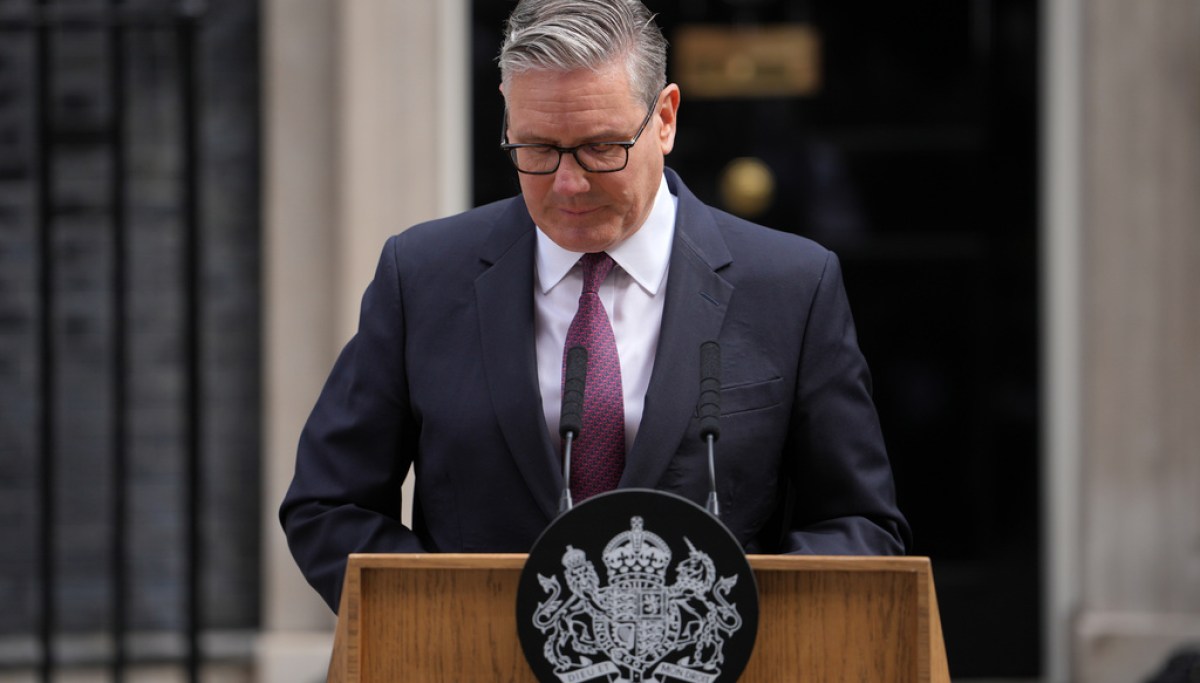
<p>” data-large-file=”https://www.washingtonexaminer.com/wp-content/uploads/2026/06/AP26173343885053.jpg?w=696″ src=”https://www.washingtonexaminer.com/wp-content/uploads/2026/06/AP26173343885053.jpg?w=696″ alt=”Kier Starmer resigns” class=”wp-image-4618322″ srcset=”https://www.washingtonexaminer.com/wp-content/uploads/2026/06/AP26173343885053.jpg 1024w, https://www.washingtonexaminer.com/wp-content/uploads/2026/06/AP26173343885053.jpg?resize=300,200 300w, https://www.washingtonexaminer.com/wp-content/uploads/2026/06/AP26173343885053.jpg?resize=768,512 768w, https://www.washingtonexaminer.com/wp-content/uploads/2026/06/AP26173343885053.jpg?resize=150,100 150w, https://www.washingtonexaminer.com/wp-content/uploads/2026/06/AP26173343885053.jpg?resize=696,464 696w” sizes=”(max width: 1024px) 100vw, 1024px”/><figcaption class=) British Prime Minister Keir Starmer speaks to the media on Monday June 22, 2026, outside 10 Downing Street in London, to announce his resignation. (AP Photo/Kin Cheung)
British Prime Minister Keir Starmer speaks to the media on Monday June 22, 2026, outside 10 Downing Street in London, to announce his resignation. (AP Photo/Kin Cheung)In Britain, this fueled Reform UK. Nigel Farage spent 15 years being dismissed as a protest politician, a provocateur and a figure that serious parties could afford to ignore. Each election seemed to confirm its uselessness. Then suddenly he wasn’t anymore. Reform UK finished third in terms of vote share, with around 14.3%in the 2024 general election. The political class has interpreted the signal as noise for so long that the volume surprised them.
In the United States, frustration has strengthened movements as diverse as Democratic Socialists of America on the left and populist conservatives on the right. Their ideologies differ radically. The mechanism is remarkably similar. Political vacuums rarely remain empty.
America should pay attention.
The United States has a different constitutional system, but the underlying challenge is familiar. Elections create mandates. They do not automatically change institutions, bureaucracies, legal incentives, or deeply ingrained assumptions of government.
President Donald Trump’s victories reflect many of the same frustrations that drove Britain’s Brexit vote. His administration can point to measurable changes at the southern border. Yet sanctuary jurisdictions, court decisions, entrenched bureaucracies, and administrative procedures continue to shape immigration policy long after elections are over. The British experience suggests that gaining office and changing governance are often two very different things.
Soon Britain will have had seven prime ministers in ten years.
That’s not the story.
The fact is that after a decade, British voters are still asking essentially the same question, while much of their political class continues to offer different messengers instead of different answers.
Will the democratic establishment fight back?
History shows that political vacuums rarely remain empty. When governments repeatedly fail to fulfill their most basic responsibilities, voters stop looking for better managers and turn to different movements. This is how Farage and Reform UK moved from the political margins to the center of British politics. This is how insurgent movements from both the left and the right are gaining ground in the United States. The warning is not that these movements exist. It was the warning that made them necessary.
Democracies rarely fail because voters stop speaking. They fail when governments stop listening. Political movements do not emerge because charismatic leaders suddenly appear. They emerge because established institutions repeatedly fail to answer the questions voters refuse to stop asking. When that happens, voters do exactly what democratic systems allow them to do: they look for someone else who will do it.
|
Sources 2/ https://www.washingtonexaminer.com/in_focus/4628964/uk-political-class-mistaking-signal-for-noise/ The mention sources can contact us to remove/changing this article |
What Are The Main Benefits Of Comparing Car Insurance Quotes Online
LOS ANGELES, CA / ACCESSWIRE / June 24, 2020, / Compare-autoinsurance.Org has launched a new blog post that presents the main benefits of comparing multiple car insurance quotes. For more info and free online quotes, please visit https://compare-autoinsurance.Org/the-advantages-of-comparing-prices-with-car-insurance-quotes-online/ The modern society has numerous technological advantages. One important advantage is the speed at which information is sent and received. With the help of the internet, the shopping habits of many persons have drastically changed. The car insurance industry hasn't remained untouched by these changes. On the internet, drivers can compare insurance prices and find out which sellers have the best offers. View photos The advantages of comparing online car insurance quotes are the following: Online quotes can be obtained from anywhere and at any time. Unlike physical insurance agencies, websites don't have a specific schedule and they are available at any time. Drivers that have busy working schedules, can compare quotes from anywhere and at any time, even at midnight. Multiple choices. Almost all insurance providers, no matter if they are well-known brands or just local insurers, have an online presence. Online quotes will allow policyholders the chance to discover multiple insurance companies and check their prices. Drivers are no longer required to get quotes from just a few known insurance companies. Also, local and regional insurers can provide lower insurance rates for the same services. Accurate insurance estimates. Online quotes can only be accurate if the customers provide accurate and real info about their car models and driving history. Lying about past driving incidents can make the price estimates to be lower, but when dealing with an insurance company lying to them is useless. Usually, insurance companies will do research about a potential customer before granting him coverage. Online quotes can be sorted easily. Although drivers are recommended to not choose a policy just based on its price, drivers can easily sort quotes by insurance price. Using brokerage websites will allow drivers to get quotes from multiple insurers, thus making the comparison faster and easier. For additional info, money-saving tips, and free car insurance quotes, visit https://compare-autoinsurance.Org/ Compare-autoinsurance.Org is an online provider of life, home, health, and auto insurance quotes. This website is unique because it does not simply stick to one kind of insurance provider, but brings the clients the best deals from many different online insurance carriers. In this way, clients have access to offers from multiple carriers all in one place: this website. On this site, customers have access to quotes for insurance plans from various agencies, such as local or nationwide agencies, brand names insurance companies, etc. "Online quotes can easily help drivers obtain better car insurance deals. All they have to do is to complete an online form with accurate and real info, then compare prices", said Russell Rabichev, Marketing Director of Internet Marketing Company. CONTACT: Company Name: Internet Marketing CompanyPerson for contact Name: Gurgu CPhone Number: (818) 359-3898Email: [email protected]: https://compare-autoinsurance.Org/ SOURCE: Compare-autoinsurance.Org View source version on accesswire.Com:https://www.Accesswire.Com/595055/What-Are-The-Main-Benefits-Of-Comparing-Car-Insurance-Quotes-Online View photos

 |
 |
 |