
Uncategorized
Changes in the Earth’s outer core revealed by seismic waves from earthquakes
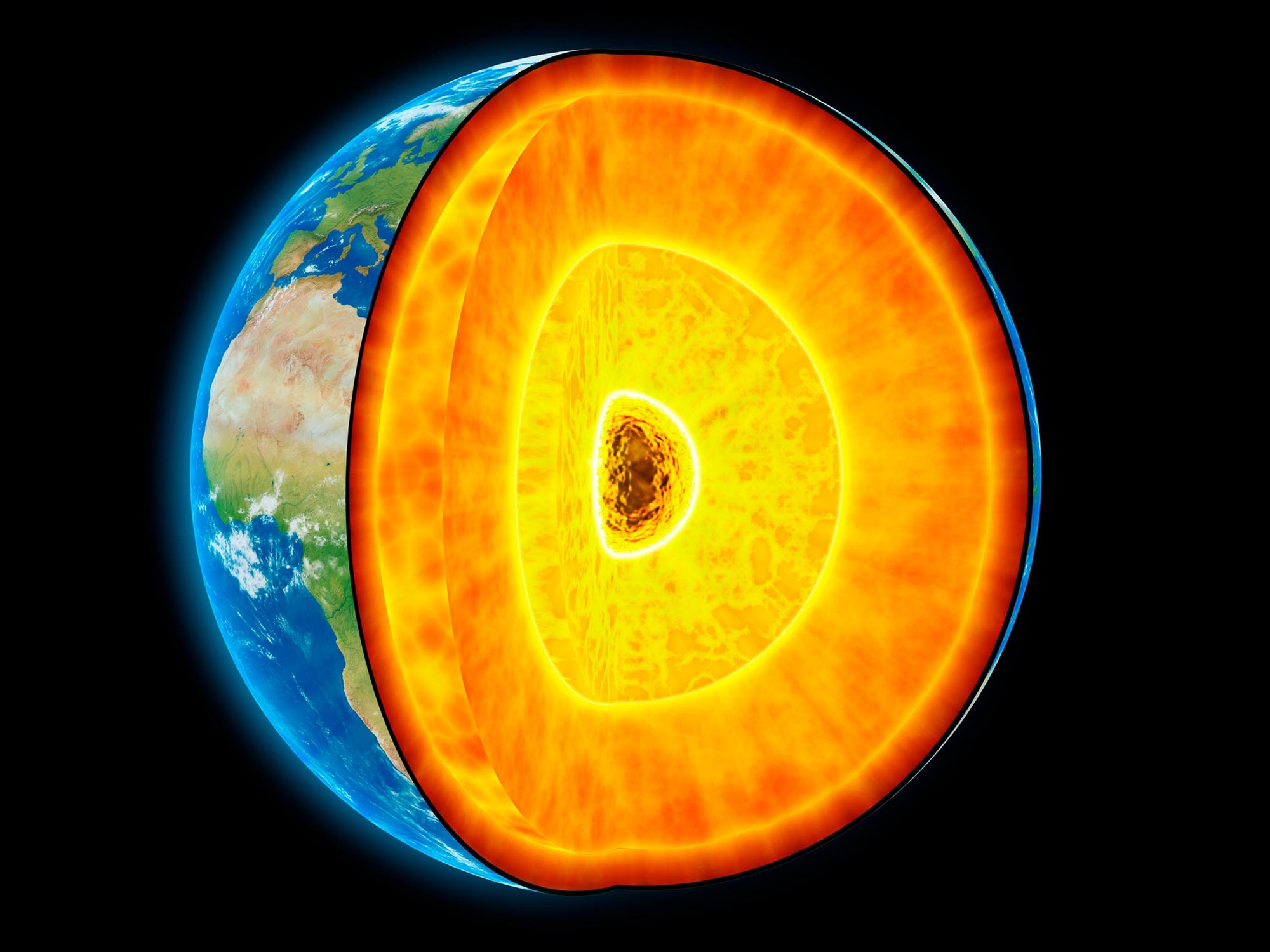
The one-second variance in the travel time of a group of seismic waves gives us an important and unprecedented glimpse into what’s going on deep inside the Earth.
The theory supports our understanding of convection in the Earth’s outer core and its function in controlling the planet’s magnetic field. Scientists have not directly observed convective fluxes or how they might change. Virginia Tech geologist Ying Zhou provides evidence for the first time.
A major earthquake rocked the Kermadec Islands region of the South Pacific in May 1997. Just over 20 years later, in September 2018, a second major earthquake hit the same location, with its waves of seismic energy emanating from the same region.
Although two decades of seismicity separated the earthquakes, because they occurred in the same region, they would be expected to send seismic waves through Earth’s layers at the same speed, said Ying Zhou, a geologist in the Department of Earth Sciences at Virginia Tech. Sciences.
The blue path shows a core-penetrating seismic wave moving through a region in the outer core, where the seismic velocity increased due to transmission of a low-intensity flux into the region. Credit: Ying Zhou from Virginia Tech
However, in data recorded at four of the more than 150 global seismic network stations that record seismic vibrations in real time, Zhou found surprising anomalies between the twin events. During the 2018 earthquake, a group of seismic waves called SKS waves moved about one second faster than their 1997 counterparts.
According to Zhou, whose results were recently published in Nature Communications Earth & Environment, this one-second discrepancy in SKS wave travel time gives us an important and unprecedented glimpse into what’s going on deep in Earth’s interior, in its outer core.
What’s inside matters?
Earth’s outer core lies between the mantle, the thickest layer of rock under the crust, and the inner core, the planet’s deepest inner layer. It consists mostly of liquid iron that undergoes convection, or fluid flow, as the Earth cools. The resulting rotation of the liquid metal produces electric currents that are responsible for generating the Earth’s magnetic field, called the magnetosphere, which protects the planet and all life on it from harmful radiation and the solar wind.
Without its magnetosphere, the Earth could not sustain life, and without the moving flow of liquid metal in the outer core, the magnetic field would not work. The scientific understanding of this dynamic relies on simulation, said Zhou, associate professor. “We know that only in theory, if you had convection in the outer core, you would be able to generate the magnetic field,” she said.
The blue lines are seismic rays in the outer core, as core-penetrating seismic waves moved through that region faster in 2018 than they did in 1997. Credit: Image courtesy of Ying Zhou
The scientists were also only able to speculate on the source of the gradual changes in strength and direction of the magnetic field observed, which likely include changing fluxes in the outer core.
“If you look at the magnetic north pole, it’s currently moving at about 50 kilometers (31 miles) per year,” Chu said. “It’s moving away from Canada and toward Siberia. The magnetic field isn’t the same every day. It changes. Because it changes, we would also expect convection in the outer core to change over time, but there’s no direct evidence. We haven’t seen it before.”
Chu set out to find this clue. She said the changes taking place in the outer core aren’t dramatic, but are worth emphasizing and basic understanding. In seismic waves and their changes in velocity on a time scale of a decade, Zhou saw a way to “directly sample” the outer core. This is because the SKS waves you studied pass through them.
“SKS” represents three phases of the wave: first it passes through the mantle as an S wave, or shear wave; then in the outer core as a compressive wave; Then they recede through the mantle as an S wave. The speed of travel of these waves depends in part on the density of the outer core in their path. If the intensity is lower in an area of the outer core where the wave penetrates, the wave will travel faster, just as the SKS anomalous waves did in 2018.
“Something has changed along that wave’s path, so it can go faster now,” Chu said.
Ying Zhou of Virginia Tech’s Department of Geosciences. Image source: Ying Zhou
For Chu, the difference in wave velocity refers to areas of low intensity forming in the outer core in the 20 years since the 1997 earthquake. She said the high SKS wave speed during the 2018 earthquake could be attributed to the release of light elements such as hydrogen, carbon and oxygen in the outer core during convection. Convection that occurs when the earth cools.
“The materials that were there 20 years ago are no longer there,” Zhou said. “This is a new material and it is lighter. These lighter elements will move up and change the density in the area they are in.”
For Zhou, this is evidence that movement actually occurs in the core, and that it changes over time, as the scientists hypothesized. “We are able to see it now,” she said. “If we can see it from seismic waves, in the future, we can set up seismic stations and monitor that flow.”
What’s Next
This is Zhou’s next effort. Using a wave measurement method known as interferometry, her team plans to analyze continuous seismic recordings from two seismic stations, one of which will serve as a “virtual” earthquake source, she said.
“We can use earthquakes, but the limitation of relying on earthquake data is that we can’t control earthquake locations,” Zhou said. But we can control the locations of seismic stations. We can place the stations anywhere we want, so that the wave path from one station to the other passes through the outer core. If we watch it over time, we can see how core-penetrating seismic waves change between these two stations. With that, we will be better able to see the movement of fluids in the outer core over time.”
Reference: “Transient variation in seismic wave velocity points to rapid fluid motion in the Earth’s outer core” by Ying Zhou, April 25, 2022, Earth and Environment Communications. DOI: 10.1038 / s43247-022-00432-7
|
Sources 2/ https://scitechdaily.com/changes-in-earths-outer-core-revealed-by-seismic-waves-from-earthquakes/ The mention sources can contact us to remove/changing this article |
What Are The Main Benefits Of Comparing Car Insurance Quotes Online
LOS ANGELES, CA / ACCESSWIRE / June 24, 2020, / Compare-autoinsurance.Org has launched a new blog post that presents the main benefits of comparing multiple car insurance quotes. For more info and free online quotes, please visit https://compare-autoinsurance.Org/the-advantages-of-comparing-prices-with-car-insurance-quotes-online/ The modern society has numerous technological advantages. One important advantage is the speed at which information is sent and received. With the help of the internet, the shopping habits of many persons have drastically changed. The car insurance industry hasn't remained untouched by these changes. On the internet, drivers can compare insurance prices and find out which sellers have the best offers. View photos The advantages of comparing online car insurance quotes are the following: Online quotes can be obtained from anywhere and at any time. Unlike physical insurance agencies, websites don't have a specific schedule and they are available at any time. Drivers that have busy working schedules, can compare quotes from anywhere and at any time, even at midnight. Multiple choices. Almost all insurance providers, no matter if they are well-known brands or just local insurers, have an online presence. Online quotes will allow policyholders the chance to discover multiple insurance companies and check their prices. Drivers are no longer required to get quotes from just a few known insurance companies. Also, local and regional insurers can provide lower insurance rates for the same services. Accurate insurance estimates. Online quotes can only be accurate if the customers provide accurate and real info about their car models and driving history. Lying about past driving incidents can make the price estimates to be lower, but when dealing with an insurance company lying to them is useless. Usually, insurance companies will do research about a potential customer before granting him coverage. Online quotes can be sorted easily. Although drivers are recommended to not choose a policy just based on its price, drivers can easily sort quotes by insurance price. Using brokerage websites will allow drivers to get quotes from multiple insurers, thus making the comparison faster and easier. For additional info, money-saving tips, and free car insurance quotes, visit https://compare-autoinsurance.Org/ Compare-autoinsurance.Org is an online provider of life, home, health, and auto insurance quotes. This website is unique because it does not simply stick to one kind of insurance provider, but brings the clients the best deals from many different online insurance carriers. In this way, clients have access to offers from multiple carriers all in one place: this website. On this site, customers have access to quotes for insurance plans from various agencies, such as local or nationwide agencies, brand names insurance companies, etc. "Online quotes can easily help drivers obtain better car insurance deals. All they have to do is to complete an online form with accurate and real info, then compare prices", said Russell Rabichev, Marketing Director of Internet Marketing Company. CONTACT: Company Name: Internet Marketing CompanyPerson for contact Name: Gurgu CPhone Number: (818) 359-3898Email: [email protected]: https://compare-autoinsurance.Org/ SOURCE: Compare-autoinsurance.Org View source version on accesswire.Com:https://www.Accesswire.Com/595055/What-Are-The-Main-Benefits-Of-Comparing-Car-Insurance-Quotes-Online View photos

 |
 |
 |