
Uncategorized
Watching the Volcano: Seismologists shed light on the processes occurring in the depths beneath Pahala
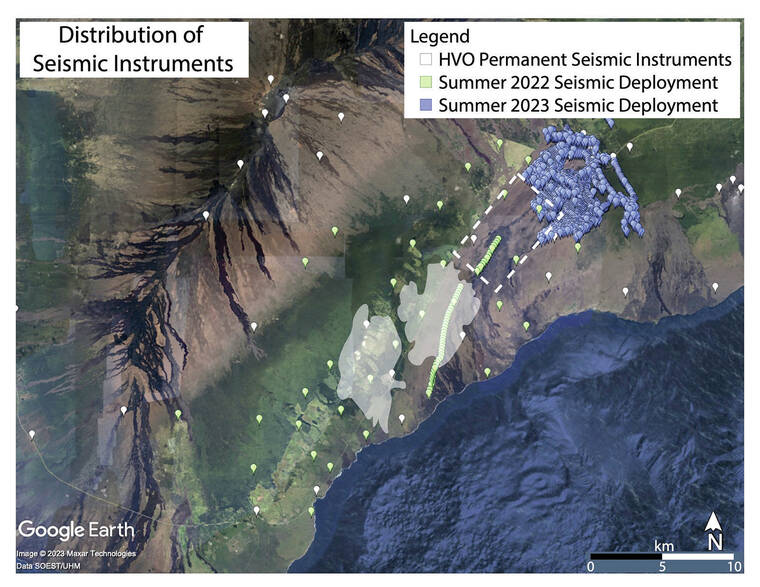
Pahala, a town located in the southeastern part of the island of Hawaii, is located above the most seismically active area of the state. In the past five years, the average weekly number of earthquakes has increased from about 60 to 600 earthquakes per week.
These frequent earthquakes occur in the depths of the Pahala region at depths of 20 to 40 kilometers (12 to 25 miles). Larger-scale events are regularly felt by residents living within Pahala and across the island.
In a 2015 study, scientists at the USGS identified and classified earthquakes in this region into two main groups.
The most persistent seismic tremor, a type of signal often used to track magma movement within a volcanic system, was identified at a depth of approximately 40 km (25 miles), in and outside the Pahala region. This activity has been interpreted as the migration of magma from the depths of the Hawaiian hotspot to shallower depths.
Above this deep zone of seismic activity, a zone of volcanic-tectonic (VT) tremors (indicating rock fracture) is observed extending from this earthquake zone to the depths of Kilauea. Based on the linear trend of this seismic activity, USGS scientists have suggested that this distribution of earthquakes represents an underground magma migration pathway from storage below Pahala toward Kilauea Peak. However, the evidence supporting this hypothesis was limited to a single series of VT events.
A recently released study by seismologists at the California Institute of Technology (CalTech) has shed new light on the processes occurring deep within the Pahala region. These scientists used newly developed machine learning (computer systems that analyze large data sets and identify key patterns in the data) to identify a large number of extremely small earthquakes (microquakes) occurring below the Pahala region that had not previously been cataloged by the Hawaii Volcano Observatory. This subtle tendency is too small to be determined using the instrumental methods normally used to detect earthquakes.
Many of these events are VT earthquakes located within the deep Pahala seismic zone previously identified by USGS scientists. This large number of newly identified VT events define what appears to be a region of horizontally layered magma storage deep beneath Pahala, called the sill complex.
Further supporting this idea, long-term earthquakes (which are indicative of the movement of fluids such as magma) have been seen to occur within these sills. Together, these observations show that the deep earthquakes below Pahala are consistent with magma migration and storage within this threshold complex.
The CalTech study also identified a limited number of VT events extending from the Threshold Complex to the magma storage area below Kilauea Summit. The authors suggested that this distribution of seismicity may represent a potential magma pathway from the deep Pahala Threshold complex to the Kilauea magma storage reservoir. However, more evidence is needed to support or refute this hypothesis.
The Hawaii Volcano Observatory (HVO) is conducting two large seismic experiments in the area to better understand the seismic and volcanic activity in the Pahala and Kilauea regions. In the summer of 2022, 86 temporary seismic instruments will be deployed throughout Pahala to record earthquakes occurring within this region for a period of three months. In the summer of 2023, it is proposed that approximately 1,600 temporary seismic instruments be deployed across Kilauea Summit to record seismic signals for six weeks.
These dense temporary deployments will record seismic activity across the Kilauea and Pahala regions more accurately than the network of permanent HVO instruments. HVO seismologists will analyze this seismic data to understand whether magma stored within the active Pahala Threshold complex is connected, and thus a source of magma for Kilauea volcano.
Volcano activity updates
Killua explodes. USGS Volcano Alert Level at WATCH. Kilauea updates are released daily.
Kilauea volcano’s summit eruption continues in Halimau Crater within Hawaii Volcanoes National Park, with vents erupting in the central-eastern part of the crater floor. The slope of the top has shown several deflationary/inflationary trends over the past week. Seismic activity at the summit remains low and there is volcanic tremor (a signal associated with fluid motion). Sulfur dioxide emissions were measured at 3,500 tons per day on January 9. For Kilauea monitoring data, see https://www.usgs.gov/volcanoes/Kilauea/past-week-monitoring-data-Kilauea.
Mauna Loa does not erupt. USGS Volcano Alert Level in ADVISORY. Mauna Loa updates are released weekly on Thursdays.
The webcams show no signs of Mauna Loa activity. Seismicity is still low. Ground deformation rates and sulfur dioxide (SO2) emission rates at background levels. For Mauna Loa monitoring data, see: https://www.usgs.gov/volcanoes/mauna-loa/monitoring-data.
There have been three earthquakes with 3 or more reports in the Hawaiian Islands during the past week: M3.1 earthquake 4 km (2 mi) southwest of Pahala at a depth of 31 km (19 mi) on January 9 at 11:23 am HST, M3 earthquake. 3 5 km (3 mi) WSW from the volcano at a depth of 0 km (0 mi) on January 5 at 3:28 p.m. HST, and a M2.2 earthquake 5 km (3 mi) south of the volcano at a depth of 0 km (0 Mel) on January 5 at 3:25 p.m. HST.
HVO continues to closely monitor the ongoing eruption on Kilauea and Mauna Loa.
Please visit the HVO website to see previous Volcano Watch articles, Kilauea and Mauna Loa updates, volcano photos, maps, recent earthquake information, and more. Email questions to [email protected].
Volcano Watch is a weekly article and activity update written by scientists at the US Geological Survey’s Hawaiian Volcano Observatory and its affiliates.
|
Sources 2/ https://www.hawaiitribune-herald.com/2023/01/15/features/volcano-watch-seismologists-shed-light-on-processes-occurring-deep-beneath-pahala/ The mention sources can contact us to remove/changing this article |
What Are The Main Benefits Of Comparing Car Insurance Quotes Online
LOS ANGELES, CA / ACCESSWIRE / June 24, 2020, / Compare-autoinsurance.Org has launched a new blog post that presents the main benefits of comparing multiple car insurance quotes. For more info and free online quotes, please visit https://compare-autoinsurance.Org/the-advantages-of-comparing-prices-with-car-insurance-quotes-online/ The modern society has numerous technological advantages. One important advantage is the speed at which information is sent and received. With the help of the internet, the shopping habits of many persons have drastically changed. The car insurance industry hasn't remained untouched by these changes. On the internet, drivers can compare insurance prices and find out which sellers have the best offers. View photos The advantages of comparing online car insurance quotes are the following: Online quotes can be obtained from anywhere and at any time. Unlike physical insurance agencies, websites don't have a specific schedule and they are available at any time. Drivers that have busy working schedules, can compare quotes from anywhere and at any time, even at midnight. Multiple choices. Almost all insurance providers, no matter if they are well-known brands or just local insurers, have an online presence. Online quotes will allow policyholders the chance to discover multiple insurance companies and check their prices. Drivers are no longer required to get quotes from just a few known insurance companies. Also, local and regional insurers can provide lower insurance rates for the same services. Accurate insurance estimates. Online quotes can only be accurate if the customers provide accurate and real info about their car models and driving history. Lying about past driving incidents can make the price estimates to be lower, but when dealing with an insurance company lying to them is useless. Usually, insurance companies will do research about a potential customer before granting him coverage. Online quotes can be sorted easily. Although drivers are recommended to not choose a policy just based on its price, drivers can easily sort quotes by insurance price. Using brokerage websites will allow drivers to get quotes from multiple insurers, thus making the comparison faster and easier. For additional info, money-saving tips, and free car insurance quotes, visit https://compare-autoinsurance.Org/ Compare-autoinsurance.Org is an online provider of life, home, health, and auto insurance quotes. This website is unique because it does not simply stick to one kind of insurance provider, but brings the clients the best deals from many different online insurance carriers. In this way, clients have access to offers from multiple carriers all in one place: this website. On this site, customers have access to quotes for insurance plans from various agencies, such as local or nationwide agencies, brand names insurance companies, etc. "Online quotes can easily help drivers obtain better car insurance deals. All they have to do is to complete an online form with accurate and real info, then compare prices", said Russell Rabichev, Marketing Director of Internet Marketing Company. CONTACT: Company Name: Internet Marketing CompanyPerson for contact Name: Gurgu CPhone Number: (818) 359-3898Email: [email protected]: https://compare-autoinsurance.Org/ SOURCE: Compare-autoinsurance.Org View source version on accesswire.Com:https://www.Accesswire.Com/595055/What-Are-The-Main-Benefits-Of-Comparing-Car-Insurance-Quotes-Online View photos

 |
 |
 |