
Uncategorized
Are the Himalayas facing an imminent massive earthquake, and millions of people will die?
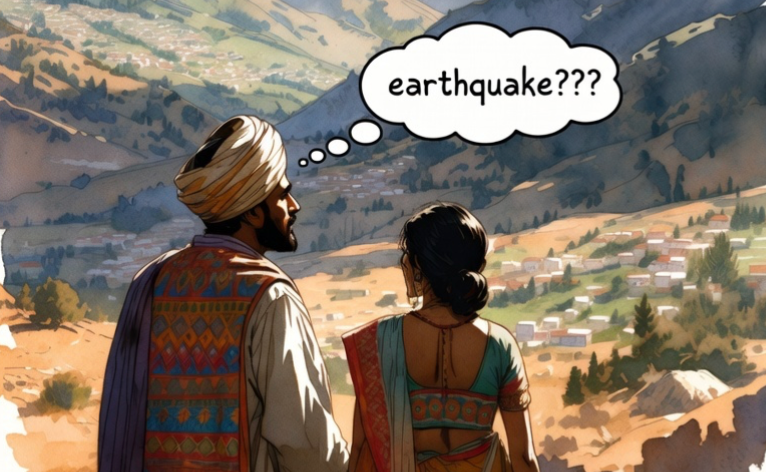
The media and social media are abuzz with alarming headlines claiming that much of India is now at high risk of massive earthquakes and that millions of people could die. Some videos and social media posts make it look as if the Himalayas will suddenly explode under our feet and above our heads, engulfing northern and northeastern India and killing the majority of the Indian population living in the foothills of the mountain range and the river plains that originate from them.
But the reality is a bit less dramatic.
On November 28, India released a new updated seismic zone map, as part of the revised Seismic Design Code, by the Bureau of Indian Standards (BIS). The new map places the entire Himalayan region under Zone VI, the most dangerous zone, for the first time. This also means that about 75% of India's population now lives in seismically active areas, and 61% of India's land area is now at risk of earthquakes.
But even this is not as worrying as it seems. Because for Indonesia, and almost the entire nation, 100% of its land area is “seismically active”. They are literally sitting on top of the ring of fire. They experienced 2,212 earthquakes in 2023 and 1,872 in 2024. Every week, some volcanoes start hissing and puffing, spewing lava around. They have about 130 active volcanoes and live happily with them. The same is true for Japan, and even China has 65% of its land area falling under the “seismically active” classification.
However, the devil is in the details. Tectonic facts in the Indian subcontinent have remained unchanged for millions of years. The news is that we are now changing how our landmass is classified by seismic activity, using the latest scientific data and ensuring the best possible preparation.
India's seismic map was first drawn in 1962.
The new map represents a radical shift in assessing seismic risk in India, because 61% of the country now falls under medium to high hazard zones. The new sixth region now extends from Jammu and Kashmir in the west to Arunachal Pradesh in the east. Although the Himalayan region was known to be a generally seismically active region, previous classification divided this region into a combination of Zone IV and Zone V.
What is the classification and what does zone six (highest risk) mean?
In a seismic zoning system, zones indicate the expected intensity of ground shaking during an earthquake, based on factors such as peak ground acceleration (PGA). High-risk areas require more stringent safety measures and design rules to reduce damage to property and loss of life. This essentially means more steel and deeper foundations, apart from more stringent planning standards over a larger area of the country.
The updated map takes into account major earthquakes that occurred in the larger region, such as the Nepal in 2015, and the Turkish-Syrian earthquake in 2023. The updated design rules take into account geological aspects, such as Himalayan Frontal Thrust (HFT), locked fault segments that accumulate stresses for more than 200 years, especially in the Central Himalayas, seismic gaps and the potential for ruptures to propagate from central to outer regions.
The new map also automatically classifies border cities between seismic zones into a higher-risk zone, unlike the previous system that relied on administrative boundaries.
The classification of the area is as follows:
Seismic zoneDanger levelZones (typical examples)Zone IILow Mild shaking expectedCentral India and parts of South India, MP, RajasthanZone IIIModerate shakingMumbai and parts of northern Odisha and JharkhandZone IVHighStrong shaking possibleDelhi NCR, Kolkata, Patna, GandhinagarZone VVery highVery strong shakingEastern Ladakh, Himalayan foothillsZone VI (new introduction)ExtremeMajor earthquakes (M8+) PotentialThe entire Himalayan arc: Kashmir-Himachal-Uttarakhand-Nepalese border region-Sikkim-Arunachal
The new Zone VI classification means that the entire Himalayan region is capable of experiencing major earthquakes of magnitude 8 and above on the Richter scale. The possibility of events with a magnitude of 9 in this region is also not excluded.
New seismic map zones, image via Vision IAS New seismic design standard: What does it mean?
The Zone VI classification means that new building and planning standards must be followed in these zones, confirming the highest earthquake resistance requirements in the Indian Building Code (updated IS 1893).
1. All new construction (houses, bridges, hospitals, schools) in District VI must now use improved designs, including higher ductility, better energy dissipation, and structural displacement limits. 2. Stricter land use rules in urban planning, such as halting development on soft soils or areas near faults, taking into account population density and earthquake exposure before implementing narrowing projects. 3. Disaster preparedness drills, audits and early warning systems will now be mandatory in states like Haryana, Punjab, Delhi NCR, Uttarakhand, Himachal Pradesh, Jammu and Kashmir, Sikkim, parts of the North East, Bihar and Uttar Pradesh. 4. The cost of construction will increase because public infrastructure such as schools, bridges, dams, highways and airports will now need better designs and reinforcements which need more expensive building materials. And engineering supervision. 5. Critical infrastructure such as schools and hospitals must now be built to the most stringent earthquake resistance standards, so that they remain safe and effective during earthquakes for better disaster management. Why is the Himalayan region seismically active?
The Himalayas, geologically speaking, are still forming. The Himalayas are one of the most seismically active regions in the world due to the constant tectonic collision that forms the mountain range. The Himalayas are the result of the Indian plate separating from the Gondwana supercontinent and colliding with the Eurasian plate, and this process has been occurring for millions of years. The Indian plate is pushing up towards the Eurasian plate and is moving at a speed of about 5 cm per year.
Image via Nature.com
The contact zone between the two plates is a massive thrust fault system called the Main Himalayan Thrust (MHT). All this violence and unrest dissipates across a series of fault lines, stretching from Delhi to Tibet.
The problem is that most parts of the Himalayas have not been torn apart in a major earthquake in 200 to 700 years, and therefore, scientists believe it is better to be prepared.
Why this is not a declaration of panic, but rather a practical and scientific approach to earthquake preparedness
Words like “highest risk”, “large number of people under threat of earthquakes”, “entire Himalayan region at risk of major earthquakes” etc. circulating in the media may be attractive headlines, but they are misleading. The new zonal rankings are not a panicked announcement, but the most honest and up-to-date reflection of the risks India has ever published.
The Himalayas have been our guardians for thousands of years. It is the cause of the monsoons, the foundation of our civilization, and the creator of our rivers, forests and plains. No matter what the media headlines scream, the mountain range is not going anywhere, and neither will the millions of people in India and Nepal who call the region home. Earthquakes are the reality of the Earth because beneath the surface calm of the Earth we walk on, tectonic plates move over a lava-filled core, the planet's engine tools.
The updated map is a testament to human preparedness, because better equipment, better surveillance and knowledge in the 21st century have made us better able to deal with disasters.
|
Sources 2/ https://www.opindia.com/2025/12/indias-new-earthquake-map-puts-entire-himalayan-region-in-high-risk-zone-what-it-really-means-are-crores-going-to-die/ The mention sources can contact us to remove/changing this article |
What Are The Main Benefits Of Comparing Car Insurance Quotes Online
LOS ANGELES, CA / ACCESSWIRE / June 24, 2020, / Compare-autoinsurance.Org has launched a new blog post that presents the main benefits of comparing multiple car insurance quotes. For more info and free online quotes, please visit https://compare-autoinsurance.Org/the-advantages-of-comparing-prices-with-car-insurance-quotes-online/ The modern society has numerous technological advantages. One important advantage is the speed at which information is sent and received. With the help of the internet, the shopping habits of many persons have drastically changed. The car insurance industry hasn't remained untouched by these changes. On the internet, drivers can compare insurance prices and find out which sellers have the best offers. View photos The advantages of comparing online car insurance quotes are the following: Online quotes can be obtained from anywhere and at any time. Unlike physical insurance agencies, websites don't have a specific schedule and they are available at any time. Drivers that have busy working schedules, can compare quotes from anywhere and at any time, even at midnight. Multiple choices. Almost all insurance providers, no matter if they are well-known brands or just local insurers, have an online presence. Online quotes will allow policyholders the chance to discover multiple insurance companies and check their prices. Drivers are no longer required to get quotes from just a few known insurance companies. Also, local and regional insurers can provide lower insurance rates for the same services. Accurate insurance estimates. Online quotes can only be accurate if the customers provide accurate and real info about their car models and driving history. Lying about past driving incidents can make the price estimates to be lower, but when dealing with an insurance company lying to them is useless. Usually, insurance companies will do research about a potential customer before granting him coverage. Online quotes can be sorted easily. Although drivers are recommended to not choose a policy just based on its price, drivers can easily sort quotes by insurance price. Using brokerage websites will allow drivers to get quotes from multiple insurers, thus making the comparison faster and easier. For additional info, money-saving tips, and free car insurance quotes, visit https://compare-autoinsurance.Org/ Compare-autoinsurance.Org is an online provider of life, home, health, and auto insurance quotes. This website is unique because it does not simply stick to one kind of insurance provider, but brings the clients the best deals from many different online insurance carriers. In this way, clients have access to offers from multiple carriers all in one place: this website. On this site, customers have access to quotes for insurance plans from various agencies, such as local or nationwide agencies, brand names insurance companies, etc. "Online quotes can easily help drivers obtain better car insurance deals. All they have to do is to complete an online form with accurate and real info, then compare prices", said Russell Rabichev, Marketing Director of Internet Marketing Company. CONTACT: Company Name: Internet Marketing CompanyPerson for contact Name: Gurgu CPhone Number: (818) 359-3898Email: [email protected]: https://compare-autoinsurance.Org/ SOURCE: Compare-autoinsurance.Org View source version on accesswire.Com:https://www.Accesswire.Com/595055/What-Are-The-Main-Benefits-Of-Comparing-Car-Insurance-Quotes-Online View photos

 |
 |
 |