
Uncategorized
Can we predict earthquakes? Warning of huge earthquakes in Japan revives global concerns
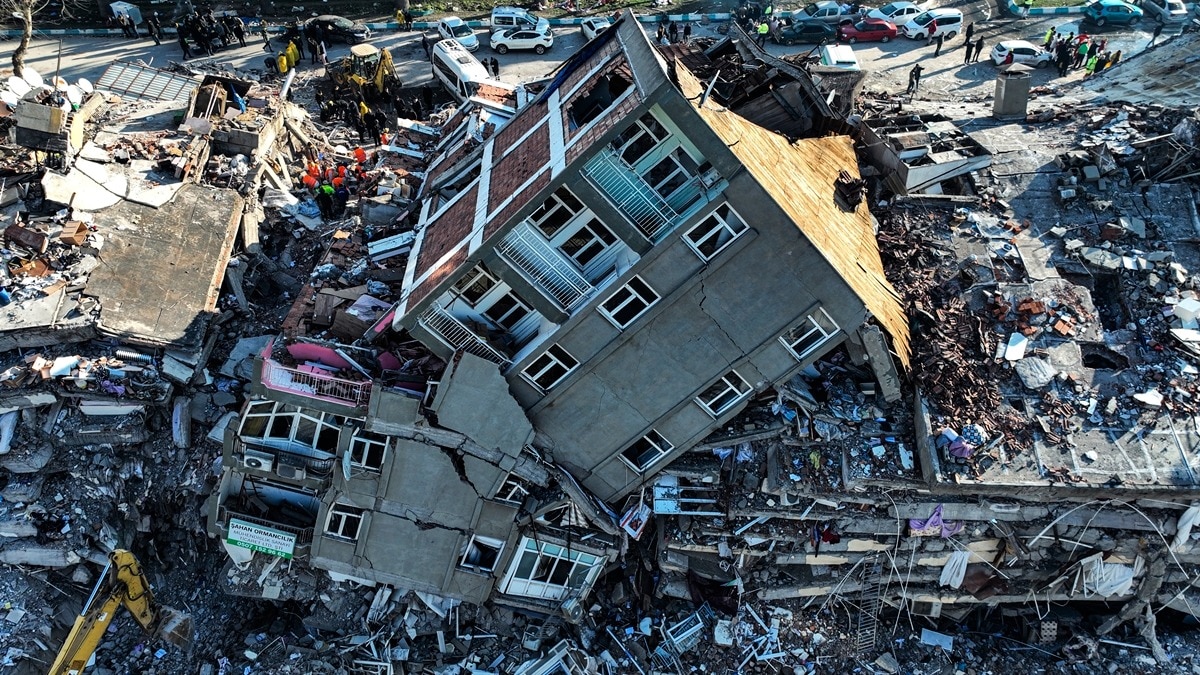
When Japan issued a warning about a possible mega-earthquake, one that could trigger 100-foot tsunami waves and destroy vast swaths of coastline, the world took notice. Japan, after all, is one of the most earthquake-prepared countries on the planet.
But the warning also raised a familiar question: Can earthquakes really be predicted? Closer to home, should India worry about the Himalayas?
Scientists say the answer is much more complex than just yes or no. Today, risk mapping is possible, and early warnings can save lives.
Assumptions or accurate predictions?
Japan sits atop one of the most volatile tectonic zones on Earth, a complex four-arc system made up of deep-ocean trenches and volcanic arcs. Nearly 80% of the country's earthquakes originate here, driven by strong subduction forces.
“The devastating Fukushima earthquake also came from this region,” said Dr OP Mishra, director of the National Center for Seismology. “It shows how the pressure built up in a subduction zone can suddenly break and release tremendous energy.”
The latest Japanese models, built using advanced seismic data, fault simulations, and assessments of shoreline vulnerability, indicate the possibility of an earthquake of magnitude 8 or higher. This analysis is what prompted the issuance of the latest advisory.
However, experts stress that such warnings are not predictions, but rather assessments based on probabilities.
How do earthquakes actually start?
At the heart of every earthquake is a violent release of buried pressure. Dr K Seshagiri Rao, Emeritus Professor of Geology at IIT Delhi, explains that earthquakes occur when rocks deep underground crack and fracture under enormous pressure, and these fractures suddenly spread over a large area, sometimes several kilometers deep.
This rapid sliding releases stored energy in the form of seismic waves that accelerate through the Earth and shake its surface. Networks of seismometers track how these waves travel, helping scientists decipher ground motion and fault structure, and improve models of how future earthquakes will appear.
“Researchers are getting better at identifying patterns that may precede major earthquakes,” he said. “But we still can't pinpoint exactly when the rift will occur.”
Why is Japan at the forefront in surveillance?
Japan lies at the intersection of several tectonic plates and along a complex system of volcanic trenches and arcs, making it one of the most seismically active places on Earth. Dr. O.P. Mishra, director of the National Center for Seismology, points out that nearly 80% of Japanese earthquakes originate along this four-arc system, where dense oceanic plates dive beneath light continental crust.
Decades of devastating earthquakes, including the Fukushima disaster, have prompted Japan to build some of the world's most advanced detection and early warning systems. Quadruple arch system in Japan.
Detailed models of areas such as the Nankai Basin allow authorities to estimate the likelihood of earthquakes and tsunamis of magnitude greater than 8, and reinforce buildings, seawalls and evacuation plans accordingly.
Forecasting versus early warning
Despite this complexity, a true prediction, specifying the exact day, hour and location of a future earthquake, remains elusive.
Much of the action occurs 10 to 20 kilometers underground, beyond the reach of direct instruments, and many of the microfractures and tremors are too small to be detected at the surface. Scientists can identify high-stress parts of faults and say the area is “due” for a major event, but they can't say when that locked section will finally explode.
In practice, what Japan and a few other countries offer is rapid early warning once the earthquake actually begins, giving trains seconds to tens of seconds to stop, surgeries temporarily halted, and people taking cover, not forecasts of the coming days. Japan is located in a very active seismic zone. (Photo: Reuters)
The Himalayas: a different, more complex story
The warning of a massive earthquake in Japan quickly led to speculation about the possibility of a similar disaster in the Himalayas?
According to Professor Sandeep Singh, Head of the Department of Earth Sciences at IIT Roorkee, this is an oversimplification. “Some suggest that a similar earthquake might hit the Himalayas, but this is just an assumption, not an accurate prediction,” he told IndiaToday.in. “The Earth's behavior is highly inconsistent. We know where stress builds up, but no one can say when it will break.”
The Himalayas are among the youngest and most tectonically active mountains in the world, formed as a result of the ongoing collision between the Indian and Eurasian plates. This collision does not occur at one point, but extends over a distance of approximately 2,500 kilometers. Stress builds up over decades or centuries before being released in the form of powerful earthquakes.
Professor Singh added: “Earthquakes are part of the planet’s ongoing process of formation and deformation.” “Geological records show that such events have always occurred.” The Himalayas as seen from space. (Image: NASA)
A huge earthquake in Japan is unlikely to cause a major event in the Himalayan region. The regions are very far apart and separated by vast, sparse plate boundaries. What science can do is highlight that parts of the Himalayan arc are vulnerable to major earthquakes and push governments to mandate earthquake-resistant construction, strengthen early warning and monitoring networks, and prepare communities.
Dr. Mishra points out that the energy from the large Japanese earthquake is unlikely to affect the Himalayan fault system: “The distance is very large, and the faults are not directly connected.”
For now, the uncomfortable truth remains: earthquakes can be predicted in a broad probabilistic sense, but they cannot be predicted accurately.
True strength lies not in guessing the exact moment, but in accepting risk, building on it, and remaining ready when the ground finally moves.
– It ends
Published on:
December 13, 2025
Tune in
|
Sources 2/ https://www.indiatoday.in/science/story/japan-megaquake-warning-great-himalayan-earthquake-tsunami-indian-plate-tectonic-2835220-2025-12-13 The mention sources can contact us to remove/changing this article |
What Are The Main Benefits Of Comparing Car Insurance Quotes Online
LOS ANGELES, CA / ACCESSWIRE / June 24, 2020, / Compare-autoinsurance.Org has launched a new blog post that presents the main benefits of comparing multiple car insurance quotes. For more info and free online quotes, please visit https://compare-autoinsurance.Org/the-advantages-of-comparing-prices-with-car-insurance-quotes-online/ The modern society has numerous technological advantages. One important advantage is the speed at which information is sent and received. With the help of the internet, the shopping habits of many persons have drastically changed. The car insurance industry hasn't remained untouched by these changes. On the internet, drivers can compare insurance prices and find out which sellers have the best offers. View photos The advantages of comparing online car insurance quotes are the following: Online quotes can be obtained from anywhere and at any time. Unlike physical insurance agencies, websites don't have a specific schedule and they are available at any time. Drivers that have busy working schedules, can compare quotes from anywhere and at any time, even at midnight. Multiple choices. Almost all insurance providers, no matter if they are well-known brands or just local insurers, have an online presence. Online quotes will allow policyholders the chance to discover multiple insurance companies and check their prices. Drivers are no longer required to get quotes from just a few known insurance companies. Also, local and regional insurers can provide lower insurance rates for the same services. Accurate insurance estimates. Online quotes can only be accurate if the customers provide accurate and real info about their car models and driving history. Lying about past driving incidents can make the price estimates to be lower, but when dealing with an insurance company lying to them is useless. Usually, insurance companies will do research about a potential customer before granting him coverage. Online quotes can be sorted easily. Although drivers are recommended to not choose a policy just based on its price, drivers can easily sort quotes by insurance price. Using brokerage websites will allow drivers to get quotes from multiple insurers, thus making the comparison faster and easier. For additional info, money-saving tips, and free car insurance quotes, visit https://compare-autoinsurance.Org/ Compare-autoinsurance.Org is an online provider of life, home, health, and auto insurance quotes. This website is unique because it does not simply stick to one kind of insurance provider, but brings the clients the best deals from many different online insurance carriers. In this way, clients have access to offers from multiple carriers all in one place: this website. On this site, customers have access to quotes for insurance plans from various agencies, such as local or nationwide agencies, brand names insurance companies, etc. "Online quotes can easily help drivers obtain better car insurance deals. All they have to do is to complete an online form with accurate and real info, then compare prices", said Russell Rabichev, Marketing Director of Internet Marketing Company. CONTACT: Company Name: Internet Marketing CompanyPerson for contact Name: Gurgu CPhone Number: (818) 359-3898Email: [email protected]: https://compare-autoinsurance.Org/ SOURCE: Compare-autoinsurance.Org View source version on accesswire.Com:https://www.Accesswire.Com/595055/What-Are-The-Main-Benefits-Of-Comparing-Car-Insurance-Quotes-Online View photos

 |
 |
 |