
Uncategorized
Study confirms that hidden clay intensified the 2011 Japan earthquake
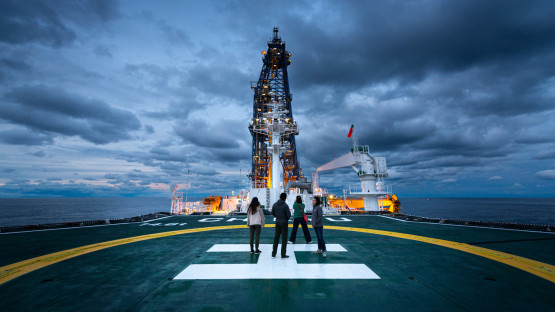
An international research expedition involving Cornell University has revealed new details about why the 2011 earthquake in northeastern Japan behaved so unusually, raising the seafloor and triggering a tsunami that devastated coastal communities along with the Fukushima Daiichi nuclear power plant.
Some of the first published data from the mission were detailed December 18 in the journal Science, finding that in the Japan Trench — the deep-ocean boundary where one tectonic plate dips beneath another — the fault zone narrows to a thin clay-rich layer hidden just beneath the seafloor. This weak layer enabled the 2011 earthquake, dubbed the “megathrust,” to blast all the way into the trench, creating a 50- to 70-meter dip that dislodged large portions of the seafloor.
Patrick Fulton, right, associate professor of Earth and atmospheric sciences at Cornell Engineering, and scientists aboard the Chikyo drillship observe core samples recovered from the Japan Trench.
“This work helps explain why the 2011 earthquake behaved very differently than many of our models predicted,” said study co-author Patrick Fulton, associate professor and Kroll Sesquicentennial Fellow in the Department of Earth and Atmospheric Sciences at Cornell Engineering. “By seeing exactly how a fault zone is created, we can better understand where slip is likely to be concentrated and how likely a tsunami is to occur in a given subduction zone.”
In most subduction zone earthquakes, rupture begins deep on the fault and the amount of slip decreases as the rupture moves upward toward the sea floor. But in 2011, the size of the slip increased as the rupture approached the surface, a surprising result that geologists like Fulton have been trying to explain for more than a decade.
Fulton served as co-chief scientist for the International Ocean Discovery Program's Expedition 405, known as JTRACK, which in 2024 collected study data by deploying a deep-sea research vessel to drill through faults and sediments in the Pacific Plate. The mission achieved a total length of drill pipe of 7,906 meters under the sea surface, which was recognized by the Guinness Book of World Records as the deepest scientific ocean drilling operation ever.
Fulton, who spent nearly two months on board, said the record highlights the ship's technical capabilities and the close collaboration between the Japan Marine-Earth Science and Technology Agency, industry partners and the international scientific team.
The JTRACK mission builds on the results of a previous expedition to the region a year after the earthquake, which identified for the first time the weak nature of the shallow plate boundary fault. Fulton, who was involved in the former Japanese Trench Rapid Drilling Project, said the JTRACK results provide a more complete picture of how the shallow fault zone and incoming sediments are organized.
Sediment samples extracted from the drilling operation revealed a 30-metre-thick layer of surface clay, a very soft and slippery material made up of microscopic particles that has slowly settled to the seafloor over millions of years. With stronger layers surrounding it, the clay acted as a natural “rupture line” that concentrated the rupture along that surface.
“In the Japan Trench, the geological strata essentially determine where the fault will form,” Fulton said. “It becomes a very concentrated and very weak surface, which makes it easier for cracks to propagate all the way to the seafloor.”
Because the surface clay layer extends hundreds of miles along the Japan Trench, Fulton said the region may be more vulnerable to surface earthquakes than previously recognized.
“Ultimately, our goal is to translate this kind of detailed fault zone knowledge into better earthquake and tsunami risk assessments for coastal communities around the world,” Fulton said.
The publication of the study coincided with the release of a 30-minute documentary film about the mission. The film follows Fulton and dozens of scientists during 105 days at sea as they plan, drill, recover core samples and install long-range observatories up to the rift zone.
More data from the mission is set to become publicly available through the International Ocean Discovery Programme.
Sil Kakabir is associate director of marketing and communications at Cornell Engineering.
|
Sources 2/ https://news.cornell.edu/stories/2025/12/hidden-clay-intensified-2011-japan-megaquake-study-confirms The mention sources can contact us to remove/changing this article |
What Are The Main Benefits Of Comparing Car Insurance Quotes Online
LOS ANGELES, CA / ACCESSWIRE / June 24, 2020, / Compare-autoinsurance.Org has launched a new blog post that presents the main benefits of comparing multiple car insurance quotes. For more info and free online quotes, please visit https://compare-autoinsurance.Org/the-advantages-of-comparing-prices-with-car-insurance-quotes-online/ The modern society has numerous technological advantages. One important advantage is the speed at which information is sent and received. With the help of the internet, the shopping habits of many persons have drastically changed. The car insurance industry hasn't remained untouched by these changes. On the internet, drivers can compare insurance prices and find out which sellers have the best offers. View photos The advantages of comparing online car insurance quotes are the following: Online quotes can be obtained from anywhere and at any time. Unlike physical insurance agencies, websites don't have a specific schedule and they are available at any time. Drivers that have busy working schedules, can compare quotes from anywhere and at any time, even at midnight. Multiple choices. Almost all insurance providers, no matter if they are well-known brands or just local insurers, have an online presence. Online quotes will allow policyholders the chance to discover multiple insurance companies and check their prices. Drivers are no longer required to get quotes from just a few known insurance companies. Also, local and regional insurers can provide lower insurance rates for the same services. Accurate insurance estimates. Online quotes can only be accurate if the customers provide accurate and real info about their car models and driving history. Lying about past driving incidents can make the price estimates to be lower, but when dealing with an insurance company lying to them is useless. Usually, insurance companies will do research about a potential customer before granting him coverage. Online quotes can be sorted easily. Although drivers are recommended to not choose a policy just based on its price, drivers can easily sort quotes by insurance price. Using brokerage websites will allow drivers to get quotes from multiple insurers, thus making the comparison faster and easier. For additional info, money-saving tips, and free car insurance quotes, visit https://compare-autoinsurance.Org/ Compare-autoinsurance.Org is an online provider of life, home, health, and auto insurance quotes. This website is unique because it does not simply stick to one kind of insurance provider, but brings the clients the best deals from many different online insurance carriers. In this way, clients have access to offers from multiple carriers all in one place: this website. On this site, customers have access to quotes for insurance plans from various agencies, such as local or nationwide agencies, brand names insurance companies, etc. "Online quotes can easily help drivers obtain better car insurance deals. All they have to do is to complete an online form with accurate and real info, then compare prices", said Russell Rabichev, Marketing Director of Internet Marketing Company. CONTACT: Company Name: Internet Marketing CompanyPerson for contact Name: Gurgu CPhone Number: (818) 359-3898Email: [email protected]: https://compare-autoinsurance.Org/ SOURCE: Compare-autoinsurance.Org View source version on accesswire.Com:https://www.Accesswire.Com/595055/What-Are-The-Main-Benefits-Of-Comparing-Car-Insurance-Quotes-Online View photos

 |
 |
 |