
Uncategorized
Hidden tsunami waves reveal source of powerful earthquake
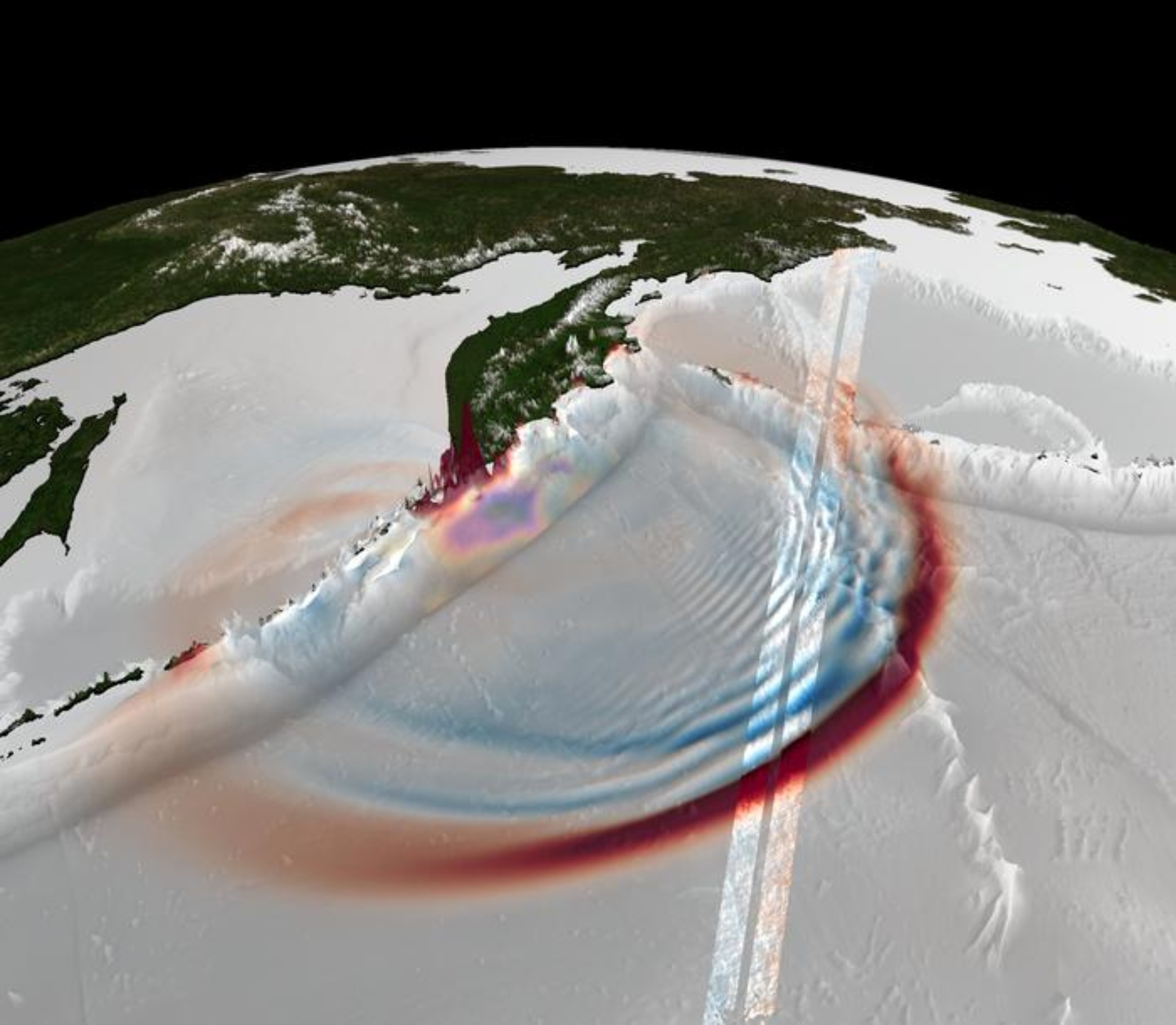
The tsunami triggered by the 2025 earthquake off Russia’s Kamchatka Peninsula carried a shorter second wave signal revealing a rupture 6 miles from the trench.
This hidden tail, discovered in a new study, turns the tsunami itself into a clearer record of where the 8.8 magnitude earthquake struck and why coastal hazards can be misread.
Visible signature after the earthquake
About 70 minutes after the quake, the sea off Kamchatka still bore the mark of that shallow rip in a wide train of cascading waves.
A team led by Ignacio Sepulveda of San Diego State University (SDSU) analyzed satellite images of surface water and ocean topography (SWOT).
Researchers documented the short waves that followed the first peak. Those disturbances showed that the rupture reached the shallowest part of the fault, an area often obscured by standard earthquake and ocean records.
The satellite view pinpointed a portion of the fault that other observations struggle to resolve, revealing the physics that drives the background waves.
Identify the source
Longer tsunami waves accelerate forward while shorter waves are delayed, resulting in dispersion, when wave speed changes with wavelength.
Because the trailing wave packets extended about 31 miles, they behaved differently from the main front and retained a clear, easy-to-read signature.
This pattern narrowed the likely source to a short strip along the trench off southern Kamchatka.
It is difficult to obtain such details from separate instruments alone, which is why the satellite view changed the situation.
What deep-ocean sensors missed
Five nearby depth-ocean assessment and tsunami reporting sensors, or DART sensors, ignited the first front at separate points.
The nearest instrument measured about 4.3 feet from crest to trough, confirming the presence of a strong wave, but not its full shape.
DART pressure records lose some shorter signals in very deep water, and wide gaps leave the distance between stations unresolved.
Satellite data filled that gap by showing direction, curvature and divergence across the surface rather than one reading at a time.
Sliding near the trench
Kamchatka is located in a subduction zone, where one plate slides under another and can suddenly push the sea floor up.
As the rupture approaches the trench, the uplift zone becomes shorter and steeper, resulting in shorter wavelengths.
Scientists have long predicted that this type of source would leave a trailing tail behind the leading wave.
Here, the event provided the first direct space link between that tail and the shallow part of the rupture.
Model testing
The team combined the satellite view with ground motion and marine wave records, then built competing versions of the earthquake.
One version retained the movement near the trench, while another removed it and forced the movement deeper under the plate.
Only the shallow version reconstructed the trailing beams, while the model designed for the long leading wave missed them.
The side-by-side result pinned the single wave train to near-trench motion rather than noise or background ocean motion.
Wider pattern of short wave tails
A previous research paper on the 2023 tsunami near the Loyalty Islands in the southwestern Pacific Ocean had already shown that SWOT can map a wave pattern in two dimensions.
Closer to the source, the satellite saw the turbulence soon enough to say something about the rupture itself.
The SDSU team described another discovery near the Drake Passage, in the waters between South America and Antarctica, hinting that such short wave tails may not be rare.
Instead, scientists may have ignored it, as the satellite would have to pass over the right stretch of ocean at just the right time.
New insights into earthquakes
Better estimates of the source are important because warning systems start by guessing how the seafloor is moving.
If that first guess misses movement near the trench, forecasters could underestimate where water will accumulate fastest near exposed shorelines.
“We are highlighting characteristics of earthquakes that advance our knowledge and may clarify scientific questions for the community,” Sepulveda said.
His team argued that models close to the source should include those delayed short waves when observations show them.
Warnings from space
Unlike older altimetry, which measures sea surface height from orbit, SWOT surveys a broad strip of ocean rather than a single narrow line.
From this broader perspective, researchers read the direction and curvature of the wave simultaneously, often missing clues that pass through a single line.
“This discovery shows the importance of the United States and the world investing in the ability of satellites to measure what is happening on our planet in terms of geohazards,” Sepulveda said.
Early, more complete images won’t stop tsunamis, but they could increase the accuracy of forecasts that guide evacuations.
It is not a stand-alone warning system
The Kamchatka event sent waves across the Pacific Ocean, but the passage close to the source occurred by chance.
SWOT analysis revisits most places about every 11 days on average, so most tsunamis will still rely on other tools.
However, when the timing works, the satellite can check seafloor sensors, coastal gauges, and seismic data.
And every lucky overpass becomes scientifically rich, even if it cannot serve as an independent alarm system.
Seen from orbit, the Kamchatka rupture gave scientists a look at the birth of a tsunami that usually remains hidden.
Future bridges will not replace ground-based sensors, but they may make tsunami source models faster, more compact and more realistic.
The study was published in the journal Science.
Image credit: Bjarke Nilsson
—–
Like what I read? Subscribe to our newsletter to get engaging articles, exclusive content and latest updates.
Visit us at EarthSnap, a free app brought to you by Eric Ralls and Earth.com.
—–
|
Sources 2/ https://www.earth.com/news/hidden-tsunami-waves-reveal-source-of-powerful-earthquake/ The mention sources can contact us to remove/changing this article |
What Are The Main Benefits Of Comparing Car Insurance Quotes Online
LOS ANGELES, CA / ACCESSWIRE / June 24, 2020, / Compare-autoinsurance.Org has launched a new blog post that presents the main benefits of comparing multiple car insurance quotes. For more info and free online quotes, please visit https://compare-autoinsurance.Org/the-advantages-of-comparing-prices-with-car-insurance-quotes-online/ The modern society has numerous technological advantages. One important advantage is the speed at which information is sent and received. With the help of the internet, the shopping habits of many persons have drastically changed. The car insurance industry hasn't remained untouched by these changes. On the internet, drivers can compare insurance prices and find out which sellers have the best offers. View photos The advantages of comparing online car insurance quotes are the following: Online quotes can be obtained from anywhere and at any time. Unlike physical insurance agencies, websites don't have a specific schedule and they are available at any time. Drivers that have busy working schedules, can compare quotes from anywhere and at any time, even at midnight. Multiple choices. Almost all insurance providers, no matter if they are well-known brands or just local insurers, have an online presence. Online quotes will allow policyholders the chance to discover multiple insurance companies and check their prices. Drivers are no longer required to get quotes from just a few known insurance companies. Also, local and regional insurers can provide lower insurance rates for the same services. Accurate insurance estimates. Online quotes can only be accurate if the customers provide accurate and real info about their car models and driving history. Lying about past driving incidents can make the price estimates to be lower, but when dealing with an insurance company lying to them is useless. Usually, insurance companies will do research about a potential customer before granting him coverage. Online quotes can be sorted easily. Although drivers are recommended to not choose a policy just based on its price, drivers can easily sort quotes by insurance price. Using brokerage websites will allow drivers to get quotes from multiple insurers, thus making the comparison faster and easier. For additional info, money-saving tips, and free car insurance quotes, visit https://compare-autoinsurance.Org/ Compare-autoinsurance.Org is an online provider of life, home, health, and auto insurance quotes. This website is unique because it does not simply stick to one kind of insurance provider, but brings the clients the best deals from many different online insurance carriers. In this way, clients have access to offers from multiple carriers all in one place: this website. On this site, customers have access to quotes for insurance plans from various agencies, such as local or nationwide agencies, brand names insurance companies, etc. "Online quotes can easily help drivers obtain better car insurance deals. All they have to do is to complete an online form with accurate and real info, then compare prices", said Russell Rabichev, Marketing Director of Internet Marketing Company. CONTACT: Company Name: Internet Marketing CompanyPerson for contact Name: Gurgu CPhone Number: (818) 359-3898Email: [email protected]: https://compare-autoinsurance.Org/ SOURCE: Compare-autoinsurance.Org View source version on accesswire.Com:https://www.Accesswire.Com/595055/What-Are-The-Main-Benefits-Of-Comparing-Car-Insurance-Quotes-Online View photos

 |
 |
 |