
Politics
EU GSP+ reform: Will Brussels finally impose its own conditions on Pakistan?
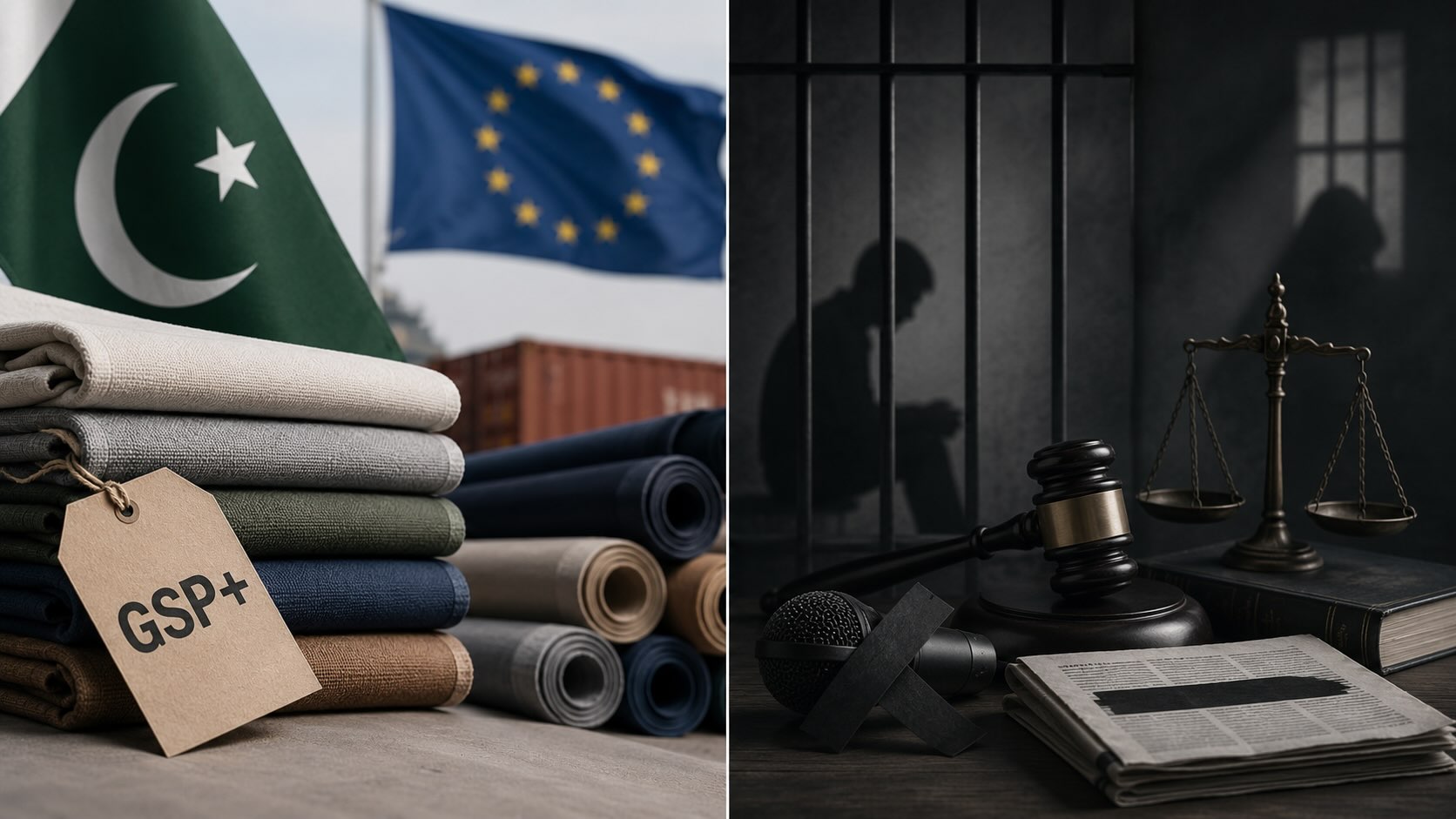
210The EU has strengthened the rules governing GSP+ trade preferences, but Pakistan’s record raises a more difficult question: whether Brussels is prepared to suspend market access when a major beneficiary fails to demonstrate sustained compliance with its human rights, labor and governance obligations.
The European Union has officially adopted revised rules for its Generalized System of Preferences, strengthening the conditions linked to preferential market access for developing countries. The new framework will apply from January 1, 2027 and aims to strengthen control, expand the list of international conventions and facilitate the suspension of benefits in the event of serious violations.
On paper, the reform is significant. In practice, its credibility will depend on one question: whether Brussels is prepared to enforce the rules against countries whose access to the European market has expanded significantly while human rights concerns persist.
Pakistan is the clearest test case. The country has benefited from GSP+ since January 1, 2014 and essentially benefits from duty-free access to the EU market on two-thirds of product categories. According to the European Commission, Pakistan is the largest beneficiary of the EU’s GSP+ system, and more than 85 percent of its exports, including textiles and clothing, enter the EU duty and quota free. In 2024, more than 88% of Pakistan’s exports eligible for tariff reductions entered the EU at preferential tariffs.
The economic value is significant. European Commission trade data shows that EU imports from Pakistan totaled around €68.9 billion between 2014 and 2024. The Commission’s trade page for 2025 reports bilateral goods trade of €12.2 billion and an EU trade deficit of €5.2 billion, implying EU imports from Pakistan of around €8.7 billion. billion euros in 2025. In total, Pakistan has exported around 77.6 billion euros worth of goods to the EU since achieving GSP+ status. Public EU data does not allow the entire figure to be identified as specifically falling under preferential use of GSP+, but the Commission’s own figures show that the vast majority of eligible Pakistani exports received preferential access.
This is why the revised GSP+ framework is important. EU trade preferences are not intended to be an unconditional trade reward. GSP was introduced by the European Community in 1971, following the recommendations of the United Nations Conference on Trade and Development, as a means of helping developing countries increase their exports to industrialized markets. The latest GSP+ agreement added a political and legal bargain: greater tariff preferences in exchange for the ratification and effective implementation of key international conventions on human rights, labor rights, environmental protection and good governance.
Pakistan received the economic side of this agreement. Whether it has met compliance requirements remains controversial.
Pakistan’s GSP+ record under formal scrutiny in new EU Today white paper
Under the current system, GSP+ beneficiaries must implement 27 international conventions. The revised framework increases this number to 32, requires new applicants and beneficiaries to submit implementation plans, improves monitoring and allows for faster suspension when violations are serious. The EU Council says the new system is designed to strengthen sustainable development and good governance. The European Commission’s GSP+ explanation describes this arrangement as an incentive for countries to implement international conventions in exchange for zero duties on more than two-thirds of tariff lines.
The problem is not the absence of rules. This is the repeated gap between formal commitments and conditions in Pakistan.
The European institutions themselves have identified areas of concern. At the 15th EU-Pakistan Joint Commission in December 2025, the EU and Pakistan reviewed the implementation of the 27 GSP+ conventions. The EU has welcomed some progress on the death penalty, anti-torture measures and the creation of a commission on minorities. But he also called for further reforms on freedom of expression and media, enforced disappearances, judicial independence, freedom of religion or belief, minority rights, labor inspections, minimum wage enforcement and low union density. The same meeting discussed the follow-up to the GSP+ monitoring mission organized in Pakistan from November 24 to December 3, 2025 and Pakistan’s future re-application under the new regulations.
The concerns are not new. The same categories have appeared repeatedly over the past decade: misuse of blasphemy laws, pressure on journalists and civil society, intimidation of activists, forced disappearances, persecution of religious minorities, forced conversions and marriages, cases of the death penalty, and restrictions on political opposition.
The imprisonment of former Prime Minister Imran Khan has added another dimension to political rights. In 2024, the United Nations Working Group on Arbitrary Detention found that Khan’s detention was arbitrary, including because it resulted from the exercise of fundamental rights such as freedom of expression, political participation and association. In December 2025, the UN Special Rapporteur on Torture expressed concern over reports of prolonged solitary confinement, severely restricted access to the outside world, poor detention conditions and denial of adequate medical care.
The European Commission has already been directly asked whether Pakistan’s GSP+ status should be re-examined in light of this affair. In a response to a parliamentary question in March 2026, High Representative Kaja Kallas said the EU delegation to Pakistan was monitoring Khan’s case and that broader engagement on human rights under GSP+ remained an important part of the bilateral relationship. She also said the next GSP monitoring report would incorporate findings from UN bodies, civil society and organizations such as Amnesty International, and inform the EU’s decision on Pakistan’s future GSP+ status.
Beyond the high-profile political cases, the general rights situation remains serious. Amnesty International reported that enforced disappearances remained a significant concern in Pakistan, with the government’s own Commission of Inquiry into Enforced Disappearances recording 125 new cases in the first half of 2025, while noting that many cases were unreported and unrecorded. Amnesty also recorded restrictions on activists, journalists and political figures, and reported that more than 100 PTI leaders and activists were convicted by anti-terrorism courts during the year in cases related to the May 9, 2023 protests.
Religious freedom concerns also remain at the heart of the GSP+ debate. Human Rights Watch has called Pakistan’s blasphemy laws discriminatory and said they have been used to target minorities, the poor and others through allegations that can lead to violence, prosecution and social exclusion. Blasphemy remains punishable by death in Pakistan, although no executions for blasphemy have taken place. In 2025, four people were sentenced to death in a blasphemy case involving alleged online content.
Forced conversion through marriage is another recurring concern, particularly affecting girls and young women from Christian and Hindu communities. UN experts have expressed concern about forced marriage conversions in Pakistan in 2026, and the EU’s engagement on human rights in Pakistan has repeatedly included women’s rights, minority rights and freedom of religion or belief.
This assessment raises a practical question for the EU. If a beneficiary country can receive tens of billions of euros in preferential market access over more than a decade while the same concerns recur throughout monitoring cycles, what level of non-compliance would actually trigger suspension?
The revised regulation could improve the legal architecture. This could make monitoring more systematic. This could require Pakistan and other recipients to present clearer implementation plans. It could also give the Commission more room to act when abuses are serious or persistent.
But the decisive question is political. The suspension of preferences would affect exporters, importers, supply chains and diplomatic relations. In the case of Pakistan, textiles and clothing dominate exports to the EU, and European buyers benefit from lower-cost sourcing. This creates an intrinsic reluctance to move from dialogue to sanctions.
The risk is that the new SPG+ rules become another control framework without implementation. The case of Pakistan shows why this would damage the EU’s credibility. The issue of GSP+ is not only tariff access for development. This is tariff access in exchange for measurable implementation of international obligations.
If Brussels renews Pakistan’s access without demanding verifiable and time-bound reforms on abuses of the blasphemy law, forced disappearances, persecution of activists and minorities, forced conversions, death penalty guarantees, media freedom, judicial independence and political rights, the revised regulation will look like a procedural upgrade rather than a real enforcement tool.
For Pakistan, the message must be direct: preferential access to the EU market is not a right. For the EU, the test is whether it is prepared to impose consequences for the standards it has set.
Publications consulted: 1,178
|
Sources 2/ https://eutoday.net/eu-gsp-reform-will-brussels-finally-enforce-its-own-conditions-on-pakistan/ The mention sources can contact us to remove/changing this article |
What Are The Main Benefits Of Comparing Car Insurance Quotes Online
LOS ANGELES, CA / ACCESSWIRE / June 24, 2020, / Compare-autoinsurance.Org has launched a new blog post that presents the main benefits of comparing multiple car insurance quotes. For more info and free online quotes, please visit https://compare-autoinsurance.Org/the-advantages-of-comparing-prices-with-car-insurance-quotes-online/ The modern society has numerous technological advantages. One important advantage is the speed at which information is sent and received. With the help of the internet, the shopping habits of many persons have drastically changed. The car insurance industry hasn't remained untouched by these changes. On the internet, drivers can compare insurance prices and find out which sellers have the best offers. View photos The advantages of comparing online car insurance quotes are the following: Online quotes can be obtained from anywhere and at any time. Unlike physical insurance agencies, websites don't have a specific schedule and they are available at any time. Drivers that have busy working schedules, can compare quotes from anywhere and at any time, even at midnight. Multiple choices. Almost all insurance providers, no matter if they are well-known brands or just local insurers, have an online presence. Online quotes will allow policyholders the chance to discover multiple insurance companies and check their prices. Drivers are no longer required to get quotes from just a few known insurance companies. Also, local and regional insurers can provide lower insurance rates for the same services. Accurate insurance estimates. Online quotes can only be accurate if the customers provide accurate and real info about their car models and driving history. Lying about past driving incidents can make the price estimates to be lower, but when dealing with an insurance company lying to them is useless. Usually, insurance companies will do research about a potential customer before granting him coverage. Online quotes can be sorted easily. Although drivers are recommended to not choose a policy just based on its price, drivers can easily sort quotes by insurance price. Using brokerage websites will allow drivers to get quotes from multiple insurers, thus making the comparison faster and easier. For additional info, money-saving tips, and free car insurance quotes, visit https://compare-autoinsurance.Org/ Compare-autoinsurance.Org is an online provider of life, home, health, and auto insurance quotes. This website is unique because it does not simply stick to one kind of insurance provider, but brings the clients the best deals from many different online insurance carriers. In this way, clients have access to offers from multiple carriers all in one place: this website. On this site, customers have access to quotes for insurance plans from various agencies, such as local or nationwide agencies, brand names insurance companies, etc. "Online quotes can easily help drivers obtain better car insurance deals. All they have to do is to complete an online form with accurate and real info, then compare prices", said Russell Rabichev, Marketing Director of Internet Marketing Company. CONTACT: Company Name: Internet Marketing CompanyPerson for contact Name: Gurgu CPhone Number: (818) 359-3898Email: [email protected]: https://compare-autoinsurance.Org/ SOURCE: Compare-autoinsurance.Org View source version on accesswire.Com:https://www.Accesswire.Com/595055/What-Are-The-Main-Benefits-Of-Comparing-Car-Insurance-Quotes-Online View photos

 |
 |
 |