
Politics
SMOKERS’ CORNER: REWRITING THE PAKISTAN NARRATIVE – Journal
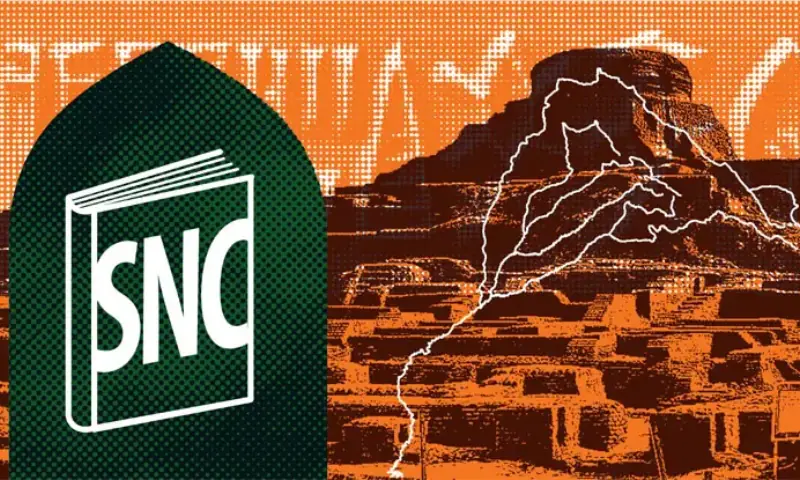
Illustration by Abro
Introduced by the Imran Khan administration (2018-2022), the controversial Single National Curriculum (SNC) represented a final institutional attempt to preserve a state-organized national narrative dating back to the 1970s.
In the 2010s, this identity framework had begun to fracture under the weight of escalating sectarian violence, unprecedented Islamist terrorism and the crumbling of civil-military relations. Islamist violence has intensified alongside growing political friction between the military and the government led by the Pakistan People’s Party (PPP) that took power in 2008. The resulting instability has sparked a national debate over the state’s religious discourse.
The conflict between the state and Islamists revealed a glaring ideological contradiction: anti-state extremists used exactly the same Islamist rhetoric that was championed by the state, major religious parties, and center-right groups, particularly since the 1980s.
This has forced a fundamental questioning of state Islam, particularly its presence in school textbooks.
For decades, the Pakistani state has crafted a national identity detached from the subcontinent’s past. But changing dynamics within the country and the region are pushing him towards a different vision of himself – as a modern heir to the ancient Indus civilization.
This speech was not entirely unprecedented. In the 1980s, intellectuals such as Sibte Hasan, KK Aziz and Ayesha Jalal created a counter-narrative by arguing that the state was distorting the fundamental vision of Pakistan’s founder, Muhammad Ali Jinnah. They claimed that Jinnah saw Islam as an enlightened, humane and modern faith. This representation contrasted sharply with the rigid version of Islam and the image of Jinnah sculpted by the state from the 1970s onwards.
However, counter-narratives remained largely confined to elite intellectual circles. Meanwhile, the official state narrative became increasingly dominant, widely propagated through school textbooks, state-controlled media, and pro-state ulama. [Islamic scholars] empowered by the dictatorship of Ziaul Haq (1977-1988).
A second wave of academic criticism emerged in the 1990s and early 2000s. Led by scholars such as Dr. Abdul Hameed Nayyar, Rubina Saigol, and Ahmad Salim, this criticism posited that the escalation of Islamist and sectarian violence during this era was a direct consequence of classroom indoctrination.
According to Saigol, after the violent secession of East Pakistan in 1971, a pervasive state paranoia began to stifle national rhetoric and reshape the school curriculum. This insecurity culminated with the official unveiling of the “Pakistani Ideology” in 1978. It was a construct born of the fear that without inserting a rigid interpretation of Islam into the political and social fabric of the country, Pakistan would face further disintegration.
Nayyar, Salim, and Saigol further suggested that the state and its nationalist intelligentsia harbored a perpetual need to separate the roots of South Asian Muslims from those of other regional faiths, particularly Hinduism.
This ideological project gained urgency after the “East Pakistan debacle” of 1971. In post-1978 textbooks, Pakistan was finally decoupled from its subcontinental geography and linked to a civilizational assertion that South Asian Muslims were genealogically linked to the cradle of Islam in Arabia. Critics called this the “Arabization of Pakistan” – a claim that Arabs found rather amusing.
Beginning in the late 1970s, history textbooks largely ignored the region’s pre-8th-century past, undermining everything that existed before the Arab invasion of Sindh. Ruins and artifacts of ancient civilizations physically located in Pakistan, including the 5,000-year-old Indus Valley Civilization, have been treated as foreign phenomena rather than founding elements of the national heritage.
Although a comprehensive 2003 study on this topic by Nayyar and Salim attracted brief interest from the “modernist” military dictatorship of Pervez Musharraf (1999–2008), it resulted in only superficial structural reforms.
In 1996, the state narrative was challenged more comprehensively by Aitzaz Ahsan, a prominent intellectual and senior member of the PPP. Synthesizing fragmented ideas into what became known as the “Indus theory”, he formalized his thesis in his book The Indus Saga and the Making of Pakistan. The theory suggests that today’s Pakistan is far from being an artificial state hastily created in 1947. Rather, it is the organic, modern manifestation of a distinct 5,000-year-old civilization rooted in the Indus river system.
According to Ahsan, the civilizational gap between Pakistan and India is fundamentally cultural and geographical rather than purely religious. It is motivated by the distinct evolution of two distinct societies: one born along the banks of the Indus in Pakistan and the other along the Ganges in India.
Versions of this theory had been circulating since the 1950s. Their lineage dates back to the 1950 book Five Thousand Years of Pakistan by British archaeologist Sir Mortimer Wheeler. The concept was later revived in the 1970s by figures such as Sibte Hasan, eminent archaeologist Ahmad Hasan Dani and veteran Sindhi nationalist GM Syed. However, the post-1971 state discarded this paradigm in favor of its Arab hypothesis. Ahsan’s formulation in the mid-1990s remains the most coherent and articulate expression of Indus theory.
In 2010, the PPP coalition government succeeded in passing the 18th Amendment to the Constitution, with the support of the main opposition party, the Pakistan Muslim League-Nawaz (PML-N). The amendment granted significant autonomy to the provinces, decentralizing education from the federal government and softening the national discourse focused on Islamabad.
Sindh took the lead, exercising its new authority to reintroduce the province’s “Sufi” history and regional heroes into provincial textbooks, bypassing the old federal frameworks. In 2015, the Sindh government reintroduced Jinnah’s speech of August 11, 1947 into school textbooks. This speech, in which Jinnah declared that the state would have nothing to do with the religion of its citizens, was removed from the school curriculum after 1971.
Combined with the wide availability of literature on the Internet questioning the state’s narrative after 1971, these developments propelled Indus theory into mainstream national discourse like never before.
The state made a final effort to mitigate the erosion of the old narrative through the SNC, launched by Imran Khan in August 2021. Although the SNC was a more radical manifestation of the traditional state narrative, it was ultimately rejected by the governments of Sindh and Balochistan. Moreover, its implementation triggered widespread confusion and discontent among middle-class parents in Punjab, causing the project to stall after the Khan regime was removed by an Act of Parliament in 2022.
Today, as Pakistan positions itself as a rising regional power, the government and military establishment prioritize pragmatism. Seeking to maintain this status while more systematically tackling Baloch separatism, Islamist violence, and the Indian threat, the state is quietly integrating Indus theory into its own narratives.
Another driver of this change is the Hindu nationalist regime in India, which is aggressively reshaping the past to construct a civilizational identity centered on Hinduism. This has eroded India’s secular image internationally. Pakistan sees this as an opportunity.
By adopting the Indus Theory, Pakistan seeks to position itself as a moderate and pragmatic nation-state with ancient roots in the civilizations that emerged along the Indus, the country’s largest river and “giver of life.”
Published in Dawn, EOS, May 24, 2026
|
Sources 2/ https://www.dawn.com/news/2002551 The mention sources can contact us to remove/changing this article |
What Are The Main Benefits Of Comparing Car Insurance Quotes Online
LOS ANGELES, CA / ACCESSWIRE / June 24, 2020, / Compare-autoinsurance.Org has launched a new blog post that presents the main benefits of comparing multiple car insurance quotes. For more info and free online quotes, please visit https://compare-autoinsurance.Org/the-advantages-of-comparing-prices-with-car-insurance-quotes-online/ The modern society has numerous technological advantages. One important advantage is the speed at which information is sent and received. With the help of the internet, the shopping habits of many persons have drastically changed. The car insurance industry hasn't remained untouched by these changes. On the internet, drivers can compare insurance prices and find out which sellers have the best offers. View photos The advantages of comparing online car insurance quotes are the following: Online quotes can be obtained from anywhere and at any time. Unlike physical insurance agencies, websites don't have a specific schedule and they are available at any time. Drivers that have busy working schedules, can compare quotes from anywhere and at any time, even at midnight. Multiple choices. Almost all insurance providers, no matter if they are well-known brands or just local insurers, have an online presence. Online quotes will allow policyholders the chance to discover multiple insurance companies and check their prices. Drivers are no longer required to get quotes from just a few known insurance companies. Also, local and regional insurers can provide lower insurance rates for the same services. Accurate insurance estimates. Online quotes can only be accurate if the customers provide accurate and real info about their car models and driving history. Lying about past driving incidents can make the price estimates to be lower, but when dealing with an insurance company lying to them is useless. Usually, insurance companies will do research about a potential customer before granting him coverage. Online quotes can be sorted easily. Although drivers are recommended to not choose a policy just based on its price, drivers can easily sort quotes by insurance price. Using brokerage websites will allow drivers to get quotes from multiple insurers, thus making the comparison faster and easier. For additional info, money-saving tips, and free car insurance quotes, visit https://compare-autoinsurance.Org/ Compare-autoinsurance.Org is an online provider of life, home, health, and auto insurance quotes. This website is unique because it does not simply stick to one kind of insurance provider, but brings the clients the best deals from many different online insurance carriers. In this way, clients have access to offers from multiple carriers all in one place: this website. On this site, customers have access to quotes for insurance plans from various agencies, such as local or nationwide agencies, brand names insurance companies, etc. "Online quotes can easily help drivers obtain better car insurance deals. All they have to do is to complete an online form with accurate and real info, then compare prices", said Russell Rabichev, Marketing Director of Internet Marketing Company. CONTACT: Company Name: Internet Marketing CompanyPerson for contact Name: Gurgu CPhone Number: (818) 359-3898Email: [email protected]: https://compare-autoinsurance.Org/ SOURCE: Compare-autoinsurance.Org View source version on accesswire.Com:https://www.Accesswire.Com/595055/What-Are-The-Main-Benefits-Of-Comparing-Car-Insurance-Quotes-Online View photos

 |
 |
 |