
Politics
Cockroaches bother India’s Narendra Modi and his court
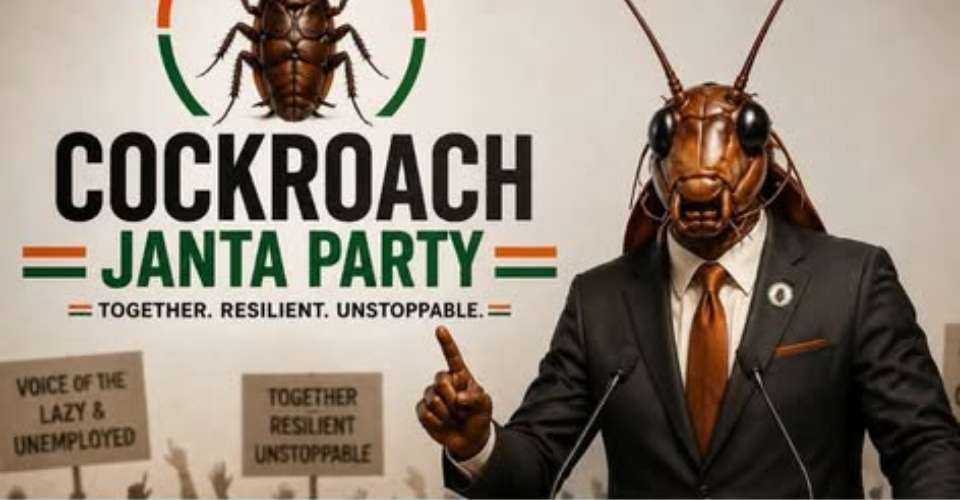
The Indian chief justice has unknowingly become the father of a universe of cockroaches who have come to annoy the government of Narendra Modi like no one, man or insect, could do since he came to power in May 2014.
The word Justice Surya Kant used to scorn has returned in the form of a parody, a slogan, a badge, a song, a meme and a mock party – with the insult multiplying faster than the system intended.
The newly formed Cockroach Janta Party (CJP or Cockroach People’s Party) is now mocking the court, mocking the regime, demanding accountability from the educational establishment and challenging the complacency of Modi’s culture which has perfected the spectacle, ignoring education, employment, science, health and public welfare.


The CJP was born after the chief justice called some unemployed youth “cockroaches and parasites of society”.
Reuters reported that Abhijeet Dipke, a 30-year-old political communications strategist based in Boston who previously worked for the Aam Admi Party (AAP or Common Man’s Party), founded the group shortly after the chief justice made the remark. Within days, she had nearly 15 million followers on Instagram and more than 400,000 registrations, with around 70% of members aged 19 to 25.
The group calls itself the “Voice of the Lazy and Unemployed,” a satire that seeks to become the voice of the unemployed graduate, the failed exam candidate, the contract and gig workers, the Kota City Coaching Center Survivorthe young woman harassed beyond belief and the middle-aged father crushed by rising prices.
Modi can take on power, as he has shown in a hundred elections in 12 years, but being the butt of a joke or a meme ridiculing his regime gets under his skin – just as his friend and US President Donald Trump is using all his might to try to crush Jimmy Kimmel and Steven Colbert from late-night talk shows.
The CJP is still in the social media ether, without any imprint, but it has made the leader look small and a bit naked.
Its early demands, including anger at educational failures and calls for accountability, do not yet constitute a program, but they speak to the suffering of unemployment, exam scams, institutional arrogance, media capture, inflation and the feeling that the state views young citizens not as human beings but as a nuisance.
For Modi, education has rarely been the moral center of politics, appearing mainly as a slogan, a skill, a branding, a digital promise or an ideological correction, spending only 2.4-2.6% of the budget over the past two years.
Science, too, has been restricted in the public imagination, with policy focus limited to missiles, satellites, drones, border technology and military hardware with theatrical celebration, especially when Pakistan is the implied enemy.
Public health sciences, climate sciences, nutrition, school laboratories, university autonomy, social sciences, and independent research do not receive the same political affection.
The economy follows the same pattern, and while in reality tycoons and crony capitalists like Adani and Ambani may not yet be the mythical gods of wealth, the proximity between state power and a few giant conglomerates has become a defining feature of the Modi era.
Reuters also reported this month that the Gautam Adani Group was restructuring internally to accelerate the growth of its businesses, which include much of its print, electronic and digital media, besides oil and gas, ports and airports, and mineral mining in the indigenous tribal belt.
The economy seems organized around those who are already powerful, while small traders, farmers, informal workers and young people looking for work are asked to wait.
This is why the cockroach metaphor stuck: the insect survives by living in cracks, kitchens, sewers and darkness, despised but difficult to kill.
The CJP took this metaphor and made it political. The joke goes: you called us pests; we will now invade your imagination.
Yet for now, Modi has little to fear.
The CJP has no boots on the ground – it has anger in its chest and Wi-Fi in cell phones with Instagram,
There are as yet no ward committees, campus cells, union links, Dalit slum organizers, women’s collectives, minority networks, farmers’ alliances, legal aid offices or booth-level discipline – plenty of on-screen visibility, but no structure.
Modi, by contrast, commands the hardline state – the world’s largest armed forces, with about 1.45 million active military personnel, a million paramilitary troops and about a million police officers along with state governments.
He and his federal interior minister, the austere Amit Shah, have repeatedly shown that they will not hesitate to use all this power; the most recent was during the recent assembly elections, especially in West Bengal, where they suppressed or drowned out political voices and noise with equal professionalism.
Citizens know how the coercive arm of the state is experienced on the ground: students, farmers, minorities, Dalits, tribals, journalists, workers and protesters have often encountered the police not as a neutral guardian of freedom but as an agent of discipline.
The government’s response to the CJP already shows this reflex; his X account has been detained in India, and others may follow.
Modi has survived strong pressure from mass movements, farmers’ protests, civil society, Muslim resistance to An Act to amend the Citizenship Actprotests against unemployment, student agitations, criticism of Manipur, attempts at opposition unity and international monitoring.
Between him and Amit Shah, they know how to anticipate dissent, label and delegitimize protesters as anti-national, foreign-funded, Khalistani, Islamist, missionary, conspiracist, urban Naxal, casteist, separatist, Pakistani or Western agents.
It’s a shortlist: the prisons are full of young men and women, many with doctorates or more under their belt, imprisoned without the benefit of the bail that was their right.
CJP, whose birth reminds old journalists of student agitation against reservations or affirmative action programs in 1985 and 1990, and India Movement Against Corruption in 2011, however, an amateur bubble appeared with a suspicious pedigree and a short life.
The “Party” has no program for the poor of this vast territory – the Dalits and tribals, the landless poor, religious minorities and other marginalized sections of society. The weakness of the CJP becomes clear when asked what it says about minorities and the very poor.
A movement that does not speak to the very poor and marginalized will remain a complaint of the lower middle class.
This was the limitation of the AAP, which emerged from anti-corruption anger, not from a deep theory of caste, labor, minority rights or economic justice. He turned moral disgust into electoral success in Delhi and Punjab, but his ideological vacuity remains.
The CJP risks repeating this path more quickly because its vocabulary is singularly devoid of Marx, Gandhi, Phule, Ambedkar, Periyar, Lohia, constitutional secularism, feminist politics, labor or serious economics.
At this point, there is no concern whether the “movement” takes the rather controlled path of Nepal’s Gen Z uprising, which led to the installation of a young government without much bloodshed or concern on the international stage, or whether it emerges as a clone of Bangladesh, with right-wing fundamentalists taking control.
The CJP is perhaps best understood as a signal of pressure, not a revolution, from the digitally connected class, which can laugh but cannot walk the roads of New Delhi.
Political observers describe the CJP as a phone-in rally, the fury of people who know something is wrong but who have not found the courage, alliances or leadership to confront it in the streets.
Modi’s complacency rests on this, because the intelligence bureau tells him that anger exists, but it is dispersed, the youth are divided by caste, the poor by religion.
The question is whether the alacrity of the Internet and the anonymity of social media can overcome the truth that Western governments weigh democracy against market access and defense deals.
But the CJP did something valuable: it made visible contempt, the seed of false citizenship.
The cockroach has become a virtual citizen.
*The opinions expressed in this article are those of the author and do not necessarily reflect the official editorial position of UCA News.
|
Sources 2/ https://www.ucanews.com/news/cockroaches-bug-indias-narendra-modi-and-his-court/113444 The mention sources can contact us to remove/changing this article |
What Are The Main Benefits Of Comparing Car Insurance Quotes Online
LOS ANGELES, CA / ACCESSWIRE / June 24, 2020, / Compare-autoinsurance.Org has launched a new blog post that presents the main benefits of comparing multiple car insurance quotes. For more info and free online quotes, please visit https://compare-autoinsurance.Org/the-advantages-of-comparing-prices-with-car-insurance-quotes-online/ The modern society has numerous technological advantages. One important advantage is the speed at which information is sent and received. With the help of the internet, the shopping habits of many persons have drastically changed. The car insurance industry hasn't remained untouched by these changes. On the internet, drivers can compare insurance prices and find out which sellers have the best offers. View photos The advantages of comparing online car insurance quotes are the following: Online quotes can be obtained from anywhere and at any time. Unlike physical insurance agencies, websites don't have a specific schedule and they are available at any time. Drivers that have busy working schedules, can compare quotes from anywhere and at any time, even at midnight. Multiple choices. Almost all insurance providers, no matter if they are well-known brands or just local insurers, have an online presence. Online quotes will allow policyholders the chance to discover multiple insurance companies and check their prices. Drivers are no longer required to get quotes from just a few known insurance companies. Also, local and regional insurers can provide lower insurance rates for the same services. Accurate insurance estimates. Online quotes can only be accurate if the customers provide accurate and real info about their car models and driving history. Lying about past driving incidents can make the price estimates to be lower, but when dealing with an insurance company lying to them is useless. Usually, insurance companies will do research about a potential customer before granting him coverage. Online quotes can be sorted easily. Although drivers are recommended to not choose a policy just based on its price, drivers can easily sort quotes by insurance price. Using brokerage websites will allow drivers to get quotes from multiple insurers, thus making the comparison faster and easier. For additional info, money-saving tips, and free car insurance quotes, visit https://compare-autoinsurance.Org/ Compare-autoinsurance.Org is an online provider of life, home, health, and auto insurance quotes. This website is unique because it does not simply stick to one kind of insurance provider, but brings the clients the best deals from many different online insurance carriers. In this way, clients have access to offers from multiple carriers all in one place: this website. On this site, customers have access to quotes for insurance plans from various agencies, such as local or nationwide agencies, brand names insurance companies, etc. "Online quotes can easily help drivers obtain better car insurance deals. All they have to do is to complete an online form with accurate and real info, then compare prices", said Russell Rabichev, Marketing Director of Internet Marketing Company. CONTACT: Company Name: Internet Marketing CompanyPerson for contact Name: Gurgu CPhone Number: (818) 359-3898Email: [email protected]: https://compare-autoinsurance.Org/ SOURCE: Compare-autoinsurance.Org View source version on accesswire.Com:https://www.Accesswire.Com/595055/What-Are-The-Main-Benefits-Of-Comparing-Car-Insurance-Quotes-Online View photos

 |
 |
 |