
ANKARA, July 15 (AJP) – The name of a deceased man rang out in a sunny park in Ankara on Wednesday, and thousands of voices responded in his favor.
“Burada!” “” the crowd shouted. Here. Here.
Another name followed, and another answer. This happened 253 times, once for every person killed on the night of July 15, 2016, when a faction of the Turkish army attempted to seize the state and the public began shooting to stop it.
To an outsider ear, the word sounded suspiciously like “brother,” and for several minutes it was as if the crowd were claiming kinship with the dead.
A Turkish official sitting nearby corrected me. The word means “here,” she explained. When the names of martyrs are read aloud in Türkiye, the living respond to the call on their behalf.
The dead are not absent. They are present.
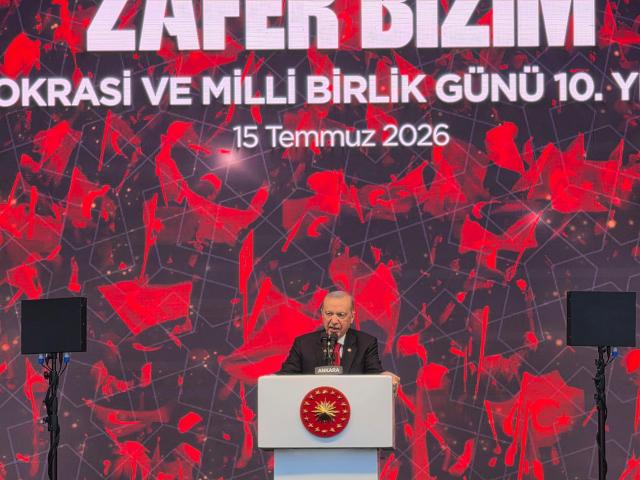
That belief, that the July 15 dead remain in service, was the emotional driving force behind Wednesday’s ceremony at Baskent Millet Bahcesi, a sprawling public park in central Ankara, to mark the 10th anniversary of the failed coup. The government designated July 15 as the Day of Democracy and National Unity, and this year’s program was themed “The will is ours, the victory is ours.”
The attempted coup began on the evening of July 15, 2016, when rebel military units seized Istanbul’s bridges, sent tanks into the streets and bombed government buildings in Ankara, including parliament and police headquarters.
President Recep Tayyip Erdogan, on vacation on the Aegean coast, escaped an assassination attempt and called on citizens via video link to resist. They did, in numbers that astounded the conspirators. Civilians lay down in front of the tanks and stormed the occupied installations.
By morning, the coup had failed. The night left 253 dead and 2,737 injured, figures that the state has since registered as a national epic.
Ankara blames the network of Fethullah Gülen, a US-based cleric whose supporters have spent decades integrating into the army, police and judiciary. The government refers to the movement as the Gulenist Terrorist Organization, or FETO. Gulen, who denied any involvement, died in Pennsylvania in October 2024.
The choice of Wednesday’s location was not accidental. The park, opening in 2023 on the grounds of the capital’s former hippodrome, is directly opposite the Ankara provincial police headquarters, one of the buildings pounded by tanks, helicopters and F-16s on the night of the coup. Erdogan emphasized this from the stage.
“The Ankara Provincial Police building, right in front of us, became the target of tanks, helicopters and F-16s,” he said. “During these attacks, seven police officers and six civilians, a total of 13 heroes, marched to martyrdom in front of the Ankara police.”
In Ankara alone, he said, 149 people were killed that night and 1,508 injured.
The ceremony took place under a harsh July sun. Participants entered through a park gate, crossed a patch of grass, and gathered on a large asphalt clearing where heat visibly rose from the ground. The crowd numbered in the thousands and spanned generations: elderly men and women who lived through the night, parents with children on their shoulders, and children who were not yet born in 2016 shouting “Burada!” with everyone else, answering for the deaths of a night they never saw.
The scene carried its own history lesson, flanked on one side by soldiers carrying the flags of history’s 16 Turkish states and on the other by guards in Ottoman janissary outfits. From a seat about 30 meters away, Erdogan was close enough to observe, but the crowd stretched far beyond the reach of a single pair of eyes. The sound carried everything.
After the call came the prayer. Tayyib Hos, imam of the Bestepe Millet mosque in the presidential complex, recited verses from the Quran in the melodic style familiar to loudspeakers at mosques across the Muslim world. Safi Arpagus, head of Turkey’s Directorate of Religious Affairs, then led a prayer for the dead.
Thousands of people raised their hands, palms open to the sky, in the Muslim posture of supplication.
Then Erdogan spoke, and he spoke less like a head of state than like a man reading letters from the dead.
He told the crowd about Varol Tosun, a police officer killed in front of the headquarters across the road. “His wife sometimes asked him, are you not afraid of anything? Our martyr answered his wife like our Master Hamza: I fear nothing that my eyes can see.”
He told them about Omer Ipek, who left his house that night knowing what would happen. “Leaving home that evening, he told his older sister: I want to leave a beautiful country for my children,” Erdogan said. “To his father,” he said, “I am going to become a martyr, my children are entrusted to you.”
He told them about Volkan Canoz, killed at 29, and Muhammed Oguz Kilinc, son of a police officer who died at 26. “I have countless memories of that night for each of our 253 martyrs and 2,737 veterans,” Erdogan said. “If we tried to tell them one by one, believe me, our hearts wouldn’t be able to bear it.”
The president presented the night of the coup as a resurrection of the spirit of the Turkish War of Independence a century earlier, and the conspirators as instruments of foreign powers.
“That night, against the Hashashin gang in the service of imperialism, we said, as we did a century ago,” he said, before reciting verses by national poet Mehmet Akif Ersoy: “I have lived free from the beginning and I will live free. Which madman will chain me?”
He reserved his harshest language for the conspirators themselves, calling those who betrayed the nation throughout history a “herd of mankurts,” evoking a Central Asian literary figure of a slave devoid of memory and identity. “They are traitors who stab their state and nation in the back in the name of world interests,” he said.
The speech was also a message addressed to the present. Erdogan credited the endurance of his governing coalition, the People’s Alliance with the Nationalist Movement Party, whose leader Devlet Bahceli he praised from the stage, for saving the country from a repeat.
“I believe that, with Allah’s permission, as long as the People’s Alliance remains strong, Turkey will no longer experience dark times,” he said. “As long as this nation remains awake, united and protects its unity and solidarity, no one will be able to fetter its will.”
Critics at home and abroad have long pointed out that the decade since the coup also brought large-scale purges, with tens of thousands of soldiers, police, judges and teachers fired or imprisoned over alleged Gulenist ties, and a broad concentration of presidential power.
None of these shadows reached the park Wednesday. What filled the asphalt clearing was grief organized into rituals, a state liturgy in which the dead are summoned by name and the living response to their place.
Erdogan concluded with a warning from the evening of the coup itself, citing a man who confronted soldiers on the Fatih Sultan Mehmet Bridge in Istanbul. “A person only dies once. But he dies like a man,” he said. “Our state has the power to eliminate any threat that targets it and to crush the heads of the traitors who try to relieve them. Everyone must make their calculations and keep their accounts accordingly.”
Copyright ⓒ Aju Press All rights reserved.



