
Politics
Republicans control Congress, so why is Trump’s SAVE America Act blocked?
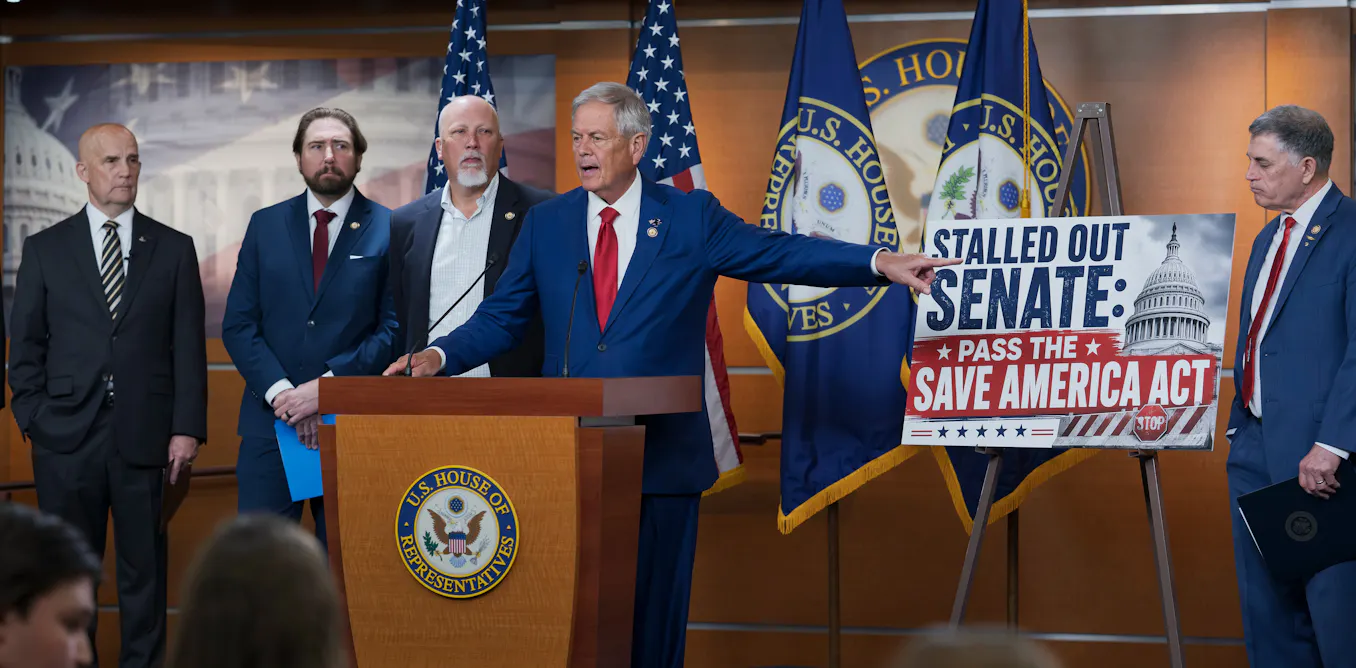
President Donald Trump’s obsession with baseless claims of election fraud has defined his second term. But in recent months, his focus has shifted from litmus tests for executive branch nominees and executive orders strengthening proof of citizenship to passing legislation — dragging Congress into the fray.
The Safeguard American Voter Eligibility Act, or SAVE America Act, was widely discussed in Trump’s prime-time speech on July 16, 2026.
It has become the administration’s priority in recent months, eclipsing previous legislative efforts in proposing strict, widespread voting changes. The bill, which would federalize elections, require additional documentation to vote and reduce registration and absentee voting in all states, faces major logistical, legal and political hurdles.
The law, stuck in limbo between the U.S. House and Senate, dominated and derailed the summer legislative calendar. In the House, Republican members have delayed votes on major legislation in an effort to pressure the Senate to bring the bill to a vote, and it has become a sticking point in other unrelated legislation.
The controversial act also soured relations between Trump and members of his party, leading him to refuse to sign a bipartisan housing bill passed by Congress. Although the bill became law without his signature, Trump’s preoccupation with the SAVE America Act ultimately prevented congressional Republicans from touting a popular, bipartisan political victory.
Yet despite mounting political pressure, Congress has not budged.
This tension between Trump’s priorities and Congressional inaction is notable because Republicans control both chambers. But as a political scientist who studies the shifting power of congressional leaders, I find the inaction on the SAVE America Act to be more than a reflection of Trump’s waning popularity among Republican lawmakers. Rather, Congress’s hesitation over what would be the biggest election reform in decades reflects an awareness of voters’ needs and lawmakers’ re-election risks.
What is the last one?
House Republicans were quick to blame the Senate — and the 60-vote filibuster threshold that legislation must clear to receive a Senate vote — for the inaction.
House Speaker Mike Johnson has brought the bill up for at least three votes in an effort to pressure the Senate to pass the bill. In July 2026, Johnson took a more creative approach, yielding to conservative lawmakers by including parts of the SAVE America Act in a House-passed bill to fund the State Department.
These actions are largely theatrical. Senate Majority Leader John Thune has said since February 2026 that there are not enough votes to pass the SAVE America Act in the Senate, telling Fox News in June that “the votes are not there right now.” Although Senate Republicans could vote to eliminate the filibuster, which Trump has also called for, they have not done so.
Even in the House, narrow margins of Republican control have made it difficult for Johnson to maintain party unity on this contentious issue. And Johnson’s strategy of tying the SAVE America Act to major legislation risks not only derailing bipartisan politics, but also causing another government shutdown.
If Republicans were serious about election reform, including moderate reforms that the majority of Americans support, their approach would be similar to that used for other major legislation: bipartisan. Instead, partisan passage of a controversial bill, with known Senate holdup, presents a half-hearted strategy that avoids real accountability.
Republican House Majority Leader Steve Scalise speaks to reporters about the SAVE America Act in February 2026. Tom Brenner/AP Photo Legal and logistical hurdles
The SAVE America Act would be confusing, time-consuming, and costly, and it would not provide funding to help states implement changes.
Changing electoral processes also requires precision and time. As Republican Senator Thom Tillis noted: “Do you honestly believe that we can implement this project in 50 states? There is no funding. There are no specific implementation instructions.”
Beyond logistics, the legality of federalizing electoral processes is murky.
Congress has the power to impose election conditions. But under Article 1, Section 4 of the Constitution, even though Congress can set parameters, states are responsible for administering elections.
For example, the National Voter Registration Act of 1993 strengthened citizenship as a requirement, but states retained responsibility for creating their own registration form and process. The SAVE America Act attempts to get around this problem by requiring federal possession of voter rolls.
Uncertainty for American citizens
Beyond the legal challenges, the SAVE America Act introduces very real implications for American voters – and the members of Congress who represent them.
Although the stated goal of the law is to ensure that only citizens vote, citizenship requirements for voting are already part of federal law. In practice, many researchers believe the bill would make it more difficult for eligible voters to participate in the democratic process.
For rural Americans, most of whom are represented by Republican members of Congress, the law would significantly restrict registration and voting by mail. More than 5 million Americans would have to drive an hour or more to register to vote, with some voters having to drive up to eight hours.
For women who changed their name after marriage, a trait more likely to be associated with Republican women, voting would require marriage records in addition to birth records.
New voters, young voters on college campuses, and voters who have recently moved may also have difficulty finding and submitting these documents in person.
Members of Congress, especially those who represent rural areas, are likely aware of this reality. Disenfranchising their voters or, at best, sowing confusion among them also endangers their own electoral success.
Safety and security of the upcoming elections
One of Trump’s first acts after the Supreme Court’s decision in Trump v. Slaughter in June 2026, which allowed the president to remove executive branch officials without cause, was to fire the remaining members of the bipartisan, Senate-confirmed Election Assistance Commission.
The agency serves as the point of contact for states regarding election administration processes, providing resources, guidance and expertise on voting logistics. If the SAVE America Act were to pass, this office would play a critical role in ensuring that changes are impartial and equitable across all 50 states.
Coupled with warnings that Trump could invoke emergency powers over election administration, aggressive actions by the Justice Department to police voter rolls, partisan redistricting, and now a vacant Elections Commission, the SAVE America Act risks further disruption to elections. And this, even though these elections have already been secure and practically free of fraud.
As Tillis pointed out to reporters, “They’re being dishonest in suggesting to the American people that they could possibly be up and running by this election. And so I start to wonder… whether we’re just starting to undermine the underlying integrity of one of our elections. And I think that’s dangerous, and I think that’s wrong.”
Trump’s hold on the Republicans
Does Congress’s hesitation to pass the SAVE America Act reflect a weakening of Trump’s hold on the Republican Party? Maybe. The president is more unpopular than he has been at any point in his second term. Ignoring Trump on the SAVE America Act may be a risk worth taking for some members.
But for most Republican members of Congress, appeasing Trump remains the key to primary and electoral success. The president’s record in primary support — even for incumbent senators — remains strong, as he continues to define the party. Among voters, some provisions of the SAVE America Act are popular among MAGA-aligned voters, making it an important election issue for members representing deep red districts.
By publicly supporting the law but relying on the Senate to serve as a stop to House-passed legislation, Congress is falling into a familiar pattern that allows conservative members to appeal to the president while using a procedure to block legislation that would make major changes to the vote, just months before Election Day.
Congress’s hesitance to pass the SAVE America Act is more than a test of its relationship with Trump. This is an example of how Congress is doing what it is supposed to do: represent its constituents.
|
Sources 2/ https://theconversation.com/republicans-control-congress-so-why-is-trumps-save-america-act-stuck-287156 The mention sources can contact us to remove/changing this article |
What Are The Main Benefits Of Comparing Car Insurance Quotes Online
LOS ANGELES, CA / ACCESSWIRE / June 24, 2020, / Compare-autoinsurance.Org has launched a new blog post that presents the main benefits of comparing multiple car insurance quotes. For more info and free online quotes, please visit https://compare-autoinsurance.Org/the-advantages-of-comparing-prices-with-car-insurance-quotes-online/ The modern society has numerous technological advantages. One important advantage is the speed at which information is sent and received. With the help of the internet, the shopping habits of many persons have drastically changed. The car insurance industry hasn't remained untouched by these changes. On the internet, drivers can compare insurance prices and find out which sellers have the best offers. View photos The advantages of comparing online car insurance quotes are the following: Online quotes can be obtained from anywhere and at any time. Unlike physical insurance agencies, websites don't have a specific schedule and they are available at any time. Drivers that have busy working schedules, can compare quotes from anywhere and at any time, even at midnight. Multiple choices. Almost all insurance providers, no matter if they are well-known brands or just local insurers, have an online presence. Online quotes will allow policyholders the chance to discover multiple insurance companies and check their prices. Drivers are no longer required to get quotes from just a few known insurance companies. Also, local and regional insurers can provide lower insurance rates for the same services. Accurate insurance estimates. Online quotes can only be accurate if the customers provide accurate and real info about their car models and driving history. Lying about past driving incidents can make the price estimates to be lower, but when dealing with an insurance company lying to them is useless. Usually, insurance companies will do research about a potential customer before granting him coverage. Online quotes can be sorted easily. Although drivers are recommended to not choose a policy just based on its price, drivers can easily sort quotes by insurance price. Using brokerage websites will allow drivers to get quotes from multiple insurers, thus making the comparison faster and easier. For additional info, money-saving tips, and free car insurance quotes, visit https://compare-autoinsurance.Org/ Compare-autoinsurance.Org is an online provider of life, home, health, and auto insurance quotes. This website is unique because it does not simply stick to one kind of insurance provider, but brings the clients the best deals from many different online insurance carriers. In this way, clients have access to offers from multiple carriers all in one place: this website. On this site, customers have access to quotes for insurance plans from various agencies, such as local or nationwide agencies, brand names insurance companies, etc. "Online quotes can easily help drivers obtain better car insurance deals. All they have to do is to complete an online form with accurate and real info, then compare prices", said Russell Rabichev, Marketing Director of Internet Marketing Company. CONTACT: Company Name: Internet Marketing CompanyPerson for contact Name: Gurgu CPhone Number: (818) 359-3898Email: [email protected]: https://compare-autoinsurance.Org/ SOURCE: Compare-autoinsurance.Org View source version on accesswire.Com:https://www.Accesswire.Com/595055/What-Are-The-Main-Benefits-Of-Comparing-Car-Insurance-Quotes-Online View photos

 |
 |
 |