
Uncategorized
How the earthquake of 1755 changed the theological narrative in Europe
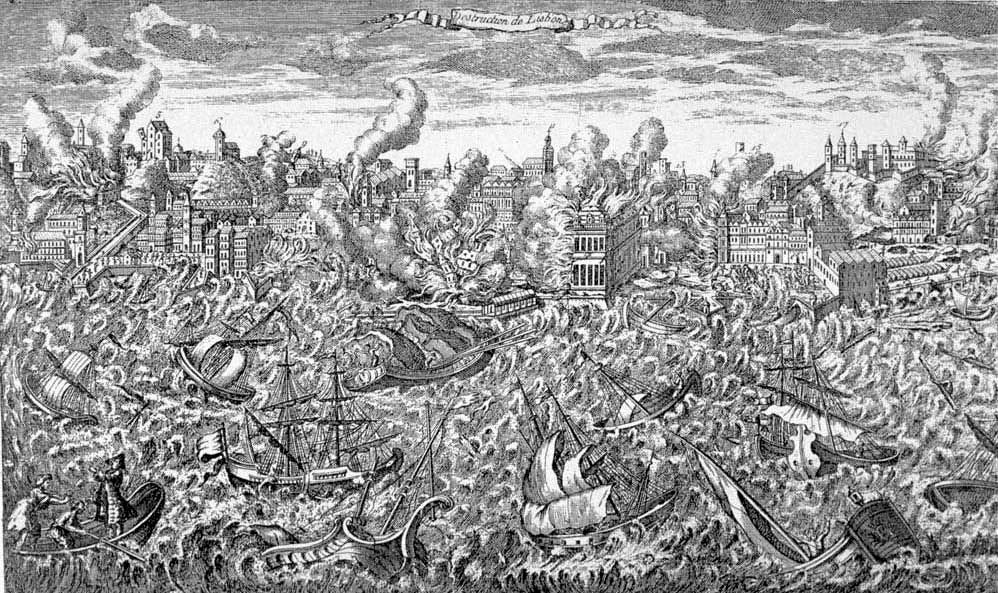
On October 31, 1755, Lisbon was the crown jewel of Christendom.
For more than two centuries, the Portuguese cultivated an overseas empire that extended from Brazil to India. Lisbon served as a port of entry for Europe's fabulous wealth, and became beautiful and prosperous in itself.
A copper engraving from 1755 shows Lisbon in flames and a tsunami sweeping away ships in the harbour. Public domain.
As the Reformation took hold in large parts of Europe, Lisbon was also a key ally of Rome.
Cardinal Manuel Clemente, patriarch emeritus of Lisbon and a church historian, told The Pillar: “Religion was everywhere. There were processions every week. King John V was trying to establish Lisbon as a second Vatican and he successfully petitioned the royal chaplain for the title of patriarch.”
—But on November 1, 1755, disaster struck.
As the day began, the Catholic fervor in the city was palpable, and a large portion of the population was attending mass.
Then the ground started shaking.
“It took six or seven minutes, it seemed like an eternity, and it was incredibly powerful,” Cardinal Clemente explained.
“The churches collapsed on top of the congregation, and the houses collapsed on their inhabitants. A terrible fire immediately swept through the city, and many victims were burned alive. Whoever managed to escape from the flames to the river bank, that was when the tsunami struck and swept away everything in its path.”
The 1755 earthquake is considered one of the most destructive earthquakes in modern history, with an estimated magnitude of 8.5 or 9. Nearly 60,000 people were killed in Lisbon, and an estimated 200,000 were killed across the Iberian Peninsula and North Africa.
The earthquake destroyed most of Lisbon. But it also shook the foundations of the theological and philosophical thought of the era, in a way that would influence the course of European history and, arguably, contribute to the founding principles of the United States.
“The first half of the 18th century was characterized by a very positive outlook in Europe. People knew more about the world than ever before, science was advancing rapidly, and we were learning more about botany, the different continents, the world, the different races of people. Of course, there were also epidemics and wars, but they were always there. There was a very optimistic outlook on life. In fact, the word 'optimism' was coined at this time, and appeared in the dictionary for the first time in Germany,” Clementi explained.
From a religious perspective, this optimism was reflected in Gottfried Leibniz's book “Theodicy” about the problem of compatibility between God's goodness and the problem of evil.
“Leibniz assumed that we live in the best of all possible worlds, and that insecurity, uncertainty and imperfection are the price that humanity must pay for existing free will,” the cardinal added.
Leibniz's theories had some influence on Voltaire, but when the French philosopher heard about the Lisbon disaster, he was horrified and began writing one of his most famous works, “Candide” – which was intended to refute Leibniz's “Theodicy.”
“Voltaire marks a break with the traditional point of view,” Cardinal Clementi said. “He concludes that there is no point in looking to divinity to try to understand natural phenomena.”
Voltaire famously said that the existence of evil – such as the Lisbon earthquake – did not make him doubt the existence of God, but it did make him doubt God's goodness. He continued to reject Christianity and organized religion.
Jean-Jacques Rousseau would take a less extreme tack, saying that much of the evil in the world is actually man-made. To address the Lisbon earthquake, he suggested that proper urban planning would have significantly reduced the death toll in Lisbon.
But he also argued for the need for rational, rather than divine, explanations for problems of evil, saying that societies should organize themselves around reason, rather than faith, paving the way for his idea of the social contract as the basis of politics and society.
At the same time, Immanuel Kant wrote three essays on the Lisbon earthquake, but instead of philosophizing about it, he investigated the scientific causes of the tremors, paving the way for the modern study of seismology.
In this sense, Cardinal Manuel Clemente explained, the Lisbon earthquake would become a touchstone for secularism, which would have an impact on the French Revolution and, indirectly, 20 years after the Earth shook, would play an important role in the founding of the United States.
Earthquake can also be considered a major contributor to atheism as a view of life.
In 2021, Swiss Cardinal Kurt Koch, then president of the Pontifical Council for Promoting Christian Unity, said that the Lisbon earthquake “radically called into question many of the certainties that had previously existed; from a religious point of view, doubts arose about the goodness and omnipotence of God.”
“The terrible suffering and death of so many people raised a far greater question about the existence of God than all enlightened philosophical theories and epistemological treatises,” the cardinal said. “The famous expression of suffering as the ‘rock of atheism’ remains inextricably linked to Lisbon.”
Historians often say that these philosophical reactions emerged as counterclaims to the prevailing belief that the earthquake must have been some kind of divine punishment. The problem? The idea that the earthquake was an expression of God's wrath did not actually receive much attention in Portugal itself, nor in the wider Catholic world at the time.
Cardinal Clemente told The Pillar: “The future Marquis of Pombal, who was instrumental in rebuilding the city, ordered all the priests in the area to give detailed accounts of how their parishes were affected. These accounts have all been preserved, and are a treasure trove of information for historians. I have read many of them, and in none of them have I found any depiction of the earthquake as divine retaliation.”
One notable exception was Fr. Gabriel Malagrida, an Italian Jesuit who was an influential missionary in the Portuguese overseas territories and was in Lisbon at the time. He preached that God had punished Portugal through the earthquake, but in doing so he was in stark contrast to his fellow Jesuits, who ran the country's most advanced educational institutions and were at the forefront of science.
“He was quite influential, because he was well-connected and was an important missionary. But by then, he was also seen as suffering from dementia,” Clemente said.
Malagrida's antics and attitudes put him on the wrong side of the Marquis of Pombal, who was effectively running the country on behalf of the king. Ultimately, the priest became the last person to be executed by the Portuguese Inquisition.
There have always been natural disasters in the world, so why was the 1755 earthquake so impactful? Cardinal Clemente believes the easiest way to understand this is to think about the events of September 11, 2001.
He said that for Catholics, “we lived the last decades of the twentieth century in anticipation of the Jubilee of the Year 2000; we were stimulated by the great Saint John Paul II; we reconsidered the foundations of our faith, and he was famous for his apology for the mistakes of the past committed by the Church. A new millennium had opened before us, and we were excited.”
“Then it all collapsed with the Twin Towers. It looked so terrible. As we watched on TV, confused, in the smoke and debris, someone who had managed to survive shouted: ‘Where is God? Where is God?
“I don’t think we have overcome the trauma of September 11 yet, culturally as a society,” the cardinal said. “We don’t see the world now as we did at the turn of the century. It takes time. This disillusionment is like the effects of the Lisbon earthquake in 1755.”
|
Sources 2/ https://www.pillarcatholic.com/p/how-a-1755-earthquake-changed-europes The mention sources can contact us to remove/changing this article |
What Are The Main Benefits Of Comparing Car Insurance Quotes Online
LOS ANGELES, CA / ACCESSWIRE / June 24, 2020, / Compare-autoinsurance.Org has launched a new blog post that presents the main benefits of comparing multiple car insurance quotes. For more info and free online quotes, please visit https://compare-autoinsurance.Org/the-advantages-of-comparing-prices-with-car-insurance-quotes-online/ The modern society has numerous technological advantages. One important advantage is the speed at which information is sent and received. With the help of the internet, the shopping habits of many persons have drastically changed. The car insurance industry hasn't remained untouched by these changes. On the internet, drivers can compare insurance prices and find out which sellers have the best offers. View photos The advantages of comparing online car insurance quotes are the following: Online quotes can be obtained from anywhere and at any time. Unlike physical insurance agencies, websites don't have a specific schedule and they are available at any time. Drivers that have busy working schedules, can compare quotes from anywhere and at any time, even at midnight. Multiple choices. Almost all insurance providers, no matter if they are well-known brands or just local insurers, have an online presence. Online quotes will allow policyholders the chance to discover multiple insurance companies and check their prices. Drivers are no longer required to get quotes from just a few known insurance companies. Also, local and regional insurers can provide lower insurance rates for the same services. Accurate insurance estimates. Online quotes can only be accurate if the customers provide accurate and real info about their car models and driving history. Lying about past driving incidents can make the price estimates to be lower, but when dealing with an insurance company lying to them is useless. Usually, insurance companies will do research about a potential customer before granting him coverage. Online quotes can be sorted easily. Although drivers are recommended to not choose a policy just based on its price, drivers can easily sort quotes by insurance price. Using brokerage websites will allow drivers to get quotes from multiple insurers, thus making the comparison faster and easier. For additional info, money-saving tips, and free car insurance quotes, visit https://compare-autoinsurance.Org/ Compare-autoinsurance.Org is an online provider of life, home, health, and auto insurance quotes. This website is unique because it does not simply stick to one kind of insurance provider, but brings the clients the best deals from many different online insurance carriers. In this way, clients have access to offers from multiple carriers all in one place: this website. On this site, customers have access to quotes for insurance plans from various agencies, such as local or nationwide agencies, brand names insurance companies, etc. "Online quotes can easily help drivers obtain better car insurance deals. All they have to do is to complete an online form with accurate and real info, then compare prices", said Russell Rabichev, Marketing Director of Internet Marketing Company. CONTACT: Company Name: Internet Marketing CompanyPerson for contact Name: Gurgu CPhone Number: (818) 359-3898Email: [email protected]: https://compare-autoinsurance.Org/ SOURCE: Compare-autoinsurance.Org View source version on accesswire.Com:https://www.Accesswire.Com/595055/What-Are-The-Main-Benefits-Of-Comparing-Car-Insurance-Quotes-Online View photos

 |
 |
 |