
Uncategorized
Artificial intelligence detects hidden warning signs before major earthquakes
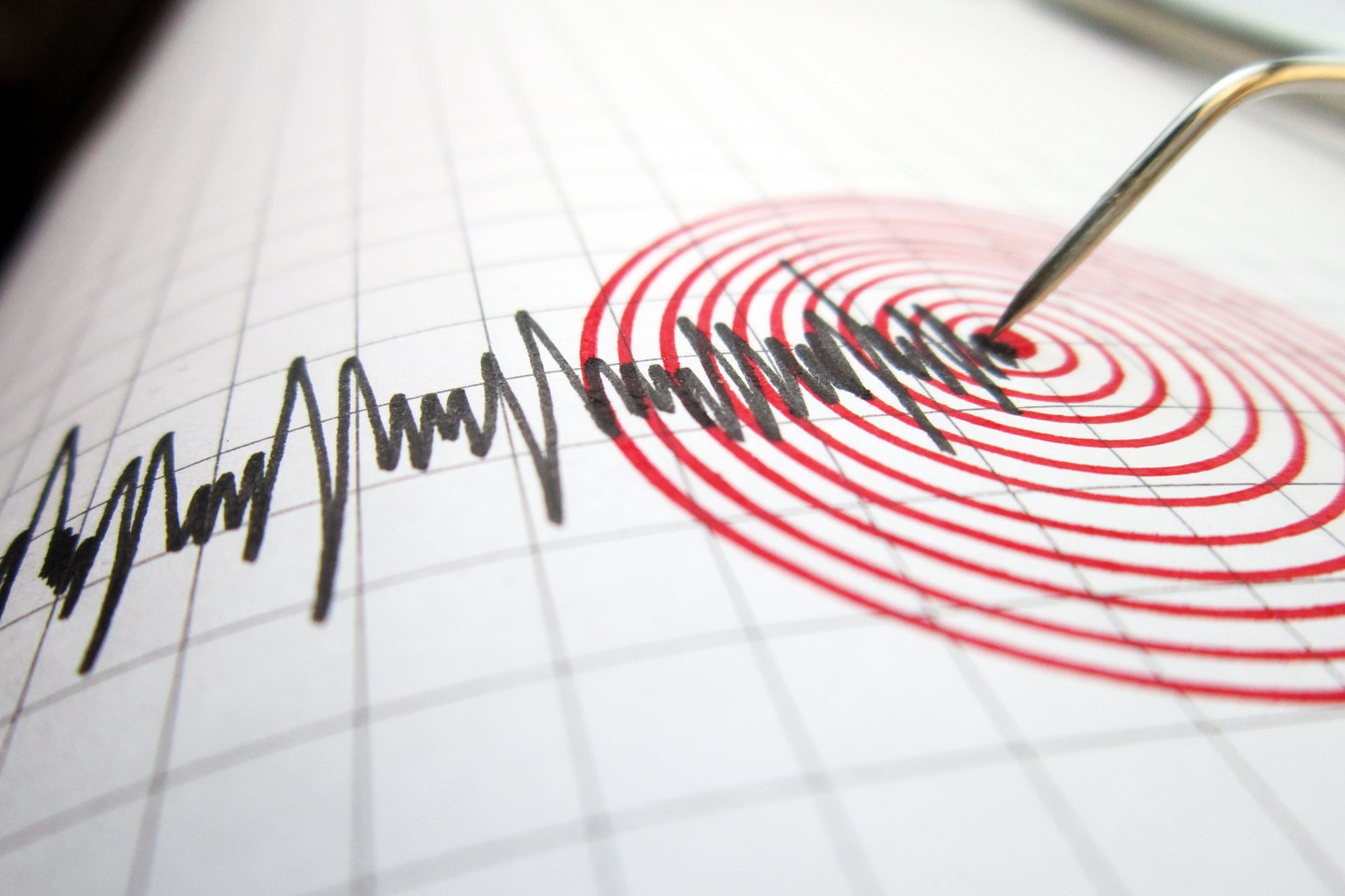
Unsupervised machine learning, coupled with the analysis of earthquake sequences as interacting events, can help identify prior signals that may occur before earthquakes. Credit: shutterstock
A new analysis of seismic “families” reveals that some large earthquakes may be preceded by hidden patterns in clustering, localization, and stress release.
The warning signs that precede a major earthquake, if any exist, are often buried in thousands of small tremors that appear ordinary at first glance. The problem geologists face is not only finding those signals, but knowing whether they are meaningful before the main rupture occurs.
Researchers from the GFZ Helmholtz Center for Geosciences, including Dr. Sadiq Karimbouli and Prof. Dr. Patricia Martinez-Garzón, worked with international partners to build a data-driven method to detect changes in seismic activity before some large earthquakes. Instead of telling the computer what warning pattern to look for, they used unsupervised machine learning, a type of artificial intelligence that looks for the structure of data without giving it pre-defined labels.
The method has been tested on several major earthquake sequences whose histories are already well documented, including Kahramanmaraş (Turkey, 2023), Iquique (Chile, 2014) and L’Aquila (Italy, 2009). In those cases, the analysis detected distinct patterns of primary tremors that appeared weeks to months before the main tremor.
When the same method was applied to earthquakes with no known prior signals, including Noto (Japan, 2024) and Amatrese (Italy, 2016), the same patterns were not found. The researchers believe that this approach could help improve practical earthquake prediction. The study was published in the journal Nature Communications.
Classification of seismic families before the 2023 Mw 7.8 Kahramanmaraş (yellow star) earthquake. Map view showing the spatial distribution of event family members color-coded with their corresponding category. Background events appear in grey. Source: Crimpoli et al. 2026, map: ESA, German Aerospace Center, AirbusEarthquake Prediction Challenge
Predicting the timing, location, and magnitude of an earthquake remains one of the most difficult unsolved problems in geoscience. Some researchers even question whether accurate prediction is possible. Instead, much of the field focuses on exogenous phenomena, that is, changes that may occur before some large earthquakes. These can include foreshocks, which are smaller earthquakes before a larger earthquake, or slow-slip events, where the fault moves quietly without causing strong shaking.
The difficulty is that these signals are inconsistent. Their timing, size, and location can vary depending on the fault, plate boundaries, local geology, and stress already stored in the crust. The pattern that appears before one earthquake may be absent before another.
Classification of earthquake families before the 2023 Mw 7.8 Kahramanmaraş (Türkiye) earthquake at major plate boundaries. Left: Colors represent chronological order. Right: Colors represent new categories of juvenile families. Credit: 4.0 Karimpouli et al 2026 Pattern recognition using unsupervised machine learning
Machine learning has already helped geologists deal with the complexity of earthquake interactions and search large earthquake catalogs for patterns that are difficult to detect manually.
In this study, Dr. Karimbouli and his colleagues changed the usual strategy. Instead of starting with a fixed idea of what the precursors should look like, they allowed the data itself to classify the seismic activity into meaningful patterns.
“Instead of searching for specific precursors, we allow the data to reveal their own structure and take advantage of so-called unsupervised learning in which diagnostic criteria are not pre-specified,” says lead author Dr. Sadiq Karimbouli, scientist in Section 4.2 “Geomechanics and Scientific Drilling” at GFZ. Similar unsupervised methods have previously helped detect early changes before landslides and volcanic eruptions.
Classification of seismic families prior to the 2014 MW 8.1 Iquique (Chile) earthquake in the subduction zone. Left: Colors represent chronological order. Right: Colors represent new categories of juvenile families. Credit: 4.0 Karimboli et al. 2026 From individual earthquakes to interacting “families.”
The next challenge was how to represent earthquakes in a way that captures their relationships. Rather than treating each earthquake as a separate point in the catalog, Dr. Karimbouli and his colleagues grouped related events into “families” based on their proximity in space, time and magnitude.
This shift is important because earthquakes can affect each other. A small rupture can change the pressure nearby, sometimes making another rupture more or less likely.
“Earthquakes are not isolated events; they influence each other, and the closer the rupture event is, the stronger this influence becomes,” explains co-author Professor Marco Bonhoff, Head of the GFZ 4.2 Department “Geomechanics and Scientific Drilling”. “By analyzing their collective behavior, we can better understand how stress builds up in the Earth’s crust before large events.”
Classification of seismic families before the 2023 Mw 7.8 Kahramanmaraş (yellow star) earthquake. Left: Map view showing the spatial distribution of color-coded juvenile family members with their corresponding category. Background events appear in grey. Right: Size and time distribution of event family members, with the cumulative number of all events (background and combined) represented by solid lines. Source: Crimpoli et al. 2026, map: ESA, German Aerospace Center, Airbus
The researchers then described each family of earthquakes using several physical and statistical characteristics. These included how tightly clustered the events were, how well they were located in space and time, and other indicators related to stress in the Earth’s crust. The unsupervised algorithm then grouped those families into categories that reflected different stages of stress development.
Dr. Karimbouli and his colleagues have already tested this approach in controlled laboratory earthquake experiments. The new question was whether this method would still work in nature, where errors are more complex and the available data are often incomplete.
Detection of transition to critical state
The researchers have applied this method to several major earthquake sequences in different tectonic environments where previous phenomena have already been reported. These included the 2023 Mw 7.8 Kahramanmaraş (Turkey) earthquake along a major strike-slip plate boundary, the 2009 Mw 6.1 L’Aquila (Italy) earthquake on segmented normal faults, and the 2014 Mw 8.1 Iquique (Chile) earthquake in a subduction zone. In each of these examples, the analysis identified a distinct type of seismic activity prior to the mainshock.
These critical modes had three main features: stronger clustering and interaction between earthquakes, increased localization in space and time, and increased seismic stress release. Together, these features indicate the presence of a fault system approaching instability.
“We are observing a shift from relatively stable activities – known from previous activities in the region – to a more organized and critical state shortly before the collapse,” says Dr. Karimbouli. In the cases studied, changes appeared weeks to months before the main earthquake.
Not all earthquakes show warning signs
The results also showed important limitations of the method. Some earthquakes may not produce detectable seismic preparations before they fail. When Dr. Crimpoli and his colleagues applied this method to the 2016 Amatrice earthquake in Italy, no clear critical category emerged compared to previous activity. The 2024 Noto earthquake in Japan also lacked a clear preparatory signal, even though the region had long-lasting swarm activity.
Classification of earthquake families prior to the 2009 Mw 6.1 L’Aquila (Italy) event on a set of segmented normal faults. Left: Colors represent chronological order. Right: Colors represent new categories of juvenile families. Credit: 4.0 Karimboli et al. 2026
“This variability reflects the complexity of monitoring conditions and seismic processes,” says co-author Professor Patricia Martinez-Garzón. “Some faults may fail without obvious seismic warning signs, which presents a major forecasting challenge.” One of the main goals of Professor Martinez-Garzón’s QUAKEHUNTER start-up project, which supports this research, is to understand when earthquake preparedness is likely to emerge and when monitoring systems can detect it.
Towards improving earthquake prediction
To explore whether this method is useful for practical forecasting, the researchers did more than just analyze past earthquakes after they occurred. In the same earthquake sequence, they also tested a possible approach. They first used previous earthquakes in each region to identify typical patterns of seismic activity. They then updated the analysis as new earthquakes occurred, observing the moments when activity began to move away from the stationary background.
In this setting, the sudden appearance of a new seismic class may indicate that the fault system is moving into a different and perhaps more dangerous state.
“This does not mean that we can predict earthquakes in a deterministic way,” Dr. Karimboli emphasizes. “But it provides a powerful tool for recognizing when a faulty system is behaving differently than usual.”
A new perspective on the evolution of large earthquakes
The study shows how earthquake physics can be combined with machine learning to reveal subtle patterns that traditional methods might miss. By focusing on how earthquake events interact as groups, this approach offers a different way to view the occurrence of large faults.
“Our findings show that machine learning can help identify the preparatory stages of earthquakes, when they are present and can be detected using installed devices,” Professor Martinez-Garzón concludes. “The next step is to incorporate such methods into real-time monitoring and better understand why some earthquakes show clear signals while others do not.”
Reference: “Preparatory phase for large earthquakes illuminated by unsupervised classification of earthquake catalog features” by Sadiq Karimpoli, Patricia Martinez-Garzón, Sebastian Nunez-Jara, Matteo Picozzi, Daniele Spalarosa, Grzegorz Kwiatek, Georg Driessen, Marco Bonhof, and Gregory C. Perosa, 4 May 2026, Nature Communications.DOI: 10.1038/s41467-026-72279-x
Sadiq Karimbouli and Patricia Martinez-Garzón have received funding from the European Research Council (ERC) under the EU Horizon 2020 research and innovation program No. 101076119 for the QUAKEHUNTER project.
Don’t miss a single breakthrough: join the SciTechDaily newsletter. Follow us on Google and Google News.
|
Sources 2/ https://scitechdaily.com/ai-detects-hidden-warning-signs-before-major-earthquakes/ The mention sources can contact us to remove/changing this article |
What Are The Main Benefits Of Comparing Car Insurance Quotes Online
LOS ANGELES, CA / ACCESSWIRE / June 24, 2020, / Compare-autoinsurance.Org has launched a new blog post that presents the main benefits of comparing multiple car insurance quotes. For more info and free online quotes, please visit https://compare-autoinsurance.Org/the-advantages-of-comparing-prices-with-car-insurance-quotes-online/ The modern society has numerous technological advantages. One important advantage is the speed at which information is sent and received. With the help of the internet, the shopping habits of many persons have drastically changed. The car insurance industry hasn't remained untouched by these changes. On the internet, drivers can compare insurance prices and find out which sellers have the best offers. View photos The advantages of comparing online car insurance quotes are the following: Online quotes can be obtained from anywhere and at any time. Unlike physical insurance agencies, websites don't have a specific schedule and they are available at any time. Drivers that have busy working schedules, can compare quotes from anywhere and at any time, even at midnight. Multiple choices. Almost all insurance providers, no matter if they are well-known brands or just local insurers, have an online presence. Online quotes will allow policyholders the chance to discover multiple insurance companies and check their prices. Drivers are no longer required to get quotes from just a few known insurance companies. Also, local and regional insurers can provide lower insurance rates for the same services. Accurate insurance estimates. Online quotes can only be accurate if the customers provide accurate and real info about their car models and driving history. Lying about past driving incidents can make the price estimates to be lower, but when dealing with an insurance company lying to them is useless. Usually, insurance companies will do research about a potential customer before granting him coverage. Online quotes can be sorted easily. Although drivers are recommended to not choose a policy just based on its price, drivers can easily sort quotes by insurance price. Using brokerage websites will allow drivers to get quotes from multiple insurers, thus making the comparison faster and easier. For additional info, money-saving tips, and free car insurance quotes, visit https://compare-autoinsurance.Org/ Compare-autoinsurance.Org is an online provider of life, home, health, and auto insurance quotes. This website is unique because it does not simply stick to one kind of insurance provider, but brings the clients the best deals from many different online insurance carriers. In this way, clients have access to offers from multiple carriers all in one place: this website. On this site, customers have access to quotes for insurance plans from various agencies, such as local or nationwide agencies, brand names insurance companies, etc. "Online quotes can easily help drivers obtain better car insurance deals. All they have to do is to complete an online form with accurate and real info, then compare prices", said Russell Rabichev, Marketing Director of Internet Marketing Company. CONTACT: Company Name: Internet Marketing CompanyPerson for contact Name: Gurgu CPhone Number: (818) 359-3898Email: [email protected]: https://compare-autoinsurance.Org/ SOURCE: Compare-autoinsurance.Org View source version on accesswire.Com:https://www.Accesswire.Com/595055/What-Are-The-Main-Benefits-Of-Comparing-Car-Insurance-Quotes-Online View photos

 |
 |
 |