
International
As the United States turns 250, new citizens feel pride and unease: ‘It’s survival’ | American immigration
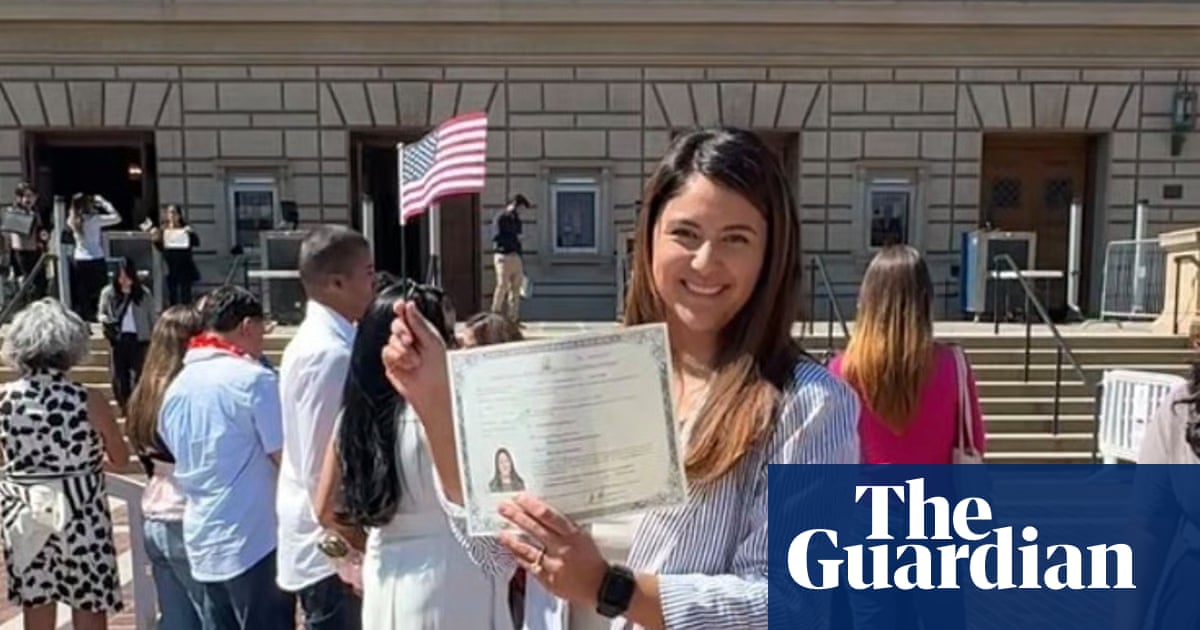
In June, Yesica McKeone officially became an American citizen. At the naturalization ceremony, she raised her hand and took the oath of allegiance to a country on the cusp of its 250th birthday. Thousands of new citizens took the oath alongside him. Some were crying softly.
“I’m finally here,” McKeone, 32, recalls thinking about his journey to citizenship. At the age of two, she left Michoacán, Mexico, with her family and moved to California, where she became a permanent resident. Today, their home is a pastoral plot of land in Solvang, in the heart of California’s central coast.
For the mother of two young children, becoming a naturalized U.S. citizen closed a long chapter of uncertainty. But at the ceremony, the surge of pride was tempered by sobering memories of federal immigrant arrests in his surrounding neighborhood.
As a new citizen, McKeone feels more legally protected, but also conflicted. His sense of true belonging seems tenuous in a country where pathways to immigration and citizenship are narrowing.
“You see people around you constantly being evicted,” McKeone said. “It’s just weird times.”
As the United States celebrates 250 years of independence, many new citizens say they feel both pride and unease about becoming Americans.
As the Trump administration seeks to limit the number of people who can reside in the country — and ultimately become Americans — the naturalization process has become more cumbersome with longer waits, stricter citizenship testing standards and high application fees. The ongoing aggressive immigration barriers and crackdown raise a question for those eligible for naturalization: Are they still welcome here?
At the same time, for many new citizens, taking the oath of naturalization provides a sense of relief amid growing uncertainty.
“It’s a matter of survival,” said Dahni Tsuboi, CEO of Asian Americans Advancing Justice Southern California (AJSocal), a Los Angeles-based nonprofit that offers citizenship application workshops, advocacy and legal services.
The cost of becoming an American
On July 4, historic sites including Mount Vernon, George Washington’s former home in Virginia, will host naturalization ceremonies as part of the nation’s celebration of America 250. The symbolism is appropriate: The country’s founders were also individuals who chose to build a new sense of belonging for their people after leaving their homeland, Tsuboi said.
“Every time a person becomes a naturalized citizen, they reenact this founding moment,” she added. “It’s very American.”
This ideal has long existed alongside a fierce debate over who can become an American. The first naturalization law, passed in 1790, limited citizenship to “free white persons.” In a speech in Chicago in 1858, Abraham Lincoln declared that anyone who believed in the Declaration of Independence’s principle that “all men are created equal” was an American.
In the 1920s, Congress began developing a restrictive quota system that limited immigration from much of the world. The Hart-Celler Act of 1965 dismantled these national origin quotas, opening the door to more diverse immigration.
But compared to other countries, such as Qatar and Kuwait, which make citizenship almost inaccessible to immigrants, the United States has an accessible naturalization process overall, said Irene Bloemraad, a professor of political science and sociology at the University of British Columbia.
Naturalization ceremony for 1,300 candidates at the Pasadena, California, convention center on June 16. Photo: Christina House/Los Angeles Times/Getty Images
“The United States is great at saying, ‘Come here. Spend some time here. Learn a little bit about us, and then you can become one of us,'” Bloemraad added. “You can become a citizen.”
As the United States enters its 250th anniversary, it is once again confronting old questions, said Rogers M Smith, professor emeritus of political science at the University of Pennsylvania.
The country’s 250th anniversary celebrations take place against a national backdrop of aggressive immigration enforcement and sweeping changes in immigration policy: the Trump administration has called into question the right to citizenship, radically restricted legal immigration, and renewed emphasis on denaturalization.
Community groups that help immigrants navigate the naturalization process say the political climate determines whether eligible immigrants feel safe enough to take the necessary steps to become citizens. At AJSocal, some people who sought legal consultation have since chosen not to move forward with the naturalization process, Tsuboi said. They cite fear, costs and other obstacles amid a broader wave of arrests of immigrants — even permanent residents and citizens.
This fear comes up against a naturalization process which has also become more demanding. Since last October, candidates have been facing a more rigorous civics test. Last week, the Department of Homeland Security proposed steep increases in citizenship application fees.
If approved, the proposal would end fee waivers and increase the application cost to $1,280 online or $1,330 on paper.
“Here we celebrate our democracy while at the same time proposing a formal act that would make membership in our democracy financially inaccessible to the most vulnerable people,” Tsuboi said.
Who does it belong to?
For some, the benefits of citizenship outweigh the costs and uncertainty. In June, Kwan “Dawn” Tang took the oath of naturalization after nearly a decade of living and working in the United States as a student and permanent resident.
For Hong Kong-born Tang, 32, the daily friction of permanent residency pushed him to begin the citizenship process. Getting home to San Francisco often meant additional checks at airports. It didn’t go well, Tang said. Coming home should be liberating, not painful. He also had no say in the elections.
Last month, after a six-month wait between application and swearing, Tang became a citizen. That was all he wanted: to be free and to call himself an American. Then double consciousness followed. He became a citizen at a time when confidence in the United States as an immigration destination was fading.
Kwan ‘Dawn’ Tang during his citizenship ceremony. Photography: Courtesy of Kwan ‘Dawn’ Tang
“At one point I just wanted to get it over with and leave,” Tang said of the naturalization ceremony. “I just wanted to go back and be in my little shell.”
Americans today live in a time that more closely resembles the restrictive period of the 1920s than any era since, Smith said. Still, he added, recent immigration restrictions are largely the result of executive action, not Congress, and may not reflect a broader national consensus.
“We are a country right now sending a signal that Americans put America first,” Smith said. “And not being as welcoming as in the past.”
This disconnect is part of a broader uncertainty about what is becoming of the country as it celebrates its 250th anniversary. More and more Americans believe America’s founders would be disappointed by the country’s current trajectory. Amid the consternation, citizenship ceremonies perpetuate a persistent idea of the country: becoming a naturalized citizen is a choice people fight for.
For July 4, the nation’s semi-fiftieth anniversary, McKeone and Tang plan to celebrate their citizenship milestones. Tang is planning a citizen-themed party in a park – cheekily dubbed “The Dawn of a New Citizen,” in reference to his nickname. There will be festive decorations with stars and stripes, and Tang plans to host a trivia game using the civics test questions he had to master to take the oath.
Let’s see what his friends know about the United States, Tang said with a laugh.
|
Sources 2/ https://www.theguardian.com/us-news/2026/jul/03/new-us-citizens-250th-anniversary The mention sources can contact us to remove/changing this article |
What Are The Main Benefits Of Comparing Car Insurance Quotes Online
LOS ANGELES, CA / ACCESSWIRE / June 24, 2020, / Compare-autoinsurance.Org has launched a new blog post that presents the main benefits of comparing multiple car insurance quotes. For more info and free online quotes, please visit https://compare-autoinsurance.Org/the-advantages-of-comparing-prices-with-car-insurance-quotes-online/ The modern society has numerous technological advantages. One important advantage is the speed at which information is sent and received. With the help of the internet, the shopping habits of many persons have drastically changed. The car insurance industry hasn't remained untouched by these changes. On the internet, drivers can compare insurance prices and find out which sellers have the best offers. View photos The advantages of comparing online car insurance quotes are the following: Online quotes can be obtained from anywhere and at any time. Unlike physical insurance agencies, websites don't have a specific schedule and they are available at any time. Drivers that have busy working schedules, can compare quotes from anywhere and at any time, even at midnight. Multiple choices. Almost all insurance providers, no matter if they are well-known brands or just local insurers, have an online presence. Online quotes will allow policyholders the chance to discover multiple insurance companies and check their prices. Drivers are no longer required to get quotes from just a few known insurance companies. Also, local and regional insurers can provide lower insurance rates for the same services. Accurate insurance estimates. Online quotes can only be accurate if the customers provide accurate and real info about their car models and driving history. Lying about past driving incidents can make the price estimates to be lower, but when dealing with an insurance company lying to them is useless. Usually, insurance companies will do research about a potential customer before granting him coverage. Online quotes can be sorted easily. Although drivers are recommended to not choose a policy just based on its price, drivers can easily sort quotes by insurance price. Using brokerage websites will allow drivers to get quotes from multiple insurers, thus making the comparison faster and easier. For additional info, money-saving tips, and free car insurance quotes, visit https://compare-autoinsurance.Org/ Compare-autoinsurance.Org is an online provider of life, home, health, and auto insurance quotes. This website is unique because it does not simply stick to one kind of insurance provider, but brings the clients the best deals from many different online insurance carriers. In this way, clients have access to offers from multiple carriers all in one place: this website. On this site, customers have access to quotes for insurance plans from various agencies, such as local or nationwide agencies, brand names insurance companies, etc. "Online quotes can easily help drivers obtain better car insurance deals. All they have to do is to complete an online form with accurate and real info, then compare prices", said Russell Rabichev, Marketing Director of Internet Marketing Company. CONTACT: Company Name: Internet Marketing CompanyPerson for contact Name: Gurgu CPhone Number: (818) 359-3898Email: [email protected]: https://compare-autoinsurance.Org/ SOURCE: Compare-autoinsurance.Org View source version on accesswire.Com:https://www.Accesswire.Com/595055/What-Are-The-Main-Benefits-Of-Comparing-Car-Insurance-Quotes-Online View photos

 |
 |
 |