
Politics
Lose the mandate of heaven
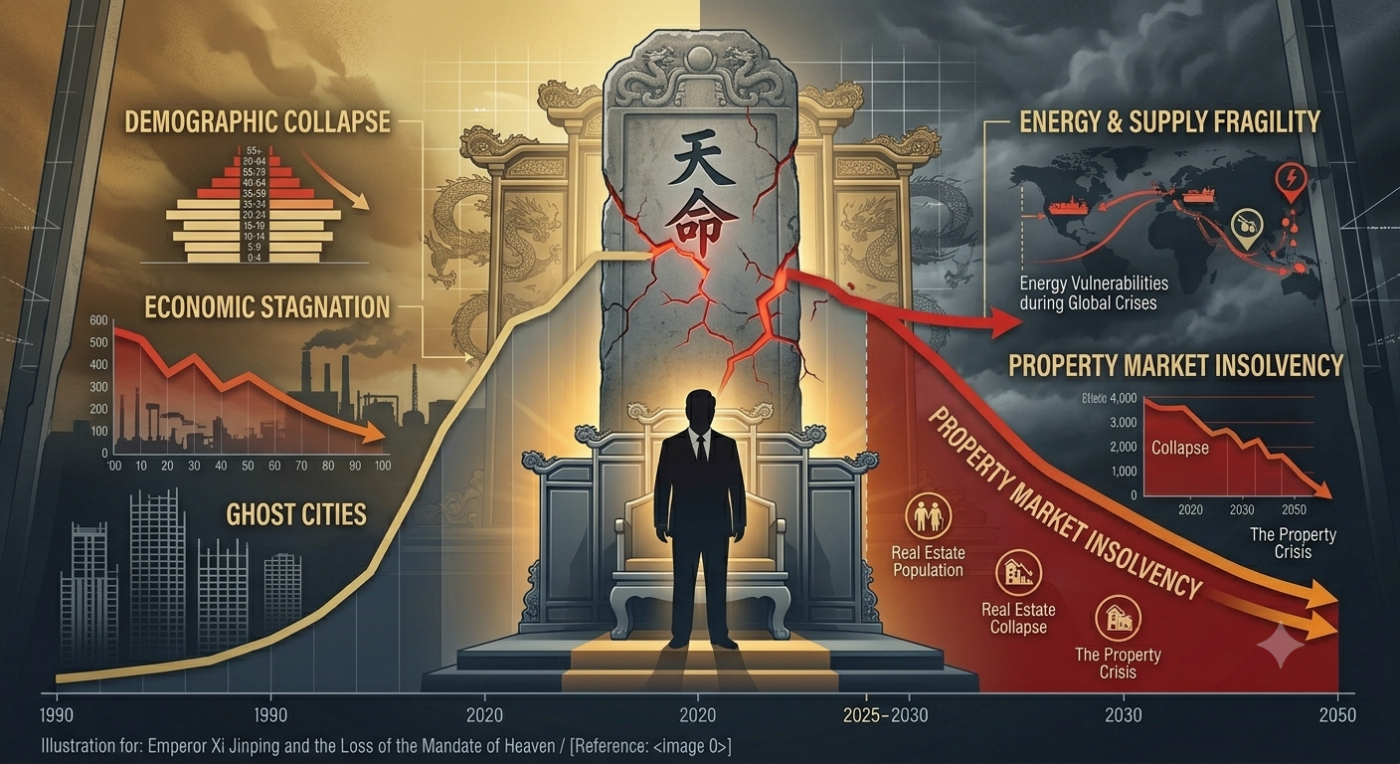

Xi Jinping must be feeling very nervous these days. Known to be a student of history, Xi is well-versed in the “dynastic cycle,” which refers to the fact that 22 Chinese dynasties have fallen or been overthrown since 2000 BCE. While popular tradition sometimes speaks of palace intrigues – indeed, precisely two of these 22 overthrows were triggered by the chaotic and destabilizing fallout from the affairs of the imperial concubines – the historical reality is that the remaining twenty collapsed due to a singular fundamental failure: the loss of the Mandate of Heaven – a Chinese one. political doctrine was used in Ancient China And Imperial China has legitimize the rule of emperor of China.
So how is China doing under Xi’s leadership? It depends where you look. On China’s periphery, the rapid consolidation of autocratic control over Hong Kong has stifled any visible dissent but permanently shattered its status as a trusted global financial center. Across the strait, Taiwan continues to reject Beijing’s overtures, thereby doubling down on its sovereignty and democratic identity. Meanwhile, heavy-handed security operations in Xinjiang and Tibet continue to draw international condemnation, and China’s aggressive maritime gray zone tactics in the South China Sea have deeply alienated its close neighbors like Vietnam and the Philippines, which are actively building counter-coalitions against Beijing’s illegal territorial expansion.
The collapse of the Twin Engine: real estate and consumer debt
On the economic front, the national discourse is no longer just about slowing growth, but rather about systemic dismantling. For decades, the Chinese Communist Party has relied on a booming real estate market to fuel local government budgets and create wealth for citizens. Today, this economic engine has completely broken down.
Figure 1. Real estate shockwave in China: key economic indicators
| Indicator | Key finding |
|---|---|
| Inventory of unsold housing | More than 778 million square meters of unsold residential inventory |
| Revenue from the sale of local government land | About 50% below the 2021 peak |
| National real estate investment | Drop of around 13.7% |
Source: Author’s compilation.
The costly and state-led construction of “ghost towns”– once seen as short-term inefficiency – has resulted in a massive and prolonged real estate collapse. Giant developers like Evergrande and Country Garden have collapsed under mountains of debt, leaving hundreds of ghost neighborhoods, half-finished skyscrapers and unbuilt apartments sprawling across the country. According to the monitoring of China National Bureau of Statisticsthe national inventory of unsold commercial housing stands at a staggering 778 million square feet, requiring an immense liquidation cycle just to stabilize the market.
This collapse directly starved local authorities, whose income from land sales fell by approximately half compared to their peak in 2021. Added to this structural rot is a metastasizing household debt crisis. Burdened by falling home values and stagnant incomes, Chinese citizens are facing severe distress, with the country accumulating around $300 billion in problematic consumer loanscrushing domestic demand and forcing state banks to aggressively restructure bad loans to hide the true extent of the damage.
Financial fatigue on the Belt and Road
Xi’s flagship foreign policy strategy, the massive Belt and Road Initiative (BRI), is simultaneously experiencing a bad debt crisis and strategic withdrawal. Initially designed to challenge US economic hegemony via trillion-dollar infrastructure loans, the program has instead exposed Beijing to immense financial vulnerability.
Many recipient countries – saddled with unpayable debts for economically unviable megaprojects – are on the brink of default. According to an exhaustive tracking of datasets published by the U.S.-China Economic and Security Review CommissionNearly 60 percent of China’s overseas loan portfolio was held by countries in explicit financial distress, a catastrophic increase from just 5 percent in 2010. Rather than financing large-scale new infrastructure under the traditional “brand,” China’s policy banks have been forced into an ongoing structural reorganization, increasingly acting as emergency lenders of last resort to prevent a chain reaction of sovereign defaults, as a study by the Journal of Global Political Economy.
This “bailout fatigue” has severely limited Beijing’s fiscal room for maneuver. Independent analysis by the Rhodium Group highlights a rapidly expanding overall domestic government deficit, reaching almost 10 percent of China’s total GDP. These domestic fiscal stresses, coupled with billions stuck in underwater foreign loans, leave the state with significantly reduced tools to inject new credit into its own crumbling national economy.
Geopolitical paralysis and Iranian energy strangulation
Nowhere is the fragility of Xi’s “superpower” ambitions more glaring than in his complete inability to influence or mitigate the devastating military conflict between the United States and Iran. Despite years of signing “comprehensive strategic partnerships” and posturing as a peacemaker in the Middle East, Beijing has remained frozen on the sidelines, completely paralyzed as a passive spectator while US kinetic operations dismantle Iranian infrastructure.
Figure 2. The Strait of Hormuz: China’s energy dependence and Iran’s export dependence
| Indicator | Key finding |
| Iranian crude oil exports to China (2025) | Around 1.4 million barrels per day, mostly disguised via Malaysian transshipment and blending |
| Chinese crude oil imports via the Strait of Hormuz | About 50% of China’s total crude oil imports pass through the strait. |
| Iranian crude oil exports to China | Around 90% of Iran’s crude oil exports are ultimately purchased by private Chinese entities. |
Source: Author’s compilation.
This paralysis reveals an existential economic vulnerability: China is totally dependent on global energy arteries that it cannot protect. Before the conflict, China was Iran’s main lifeline, quietly purchasing more than 90 percent of Iran’s total oil exports, or about 1.4 million barrels per day, often laundered and relabeled by third countries to evade secondary sanctions, according to Kpler ship tracking data evaluated by the Center on Global Energy Policy at Columbia University.
With the virtual closure of the Strait of Hormuz, through which about 50 percent of China’s total imports of foreign crude oil pass throughBeijing was hit by a massive supply shock. To avoid immediate economic cardiac arrest, Chinese refineries were forced into an unprecedented emergency withdrawal, slashing seaborne imports to their lowest level in eight years, the document shows. Reuters Market Monitoring and withdraw hundreds of millions of barrels of crude from its strategic stockpiles to keep the lights on. “of Xi”navy blue“and diplomatic influence have fully proven themselves useless to ensure the security of its own energy supply chain, proving that China remains a structural hostage to Middle East stability and US naval dominance.
The demographic death spiral
Perhaps the most permanent threat to Xi’s imperial ambitions is a self-inflicted demographic catastrophe. The long-term fallout from the one-child policy, combined with the high cost of living and the economic pessimism of young adults, has plunged China into a deadly demographic spiral from which it cannot escape.
Figure 3. Demographic reality check
| Indicator | Key statistic |
| Total births | 7.92 million (Lowest since 1949) |
| Population 60+ | 23% (323 million people) |
| Fertility rate | 0.97 (Well below the threshold of 2.1) |
Source: Author’s compilation.
China’s population now faces increasing and long-term decline. Demographic assessments published by PBS News Hour reveal that annual births have collapsed to just 7.92 million, the lowest level recorded since the founding of the People’s Republic of China in 1949. The country’s total fertility rate has fallen to a catastrophic low of 0.97 children per woman, regional research recorded in 2007. Think Chinawell below the replacement threshold of 2.1 needed to stabilize a society.
At the same time, society is aging at one of the fastest rates in human history. More than 23% of the population, or more than 323 million people, are now over 60 years old. China faces the unique crisis of aging before it gets rich. A rapidly shrinking workforce must support an exploding elderly population, putting immense pressure on public pension systems and healthcare infrastructure, while completely undermining the manufacturing labor advantage that has fueled China’s rise.
Lose the mandate
Although Xi Jinping is not an official emperor, his consolidation of absolute power – eliminating presidential term limits to effectively rule for life – means he has assumed the absolute responsibilities of an emperor.
In ancient tradition, an emperor’s right to rule was justified by the Mandate of Heaven. When a dynasty suffered from economic inequality, excessive debt, structural energy shocks, moral corruption, and domestic difficulties, it was seen as a clear sign that the gods had withdrawn their blessing.
By centralizing all state authority on himself, Xi achieved his goal of absolute control, but he also ensured that he alone bore responsibility for this systemic collapse on multiple fronts. With an imploded housing market, an unsustainable foreign aid trap, an insecure energy pipeline and a shrinking population, the cracks in the party’s foundations are growing. History suggests that when the economic bargain between rulers and ruled completely collapses, even the most heavily guarded empires discover that it is remarkably easy to lose the Mandate of Heaven.
|
Sources 2/ https://smallwarsjournal.com/2026/07/03/emperor-xi-jinping-and-the-loss-of-the-mandate-of-heaven/ The mention sources can contact us to remove/changing this article |
What Are The Main Benefits Of Comparing Car Insurance Quotes Online
LOS ANGELES, CA / ACCESSWIRE / June 24, 2020, / Compare-autoinsurance.Org has launched a new blog post that presents the main benefits of comparing multiple car insurance quotes. For more info and free online quotes, please visit https://compare-autoinsurance.Org/the-advantages-of-comparing-prices-with-car-insurance-quotes-online/ The modern society has numerous technological advantages. One important advantage is the speed at which information is sent and received. With the help of the internet, the shopping habits of many persons have drastically changed. The car insurance industry hasn't remained untouched by these changes. On the internet, drivers can compare insurance prices and find out which sellers have the best offers. View photos The advantages of comparing online car insurance quotes are the following: Online quotes can be obtained from anywhere and at any time. Unlike physical insurance agencies, websites don't have a specific schedule and they are available at any time. Drivers that have busy working schedules, can compare quotes from anywhere and at any time, even at midnight. Multiple choices. Almost all insurance providers, no matter if they are well-known brands or just local insurers, have an online presence. Online quotes will allow policyholders the chance to discover multiple insurance companies and check their prices. Drivers are no longer required to get quotes from just a few known insurance companies. Also, local and regional insurers can provide lower insurance rates for the same services. Accurate insurance estimates. Online quotes can only be accurate if the customers provide accurate and real info about their car models and driving history. Lying about past driving incidents can make the price estimates to be lower, but when dealing with an insurance company lying to them is useless. Usually, insurance companies will do research about a potential customer before granting him coverage. Online quotes can be sorted easily. Although drivers are recommended to not choose a policy just based on its price, drivers can easily sort quotes by insurance price. Using brokerage websites will allow drivers to get quotes from multiple insurers, thus making the comparison faster and easier. For additional info, money-saving tips, and free car insurance quotes, visit https://compare-autoinsurance.Org/ Compare-autoinsurance.Org is an online provider of life, home, health, and auto insurance quotes. This website is unique because it does not simply stick to one kind of insurance provider, but brings the clients the best deals from many different online insurance carriers. In this way, clients have access to offers from multiple carriers all in one place: this website. On this site, customers have access to quotes for insurance plans from various agencies, such as local or nationwide agencies, brand names insurance companies, etc. "Online quotes can easily help drivers obtain better car insurance deals. All they have to do is to complete an online form with accurate and real info, then compare prices", said Russell Rabichev, Marketing Director of Internet Marketing Company. CONTACT: Company Name: Internet Marketing CompanyPerson for contact Name: Gurgu CPhone Number: (818) 359-3898Email: [email protected]: https://compare-autoinsurance.Org/ SOURCE: Compare-autoinsurance.Org View source version on accesswire.Com:https://www.Accesswire.Com/595055/What-Are-The-Main-Benefits-Of-Comparing-Car-Insurance-Quotes-Online View photos

 |
 |
 |