
Uncategorized
UT-led team wins Gordon Bell Prize for advanced research on real-time tsunami digital twin – UT Austin News
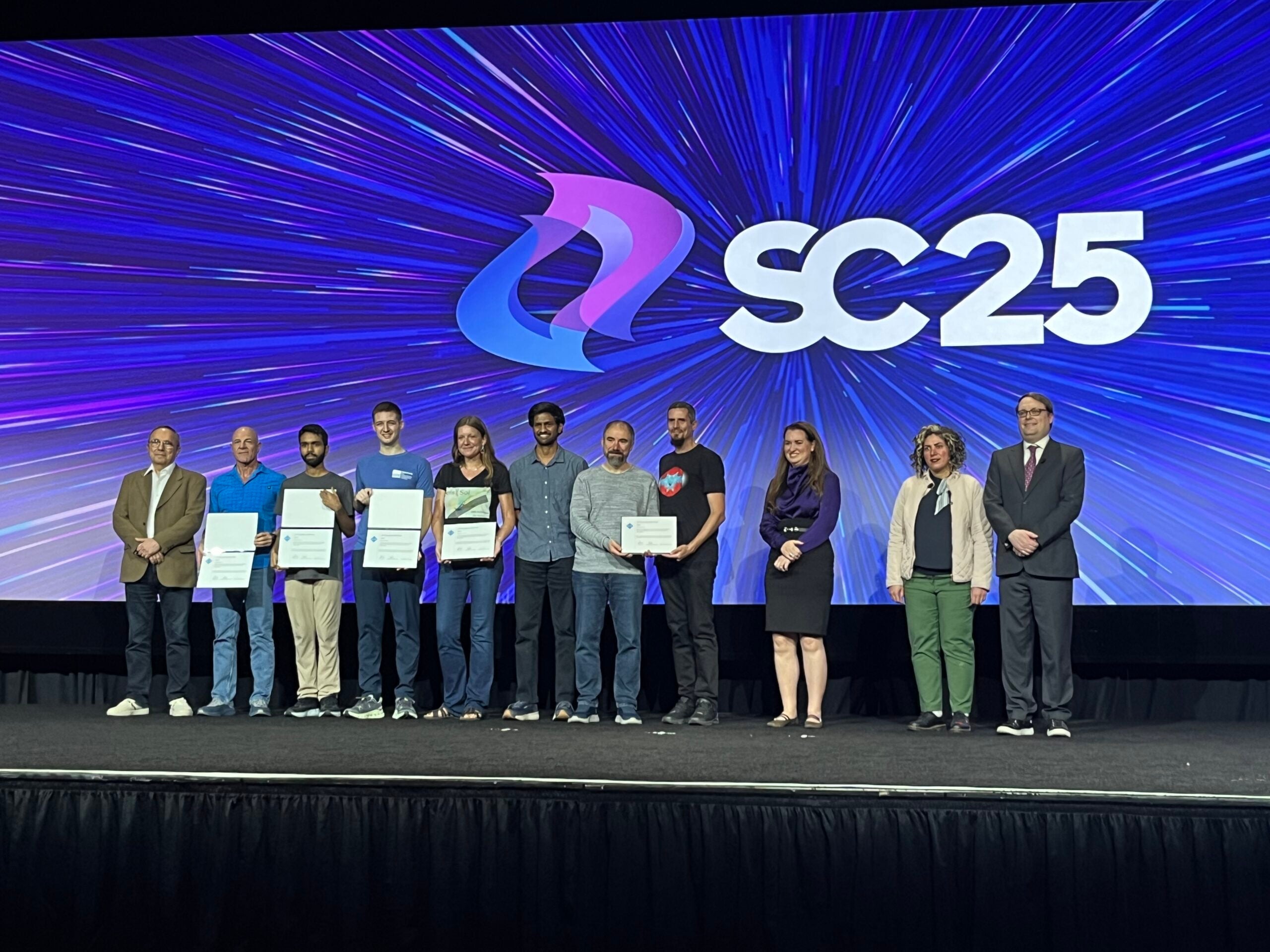
A research team led by Omar Ghattas, professor of mechanical engineering and senior faculty member at the Auden Institute at the University of Texas at Austin, has received the 2025 Gordon Bell Award from the Association for Computing Machinery (ACM) for their work in real-time tsunami prediction. The Gordon Bell Prize, often referred to as the Nobel Prize for Supercomputing, rewards innovation in high-performance computing applications in science, engineering, and large-scale data analytics. It was awarded on November 20 at the leading high-performance computing conference, SC25.
The team's pioneering research has the potential to significantly improve early warning systems for coastal communities close to earthquake and tsunami-prone areas. Their approach uses pressure sensor data from the seafloor combined with physics-based predictive models to create a digital twin that predicts tsunami propagation. The novelty of the work lies in the team's new digital twin algorithms, which achieve a 10 billion-fold speedup compared to current state-of-the-art methods. This means that a prediction that would have until now required fifty years of supercomputing time can be made by the digital twin in a fraction of a second – enough time to save lives.
“For the first time, we can combine real-time sensor data with full physical modeling and quantification of uncertainty – fast enough to make decisions before the tsunami reaches shore,” said Ghattas, the project leader. “It is a great honor for our team to receive this highest recognition in the field of supercomputing.”
The research focused on the seismically dangerous Cascadia Subduction Zone in the Pacific Northwest — an area extending from northern California to British Columbia, Canada, where seismologists estimate a 37% chance of an earthquake of magnitude 8.0 or higher occurring in the next 50 years. The team used the world's most powerful supercomputers, including the No. 1 El Capitan machine at Lawrence Livermore National Laboratory (LLNL), the Perlmutter machine from the National Energy Research Center for Scientific Computing, the Alps machine from the Swiss National Supercomputing Center, and the Frontera machine from the Texas Center for Advanced Computing. Extensions of this dual digital framework could enable modular predictive early warning systems for many other hazards, from wildfires and severe weather to pollutant spread and threat detection.
In addition to Ghattas, the research team includes Stefan Henking, Sriram Venkat, and Melinda Fernando (Auden Institute); Alice Agnes Gabriel (Scripps Institution of Oceanography, University of California, San Diego); Veselin Dobrev, John Kamer, and Tzanio Kolev (Lawrence Livermore National Laboratory).
“By combining the power of El Capitan with advanced high-order finite element algorithms, we were able to solve problems with more than 50 trillion unknowns in an unprecedented way on 40,000 GPUs, while maintaining excellent parallel efficiency,” said Kolev, a computational mathematician at Lawrence Livermore National Laboratory.
“As a seismologist, what interests me most is that this digital twin links the full physics of massive dynamic rupture and tsunami generation with real-time seafloor observations,” said Gabriel, associate professor in the Institute of Geophysics and Planetary Physics at Scripps Institution of Oceanography.
How does a digital twin work?
The digital coupled framework uses subduction zone seafloor pressure data, combined with 3D coupled acoustic gravity-wave equations, to infer the spatiotemporal seafloor motion induced by earthquakes using new Bayesian inversion algorithms. The inferred seafloor motion then provides the source for simulating tsunami propagation towards coastlines and producing predictions of wave heights at specific locations with quantitative uncertainty. The entire frame is executed in a fraction of a second, providing an actionable early warning to inform evacuation decisions and first responders before a tsunami hits, which can reach the coast in less than 15 minutes after an earthquake.
The team's 10 billion-fold speedup was achieved by designing new GPU algorithms for real-time Bayesian inversion. The digital twin is built and deployed in two phases: a computationally demanding offline phase that precomputes effective representations of the inversion operator, and an online phase that issues real-time probabilistic tsunami forecasts when an earthquake occurs. In the offline phase, the research team used the MFEM finite element library to solve 3D acoustic gravitational wave equations, scaling the solution with near-perfect parallel efficiency to 43,520 GPUs on the world's fastest supercomputer, LLNL's El Capitan. In the online phase, new virtual inversion algorithms allowed inference and prediction on a more modest set of 512 GPUs in less than a second.
The Bell Award-winning research, titled “Large-Scale Real-Time Bayesian Inference: A Digital Twin of Tsunami Early Warning Applied to the Cascadia Subduction Zone,” was published on November 15 as part of the proceedings of the SC25 conference. Innovations reported in the paper include:
Fastest time to solve a PDE-based Bayesian inverse problem with 1 billion parameters in 0.2 seconds Largest unstructured lattice finite element simulation to date with 55.5 trillion unknowns on 43,520 GPUs of LLNL's El Capitan system
In addition to the Bell Award, the team received two other awards at SC25: the Hyperion Research HPC Innovation Excellence Award and the HPCWire Reader's Choice Award for Best Use of HPC in the Physical Sciences.
The ACM Gordon Bell Award is awarded annually, honoring outstanding achievement in high-performance computing applications. The award is named after the pioneering computer engineer who founded the US National Science Foundation's Directorate of Computer and Information Science and Engineering.
|
Sources 2/ https://news.utexas.edu/2025/11/20/ut-austin-led-team-wins-gordon-bell-prize-for-breakthrough-research-on-real-time-tsunami-digital-twin/ The mention sources can contact us to remove/changing this article |
What Are The Main Benefits Of Comparing Car Insurance Quotes Online
LOS ANGELES, CA / ACCESSWIRE / June 24, 2020, / Compare-autoinsurance.Org has launched a new blog post that presents the main benefits of comparing multiple car insurance quotes. For more info and free online quotes, please visit https://compare-autoinsurance.Org/the-advantages-of-comparing-prices-with-car-insurance-quotes-online/ The modern society has numerous technological advantages. One important advantage is the speed at which information is sent and received. With the help of the internet, the shopping habits of many persons have drastically changed. The car insurance industry hasn't remained untouched by these changes. On the internet, drivers can compare insurance prices and find out which sellers have the best offers. View photos The advantages of comparing online car insurance quotes are the following: Online quotes can be obtained from anywhere and at any time. Unlike physical insurance agencies, websites don't have a specific schedule and they are available at any time. Drivers that have busy working schedules, can compare quotes from anywhere and at any time, even at midnight. Multiple choices. Almost all insurance providers, no matter if they are well-known brands or just local insurers, have an online presence. Online quotes will allow policyholders the chance to discover multiple insurance companies and check their prices. Drivers are no longer required to get quotes from just a few known insurance companies. Also, local and regional insurers can provide lower insurance rates for the same services. Accurate insurance estimates. Online quotes can only be accurate if the customers provide accurate and real info about their car models and driving history. Lying about past driving incidents can make the price estimates to be lower, but when dealing with an insurance company lying to them is useless. Usually, insurance companies will do research about a potential customer before granting him coverage. Online quotes can be sorted easily. Although drivers are recommended to not choose a policy just based on its price, drivers can easily sort quotes by insurance price. Using brokerage websites will allow drivers to get quotes from multiple insurers, thus making the comparison faster and easier. For additional info, money-saving tips, and free car insurance quotes, visit https://compare-autoinsurance.Org/ Compare-autoinsurance.Org is an online provider of life, home, health, and auto insurance quotes. This website is unique because it does not simply stick to one kind of insurance provider, but brings the clients the best deals from many different online insurance carriers. In this way, clients have access to offers from multiple carriers all in one place: this website. On this site, customers have access to quotes for insurance plans from various agencies, such as local or nationwide agencies, brand names insurance companies, etc. "Online quotes can easily help drivers obtain better car insurance deals. All they have to do is to complete an online form with accurate and real info, then compare prices", said Russell Rabichev, Marketing Director of Internet Marketing Company. CONTACT: Company Name: Internet Marketing CompanyPerson for contact Name: Gurgu CPhone Number: (818) 359-3898Email: [email protected]: https://compare-autoinsurance.Org/ SOURCE: Compare-autoinsurance.Org View source version on accesswire.Com:https://www.Accesswire.Com/595055/What-Are-The-Main-Benefits-Of-Comparing-Car-Insurance-Quotes-Online View photos

 |
 |
 |