
International
10 years of Brexit: the economy
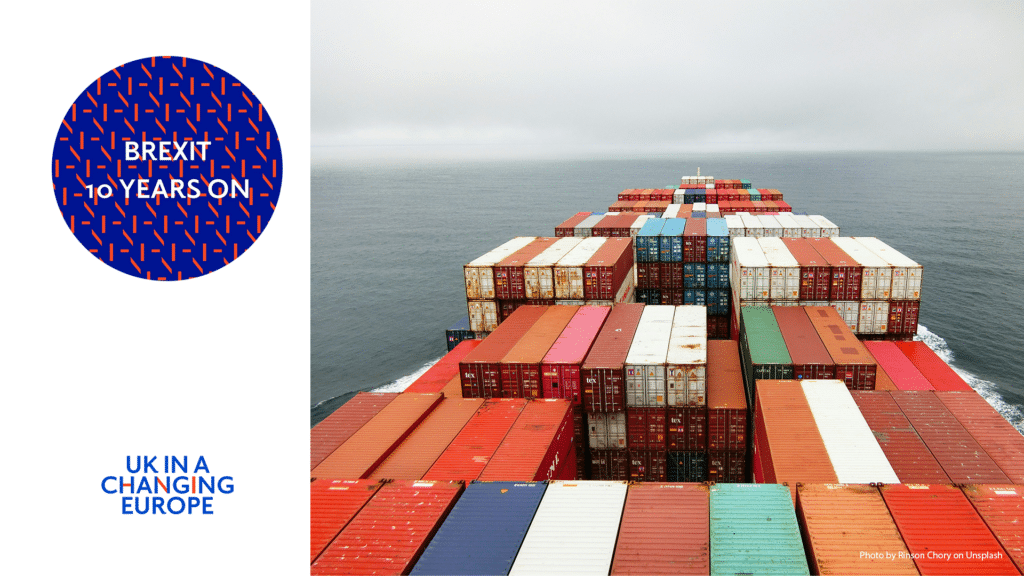
Ahead of the 10th anniversary of the EU referendum on 23 June, experts on Britain’s changing Europe have written a series of short blogs reflecting on the key issues of Brexit then and now. Here, Jonathan Portes looks at the economic impact of Brexit.
Brexit has always been an economic balance. The decision was to move away from closer integration with the EU in exchange for greater domestic control over immigration, regulation and trade policy. The question was not whether this would entail costs. The question was how big the costs would be, how quickly they would emerge, and whether the benefits of autonomy would offset them.
Now, almost a decade after the referendum, the broad answer has become clearer. Brexit has left the UK economy smaller than it would otherwise have been. The result was not a sudden collapse but a gradual and cumulative disruption to trade, investment and productivity.
The Trade and Cooperation Agreement avoided tariffs on most trade in goods. But this has not preserved anything close to the economic relationship the UK had as a member of the single market and customs union. Businesses now face customs inspections, rules of origin requirements, regulatory paperwork and the loss of automatic business name recognition. Service companies, especially in the regulated sector, have lost important market access. Free movement has ended.
These changes have increased the cost of doing business with the UK’s largest trading partner. Standard trade theory predicted declines in trade, investment, and productivity over time.
The evidence now points strongly in that direction. The initial estimates released immediately after the referendum were necessarily provisional. They had little post-Brexit data to work with and had to separate the impact of Brexit from Covid-19, the energy shock and wider global disruption. But as more data accumulated, a clearer picture emerged.
The most severe current estimates suggest that Britain’s GDP is several percentage points lower than it would otherwise be. The Office for Budget Responsibility has long assumed that Brexit would reduce long-term productivity by around 4%. The main reason is that lower trade intensity makes the economy less open and less productive. Other studies using synthetic control methods or firm-level evidence produce estimates with equally wide ranges, sometimes larger.
The exact number is less important than the direction and persistence of the effect. Brexit has not caused an immediate recession since 2016. Trade with Europe did not simply stop either. But that was by no means the most plausible mechanism. The more important effects are cumulative. That is: fewer business transactions, weaker investments, less competitive pressures, less integration into European supply chains, and fewer flows of knowledge and technology across borders.
Trade is the most direct channel. The UK’s goods trade has underperformed pre-Brexit trends and comparable economies. Typically, estimates suggest that exports of goods are about 10 to 15 percent lower than they would otherwise be, with a similar impact on imports.
One obvious conundrum is that aggregate data does not always show a simple collapse in UK-EU trade compared to trade with the rest of the world. But this is less reassuring than it seems. Brexit has affected the UK’s position in global value chains, as well as its bilateral trade with the EU. If British companies become less attractive as part of European supply chains, they could lose business with both EU and non-EU partners.
There is also a company size effect. Larger companies are better able to absorb new administrative and regulatory costs. Smaller companies have less ability to do that. As a result, while the number of companies exporting to the EU may decline, total trade flows may appear relatively resilient. This is important because exports are one route for small businesses to grow, innovate and increase productivity.
Trade in services is more mixed. The UK is strong in high-value services that can be delivered digitally, which have proven to be more resilient than goods. But this aggregate resilience masks sector-specific losses. Financial services, legal services and other regulated sectors face new barriers as the TCA offers only limited access compared to single market membership.
Investment may be the most important channel economically. Brexit has brought about increased uncertainty and reduced expected returns for companies that base their European markets on the UK.
This is important because productivity growth largely depends on investment. If investment continues to be low, the productivity of the economy declines. Brexit has therefore exacerbated one of the UK’s existing weaknesses: its poor productivity performance since the financial crisis.
The migration story is different. The end of free movement led to a sharp decline in EU migration. In sectors such as hospitality, agriculture, logistics, food processing and manufacturing, the supply of a familiar and flexible workforce has become impossible. In many cases, adjustments have been made not through large wage increases but through price increases, production reductions, or business model changes.
However, the post-Brexit immigration system has allowed for much more non-EU migration, particularly through work and study routes. Collectively, this more than offsets the decline in EU migration. The result was a compositional shift rather than a simple reduction in migration.
Economically, this is more ambiguous than the trade story. Overall, changes in migration increased total GDP compared to the low-migration scenario, but the impact on GDP per capita was smaller and harder to pinpoint.
The broader problem is that Brexit has made it more difficult to address the UK’s existing economic challenges. The country already had low productivity growth, low investment, strained public finances and large regional inequalities. Reducing trade intensity and weakening investment will make these problems worse. A smaller economy means lower tax revenues, which limits the government’s fiscal space to improve public services or cut taxes.
What about the benefits of autonomy? In principle, the UK could now regulate differently, set its own trade policy and design its own immigration system. In reality, the economic benefits have so far been limited. Regulatory differences can create opportunities in certain areas, but they also increase costs in many other areas. New trade deals with non-EU countries could bring some benefits, but these are small compared to the costs of reduced EU integration, according to official estimates.
The UK-EU ‘common understanding’ of May 2025 must be seen in this context. Agreements that reduce checks on agri-food trade, improve professional mobility, ease regulatory friction or support collaboration in specific sectors will reduce costs for some companies. Smaller exporters in particular can benefit from lower fixed costs. However, such measures cannot replicate the economic value of single market membership.
So Brexit did not cause an economic crisis in the traditional sense. The UK economy continues to grow, unemployment is relatively low and many businesses have adapted. But adaptation is not the same as being cost-free. The more relevant counterfactual is not whether the economy is still functioning, but rather how much better the economy might have performed. The evidence on that question has become increasingly clear.
Author: Professor Jonathan Portes, Professor of Economics and Public Policy, Department of Political Economy, King’s College London.
|
Sources 2/ https://ukandeu.ac.uk/brexit-ten-years-on-the-economy/ The mention sources can contact us to remove/changing this article |
What Are The Main Benefits Of Comparing Car Insurance Quotes Online
LOS ANGELES, CA / ACCESSWIRE / June 24, 2020, / Compare-autoinsurance.Org has launched a new blog post that presents the main benefits of comparing multiple car insurance quotes. For more info and free online quotes, please visit https://compare-autoinsurance.Org/the-advantages-of-comparing-prices-with-car-insurance-quotes-online/ The modern society has numerous technological advantages. One important advantage is the speed at which information is sent and received. With the help of the internet, the shopping habits of many persons have drastically changed. The car insurance industry hasn't remained untouched by these changes. On the internet, drivers can compare insurance prices and find out which sellers have the best offers. View photos The advantages of comparing online car insurance quotes are the following: Online quotes can be obtained from anywhere and at any time. Unlike physical insurance agencies, websites don't have a specific schedule and they are available at any time. Drivers that have busy working schedules, can compare quotes from anywhere and at any time, even at midnight. Multiple choices. Almost all insurance providers, no matter if they are well-known brands or just local insurers, have an online presence. Online quotes will allow policyholders the chance to discover multiple insurance companies and check their prices. Drivers are no longer required to get quotes from just a few known insurance companies. Also, local and regional insurers can provide lower insurance rates for the same services. Accurate insurance estimates. Online quotes can only be accurate if the customers provide accurate and real info about their car models and driving history. Lying about past driving incidents can make the price estimates to be lower, but when dealing with an insurance company lying to them is useless. Usually, insurance companies will do research about a potential customer before granting him coverage. Online quotes can be sorted easily. Although drivers are recommended to not choose a policy just based on its price, drivers can easily sort quotes by insurance price. Using brokerage websites will allow drivers to get quotes from multiple insurers, thus making the comparison faster and easier. For additional info, money-saving tips, and free car insurance quotes, visit https://compare-autoinsurance.Org/ Compare-autoinsurance.Org is an online provider of life, home, health, and auto insurance quotes. This website is unique because it does not simply stick to one kind of insurance provider, but brings the clients the best deals from many different online insurance carriers. In this way, clients have access to offers from multiple carriers all in one place: this website. On this site, customers have access to quotes for insurance plans from various agencies, such as local or nationwide agencies, brand names insurance companies, etc. "Online quotes can easily help drivers obtain better car insurance deals. All they have to do is to complete an online form with accurate and real info, then compare prices", said Russell Rabichev, Marketing Director of Internet Marketing Company. CONTACT: Company Name: Internet Marketing CompanyPerson for contact Name: Gurgu CPhone Number: (818) 359-3898Email: [email protected]: https://compare-autoinsurance.Org/ SOURCE: Compare-autoinsurance.Org View source version on accesswire.Com:https://www.Accesswire.Com/595055/What-Are-The-Main-Benefits-Of-Comparing-Car-Insurance-Quotes-Online View photos

 |
 |
 |