
Politics
The president keeps contradicting himself on AI
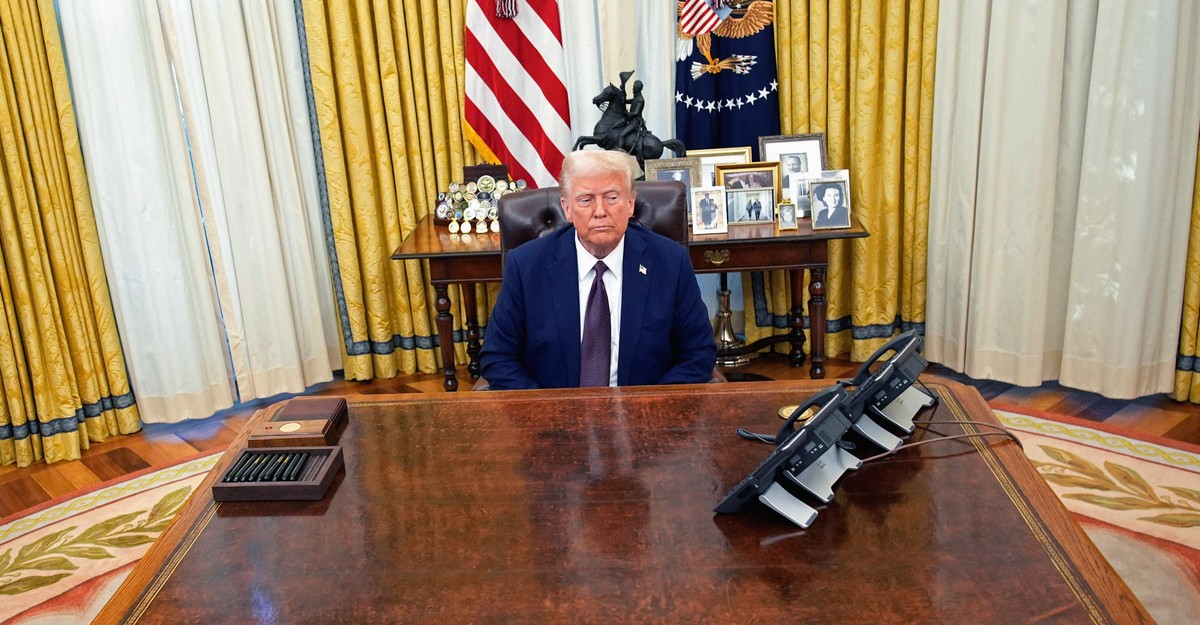
For months, the White House has suggested that it could try to rein in the AI industry. Just two weeks ago, the country’s top tech executives, including Sam Altman and Dario Amodei, were invited to attend a signing ceremony for a highly anticipated executive order on AI. But just hours before the ceremony, Donald Trump abandoned him. America is leading the world in the AI race, the president told reporters at the time, “and I don’t want to do anything that will hinder that lead.”
Apparently, Trump has changed his mind again. Earlier today, the president signed an executive order that will create a process for large AI companies to voluntarily share certain upcoming models with the government for security testing for up to a month before wider release. OpenAI, Anthropic and others will also be asked to work with the government to strengthen federal, state and local cyber defenses. White House spokesperson Liz Huston told us the policy reflects a “common-sense approach to working with industry to balance innovation and safety.”
The order itself is relatively ineffective: even before today, major AI companies already had deals in place that allowed the government to preemptively test their models for security risks. The new rule “effectively formalizes what has already happened between the U.S. government and major AI companies,” Daniel Remler, an AI expert at the Center for a New American Security, told us.
But the executive order is significant in that the president does something – anything – about AI. Early in his second term, Trump let tech companies know he would stay away. Last January, he rolled back a series of modest Joe Biden-era policies, calling the rules “dangerous” and an “impediment” to U.S. leadership on AI. Even the preamble to today’s executive order celebrates the fact that Trump “unleashed tremendous technological growth” by “removing the bureaucratic constraints that the previous administration placed on American AI developers.” Yet the core elements of these supposedly dangerous Biden-era AI regulations — voluntary agreements to share information about advanced AI models with federal agencies, for example, as well as federal programs aimed at harnessing AI for cyber defense — are strikingly similar to today’s new executive order on AI. Dean Ball, a former AI adviser to the Trump administration, wrote that this policy “is considerably more intrusive” than Biden’s executive order.
Today’s order could have been much harsher. When the White House began considering the possibility of regulatory action in May, an administration official suggested that AI models would be reviewed “just like an FDA drug.” Even the leaked draft of the version Trump initially planned to sign last month would have been more burdensome for tech companies. After David Sacks, the former White House AI chief, called the president to complain, Trump canceled the signing ceremony. Today, after the new order was announced, Sacks said the watered-down provisions were a “game changer” on X — despite the fact that the government’s new review process isn’t all that different from what he initially opposed. That means two former libertarian AI advisers in the White House – Ball and Sacks – disagree on whether this order is a good thing.
At the same time, Steve Bannon, Trump’s former chief strategist and one of the leading critics of AI on the right, joined Sacks in praising the rule. “It’s not perfect,” he told us. “But directionally, it’s pretty darn good.” According to Bannon, even though the order is weaker than previous versions, the codification of the rules is a step in the right direction.
This whole chaotic saga – an insane White House, confusing pronouncements from populists and whisperers from Trump’s tech elite – is just the latest in a long line of strange and often contradictory positions on AI policy. Trump’s approach to AI has been inconsistent, if not incoherent, almost since the day he took office. Consider that, for all the talk about cybersecurity, this administration has also gutted the Cybersecurity and Infrastructure Security Agency, the government agency that aims to protect the nation from hackers. CISA also happens to be one of the primary federal agencies responsible for implementing the current executive order.
Or take the White House’s relationship with Anthropic. On the one hand, Anthropic likely triggered the executive order in the first place. In April, the company announced Claude Mythos Preview, a new model with advanced hacking capabilities that sparked concerns about the growing power of AI companies. Since then, the president seems to be getting closer to Anthropic. Dario Amodei, the company’s CEO, visited the White House that same month to discuss the future of the government’s relationship with the company. “I like high IQ people, and they certainly have high IQs,” Trump later told reporters about Anthropic’s leadership.
On the other hand, the Trump administration appears to be fighting in court to ban Anthropic from doing most national security work. In February, the Pentagon designated Anthropic a “supply chain risk” after a high-profile contract dispute over the use of AI in warfare, essentially declaring that simply touching Anthropic products constituted a national security risk. In late April, when Anthropic attempted to grant Mythos access to more companies for cyber defense – entirely consistent with today’s executive order – the White House appeared to inexplicably block the move. (An Anthropic spokesperson pointed us to an article on X in which the company called today’s executive order “an important step in strengthening U.S. leadership in AI.”)
Then there is the administration’s attitude toward China. Trump has repeatedly emphasized the need to deregulate the AI industry in order to stay ahead of China. At the same time, he also allowed Nvidia to sell some of its most advanced AI chips to Chinese companies, lifting export controls put in place by the Biden administration precisely to hinder the development of Chinese AI. (Anthropic, incidentally, denied a Chinese think tank access to Mythos.) Trump has, in the name of his victory over China, pushed to remove regulatory constraints on data center construction: “Build, baby, build,” he said last July. But when the outcry erupted over rising data center electricity bills, the White House announced a voluntary commitment for AI companies to take a number of steps that would prevent ordinary people from paying for data center electricity. Build, baby, but with caution.
In fact, some hesitation appears to be driven by public opinion. In recent months, as AI models have improved, attitudes toward the technology have deteriorated. Today’s order makes the administration appear to be undertaking stricter regulation of AI, but it doesn’t actually require the industry to do much, if anything. Trump is trying to score points with both the public and Silicon Valley. But in doing so, he neither says nor does anything of substance.
AI spending is consuming the U.S. economy, people are afraid of losing their jobs to AI, and communities across the country are coming together to protest data centers. Political figures as divergent as Bannon and Bernie Sanders are expressing concern about AI and the concentration of power among industry leaders. This appears to be a clarion call for the President of the United States, and a populist one at that. Instead, the White House spent weeks procrastinating on an executive order that relies on the voluntary cooperation of the AI industry. As Anthropic, OpenAI, and their competitors become major economic and geopolitical powers, the window for a government to seriously regulate AI is rapidly closing. Hopefully it’s not gone already.
|
Sources 2/ https://www.theatlantic.com/technology/2026/06/trump-ai-executive-order/687410/ The mention sources can contact us to remove/changing this article |
What Are The Main Benefits Of Comparing Car Insurance Quotes Online
LOS ANGELES, CA / ACCESSWIRE / June 24, 2020, / Compare-autoinsurance.Org has launched a new blog post that presents the main benefits of comparing multiple car insurance quotes. For more info and free online quotes, please visit https://compare-autoinsurance.Org/the-advantages-of-comparing-prices-with-car-insurance-quotes-online/ The modern society has numerous technological advantages. One important advantage is the speed at which information is sent and received. With the help of the internet, the shopping habits of many persons have drastically changed. The car insurance industry hasn't remained untouched by these changes. On the internet, drivers can compare insurance prices and find out which sellers have the best offers. View photos The advantages of comparing online car insurance quotes are the following: Online quotes can be obtained from anywhere and at any time. Unlike physical insurance agencies, websites don't have a specific schedule and they are available at any time. Drivers that have busy working schedules, can compare quotes from anywhere and at any time, even at midnight. Multiple choices. Almost all insurance providers, no matter if they are well-known brands or just local insurers, have an online presence. Online quotes will allow policyholders the chance to discover multiple insurance companies and check their prices. Drivers are no longer required to get quotes from just a few known insurance companies. Also, local and regional insurers can provide lower insurance rates for the same services. Accurate insurance estimates. Online quotes can only be accurate if the customers provide accurate and real info about their car models and driving history. Lying about past driving incidents can make the price estimates to be lower, but when dealing with an insurance company lying to them is useless. Usually, insurance companies will do research about a potential customer before granting him coverage. Online quotes can be sorted easily. Although drivers are recommended to not choose a policy just based on its price, drivers can easily sort quotes by insurance price. Using brokerage websites will allow drivers to get quotes from multiple insurers, thus making the comparison faster and easier. For additional info, money-saving tips, and free car insurance quotes, visit https://compare-autoinsurance.Org/ Compare-autoinsurance.Org is an online provider of life, home, health, and auto insurance quotes. This website is unique because it does not simply stick to one kind of insurance provider, but brings the clients the best deals from many different online insurance carriers. In this way, clients have access to offers from multiple carriers all in one place: this website. On this site, customers have access to quotes for insurance plans from various agencies, such as local or nationwide agencies, brand names insurance companies, etc. "Online quotes can easily help drivers obtain better car insurance deals. All they have to do is to complete an online form with accurate and real info, then compare prices", said Russell Rabichev, Marketing Director of Internet Marketing Company. CONTACT: Company Name: Internet Marketing CompanyPerson for contact Name: Gurgu CPhone Number: (818) 359-3898Email: [email protected]: https://compare-autoinsurance.Org/ SOURCE: Compare-autoinsurance.Org View source version on accesswire.Com:https://www.Accesswire.Com/595055/What-Are-The-Main-Benefits-Of-Comparing-Car-Insurance-Quotes-Online View photos

 |
 |
 |