
Politics
Two brands, two visions of the future of NATO

07/19/2026. 07:15
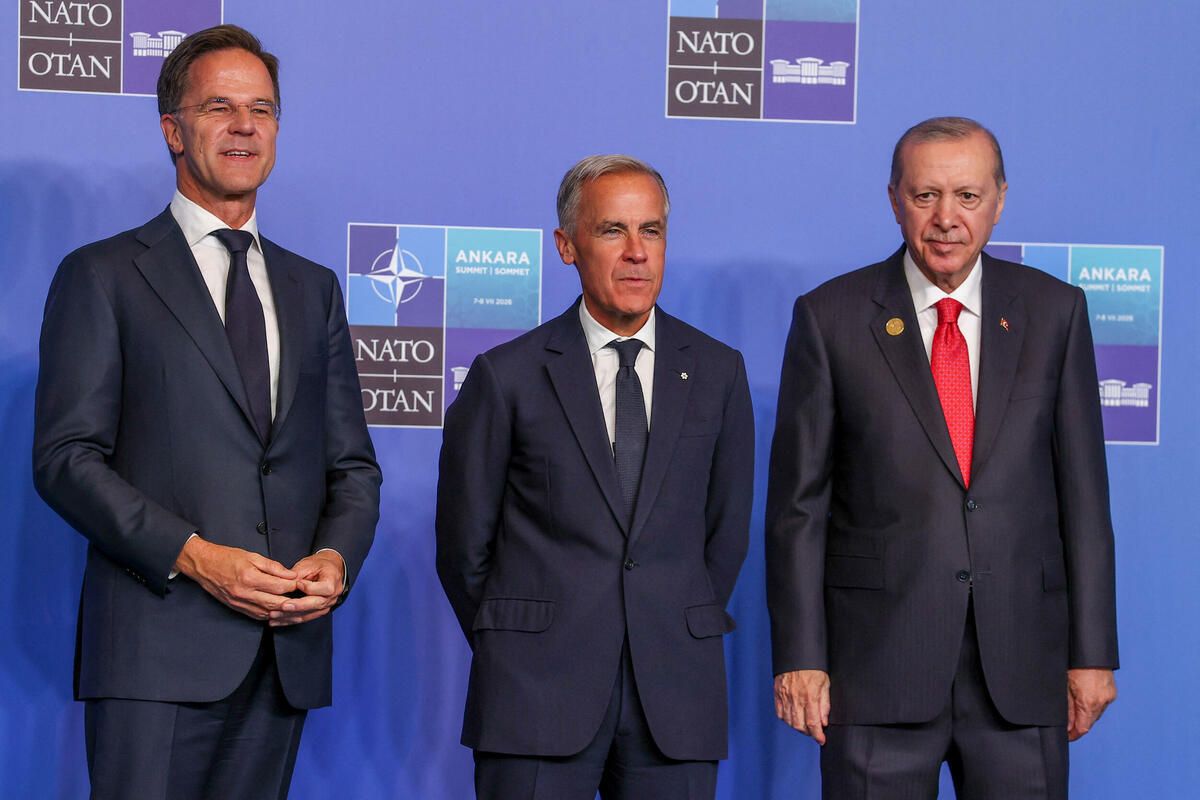
The recent NATO summit in Ankara, Turkey, was hailed as a great success. On the one hand, European leaders managed to avoid a clash with US President Donald Trump by courting him and presenting evidence of increased military spending. Turkish President Recep Tayyip Erdogan, meanwhile, has moved closer to lifting US sanctions that could finally allow Turkey to buy F-35 planes.
There was also the joint statement, a document that was often problematic during Trump’s term. Ankara’s statement was admittedly rather impersonal, but it contained all the appropriate phrases and buzzwords, from the allies’ “strong commitment to mutual defense in accordance with Article 5 of the Washington Treaty” to their commitment to a “360-degree approach to deterrence and defense.”
The managers even left with a nice farewell gift. Erdogan gave each of them a loaded revolver engraved with their name, whether it was a thoughtful gesture or a bureaucratic nightmare, depending on the country of origin of the leader in question. Even the sudden resumption of airstrikes on Iran during the summit did not disrupt the course of events.
For now, everything is fine.
Significantly, however, NATO leaders concluded their statement by committing to future meetings, but did not set a date for next summer’s summit. This reflects a growing view that NATO summits in the Trump era are little more than an opportunity for conflict and presidential outbursts from the US camp, and an obstacle to stable, bureaucratic decision-making.
Despite all the positive messages and photo ops, the summit also showed that while significant progress has been made in recent years in terms of burden sharing, particularly with regard to allocations, other NATO members remain divided on a fundamental question: what do they really want to achieve with all these new allocations?
The two Marks represent two sides of this disagreement: Canadian Prime Minister Mark Carney and NATO Secretary General Mark Rutte. While at first glance they appear divided mainly by rhetorical and stylistic choices, with Carney ready to openly confront Trump while Rutte’s flattery of the US president has become a subject of ridicule, they in fact present fundamentally different views on the future of the transatlantic alliance, which the Wall Street Journal recently described as “opposite poles of a decades-long debate currently raging in Europe.”
The first is Rutte. Since taking office as NATO secretary general, he has been nicknamed “the Trump whisperer,” a man so adept at flattering the White House chief that he could eliminate the possibility of Trump withdrawing from NATO. His main weapon in this fight is military spending, and unlike previous general secretaries, he has a lot to show.
Canada and Europe have pledged to spend an additional $1.2 trillion since Rutte took office; Germany alone plans to spend around $125 billion on defense by 2027, while Poland aims to spend 5% of its GDP on defense. European countries are finally getting serious about developing their own specific capabilities, even as they continue to squabble over public procurement, budgets and the protection of their own domestic industries.
But Rutte also made very clear that these allocations are not intended to replace American capabilities; on the contrary, they constitute a means of ensuring the continuation of American engagement in Europe in the future. This involves advocating for “buying American weapons” instead of focusing on developing Europe’s own defense capabilities. European leaders have feared for years that increased defense spending could lead the United States to distance itself from Europe. Rutte, however, argued the opposite: that an increase in defense spending is a way to convince the US president not to reduce the number of US troops, or rather a sign of goodwill on the part of European states.
In contrast, Carney has become one of Trump’s most vocal critics. This is not surprising: Trump’s criticism of Canada and his repeated, unwarranted threats to impose tariffs and even attack its northern neighbor almost certainly contributed to Carney’s election victory. Yet despite the political benefits he might gain from criticizing the US president, Carney’s statements were surprisingly strategic.
At the World Economic Forum in Davos, Switzerland, earlier this year, Carney surprised attendees by saying that middle powers like Canada and its European allies must find a way to assert themselves in an increasingly multipolar world if they don’t want to fall prey to great powers. The speech attracted attention largely because it implied, albeit indirectly, that the United States and China could be such predatory great powers. Carney traveled to Beijing after the speech, emphasizing his main message: Even longtime U.S. allies and neighbors like Canada must find a way to balance different powers.
In Ankara, Carney continued to urge NATO’s middle powers to unite in the face of a United States that is “reevaluating its priorities.” Carney’s model, unlike Rutte’s, implies that NATO members other than the United States must develop independent defense capabilities, not only as a safeguard against possible reductions in American capabilities, but also as a means of reducing their dependence and vulnerability to an increasingly unpredictable United States.
Ankara has been a particularly interesting place to promote this approach. If European states or Canada adopted this model, their policies could end up more closely resembling those of Turkey, a long-time NATO member but with questionable commitment. During the war on terror, and even since the start of the war between Russia and Ukraine, Erdogan’s Turkey has been willing to support the alliance, but only to the extent that it fits Turkish needs and interests.
Yet the Ankara summit shows that even as European leaders increasingly agree on the need to increase military spending and expand military capabilities, they remain divided between these two opposing worldviews.
Leaders like French President Emmanuel Macron have long defended Carney’s position. In fact, France was “the Carney before the Carney,” pushing the idea of European strategic autonomy from the United States at a time when such ideas were almost heretical in European politics. Rutte, on the other hand, enjoyed the support of other actors in Ankara, notably British Prime Minister Keir Starmer. Even though Starmer is nearing the end of his term, his successor is likely to be just as supportive of Rutte’s view.
The consequences of this disagreement are profound; it strongly influences the decisions of States on the areas in which they must invest during this transition period. Is it enough simply to highlight the increase in allocations? Or should European states quickly develop specific military capabilities?
There is currently little room for either those who want a complete break with the United States, or those who want a return to the pre-Trump state, such as the U.S. Department of Defense’s approach known as “NATO 3.0,” which would maintain the transatlantic alliance but with a reduced U.S. presence on the continent.
Yet whichever school of thought, Carney’s or Rutte’s, prevails, NATO leaders can breathe a sigh of relief as another summit passed without another outburst from Trump. If only all the alliance’s problems could be solved so easily through flattery and photo ops.
Translation: S. STRUGAR
Download the app and follow the news


FOLLOW US ON
News
|
Sources 2/ https://en.vijesti.me/world-a/globus/818322/two-marks-two-visions-of-the-future-nato-a The mention sources can contact us to remove/changing this article |
What Are The Main Benefits Of Comparing Car Insurance Quotes Online
LOS ANGELES, CA / ACCESSWIRE / June 24, 2020, / Compare-autoinsurance.Org has launched a new blog post that presents the main benefits of comparing multiple car insurance quotes. For more info and free online quotes, please visit https://compare-autoinsurance.Org/the-advantages-of-comparing-prices-with-car-insurance-quotes-online/ The modern society has numerous technological advantages. One important advantage is the speed at which information is sent and received. With the help of the internet, the shopping habits of many persons have drastically changed. The car insurance industry hasn't remained untouched by these changes. On the internet, drivers can compare insurance prices and find out which sellers have the best offers. View photos The advantages of comparing online car insurance quotes are the following: Online quotes can be obtained from anywhere and at any time. Unlike physical insurance agencies, websites don't have a specific schedule and they are available at any time. Drivers that have busy working schedules, can compare quotes from anywhere and at any time, even at midnight. Multiple choices. Almost all insurance providers, no matter if they are well-known brands or just local insurers, have an online presence. Online quotes will allow policyholders the chance to discover multiple insurance companies and check their prices. Drivers are no longer required to get quotes from just a few known insurance companies. Also, local and regional insurers can provide lower insurance rates for the same services. Accurate insurance estimates. Online quotes can only be accurate if the customers provide accurate and real info about their car models and driving history. Lying about past driving incidents can make the price estimates to be lower, but when dealing with an insurance company lying to them is useless. Usually, insurance companies will do research about a potential customer before granting him coverage. Online quotes can be sorted easily. Although drivers are recommended to not choose a policy just based on its price, drivers can easily sort quotes by insurance price. Using brokerage websites will allow drivers to get quotes from multiple insurers, thus making the comparison faster and easier. For additional info, money-saving tips, and free car insurance quotes, visit https://compare-autoinsurance.Org/ Compare-autoinsurance.Org is an online provider of life, home, health, and auto insurance quotes. This website is unique because it does not simply stick to one kind of insurance provider, but brings the clients the best deals from many different online insurance carriers. In this way, clients have access to offers from multiple carriers all in one place: this website. On this site, customers have access to quotes for insurance plans from various agencies, such as local or nationwide agencies, brand names insurance companies, etc. "Online quotes can easily help drivers obtain better car insurance deals. All they have to do is to complete an online form with accurate and real info, then compare prices", said Russell Rabichev, Marketing Director of Internet Marketing Company. CONTACT: Company Name: Internet Marketing CompanyPerson for contact Name: Gurgu CPhone Number: (818) 359-3898Email: [email protected]: https://compare-autoinsurance.Org/ SOURCE: Compare-autoinsurance.Org View source version on accesswire.Com:https://www.Accesswire.Com/595055/What-Are-The-Main-Benefits-Of-Comparing-Car-Insurance-Quotes-Online View photos

 |
 |
 |