
International
Akira Ikezoe’s Frogs and Bears Have Something Urgent to Tell Us
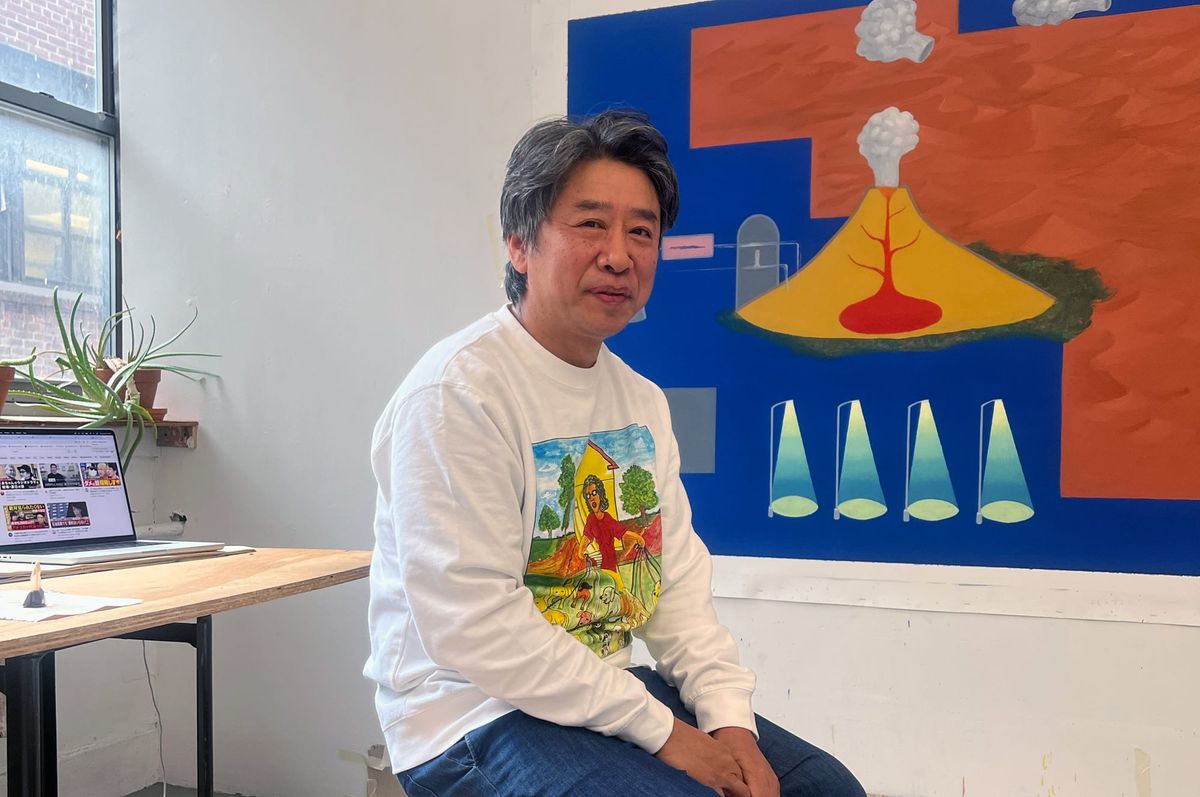
Akira Ikezoe welcomes me to his studio wearing a long-sleeved T-shirt made by the Cevallos brothers, with whom he recently participated in the Greater New York survey at MoMA PS1. This is just one of several large-scale exhibitions and international biennials that Ikezoe has participated in in recent years, including last year’s Sharjah Biennial and this year’s Whitney Biennial. As a result, his studio is sparse, with the exception of a few paintings in progress.
Ikezoe buys me tea as we remember our meeting in 2023 at the Rehearsal Art Book Fair, co-hosted by Bungee Space and Accent Sisters. There, Ikezoe introduced me to his Baby Recipes series (2022), in which babies’ body parts become ingredients in illustrated, comic-book style cooking guides. In the studio, I ask where the idea came from.
“Frustrations with raising my three-year-old son,” he responds.
I ask him if his wife was worried when she first saw the drawings.
“No, she liked them. She understood how I felt.”
Akira Ikezoe pouring tea in his studio
We laugh. It is precisely this dark humor that first fascinated me, and it continues to permeate Ikezoe’s work, which deals with energy systems, resource extraction and the ambiguities of natural and industrial cycles. Laughter comes easily to Ikezoe, whose frankness on morbid subjects is immediately disarming. The cartoonish seriousness of the artist and the artwork hides a keen attention to the environmental and man-made disasters unfolding around us. Humor becomes the hidden vessel of his satire.
Akira Ikezoe, “Bears on the Diagram of Chernobyl Nuclear Power Plant” (2021), oil on canvas (photo provided by the artist)
Ikezoe’s meticulously detailed oil paintings—the works that propelled him to prominence—depict anthropomorphic frogs, bears, raccoons, and monkeys engaged in industrial workflows, hallucinatory work systems, and sequential transformations unfolding against flat, schematic backgrounds viewed from above. For years, his compositions have drawn direct inspiration from found flowcharts and blueprints, materials that he believes are generally excluded from the realm of art. This is particularly true for the work he presented in Sharjah, for which he associated diagrams of nuclear power plants that had suffered serious accidents with animals native to these ecosystems. In these paintings, Chernobyl is exploited by bears; Three Mile Island is full of raccoons. He explains that his earlier works mainly depicted naked humans, but as nudity could not be shown in Sharjah, he turned to animals – and the images remained.
“I love frogs,” Ikezoe said. “My grandparents were farmers, and when I visited them, the frogs were very noisy at night. Their rice fields were filled with water – a very nice home for frogs.”
Left: watercolor sketch in Akira Ikezoe’s studio; right: paintings leaning against and fixed to the wall in Akira Ikezoe’s workshop
Ikezoe’s knowledge of animals rivals his understanding of energy infrastructure. This becomes particularly clear when we begin to discuss nuclear power and the unresolved dilemma of its toxic waste, especially in the wake of disasters such as the 2011 Fukushima Daiichi nuclear disaster, which occurred just months after it was installed in New York in late 2010.
“I started thinking about how civilization and nature are always invading each other,” he said. “Our cultural and natural elements always contradict each other. Countries are now building more nuclear power plants because oil supplies are unstable due to war.” Ikezoe understands that this is an inevitable trajectory, given our global energy needs: “It now seems impossible to simply say no to nuclear power. We need something to substitute or replace it. Hopefully, technological development will offer solutions.”
Akira Ikezoe, “Nuclear Power Plant and Star Formation” (2026), oil on canvas (photo provided by the artist)
At its core, Ikezoe’s work addresses the cost of prioritizing short-term economic growth over local communities and the long-term consequences of nuclear waste. But they also offer fantastic, circular alternatives: imaginative new energy and exchange systems.
He traces these concerns to his childhood in Kochi, Japan, where his nature-loving parents hunted, collected specimens, and spent weekends in the mountains or by the ocean. As a child, he imagined working closely with nature, perhaps becoming a zoologist, before turning to art as a teenager and eventually enrolling at Tokyo’s Tama Art University. But it is partly because of this early interest in the natural world that Ikezoe draws less inspiration from art history than from science magazines, documentaries and science fiction films.
He shows me a painting in progress.
Akira Ikezoe in front of a painting in progress in his studio
“This blue painting depicts a geothermal energy plant for a greening project in the Sahara Desert. Heat comes out of a volcano, producing steam in the energy plant – “
In the middle of a sentence, Ikezoe accidentally brushes the surface of the painting. We laugh as he wipes away the gray stain on the wall below.
“The electricity powers these street lights, which attract insects. I’m going to paint chameleons eating the insects,” he continued. “Then, on the other side, camels come out of the smoke of the volcano. Their humps open and people put the chameleons inside. Then the camels go into the desert and die. Corpses, plants grow, making the desert greener.”
Akira Ikezoe, “Not So Still Life with a Visual System” (2024), oil on canvas (photo provided by the artist)
We burst out laughing again. The novelty of Ikezoe’s work lies partly in the absurd internal logic of his image-making: the magical mutability of physical properties, or the free association of completely different things. Of course, a monkey’s spiral tail can be planted and turn into a tornado. It’s so simple that even a child could understand it.
“The studio is my playground,” he says. “The people who come here are adults, so I have to explain what I do in the sandbox. My work is purely personal entertainment and it’s difficult to explain why it’s important.”
I laugh again, in disbelief, because it’s hard to imagine how Ikezoe’s concepts could be unimportant. For all their fantasy, his paintings are deeply concerned about the future of humanity.
Two paintings in progress by Akira Ikezoe in his studio
Our conversation drifts to aquaponics and solar energy.
“Solar panels are very problematic in Japan right now,” he explains, “because companies are cutting down forests to install them. It’s so contradictory. They don’t understand the real purpose of solar panels. I wanted to make fun of that in this red painting.” Ikezoe gestures to a painting in progress with several flat areas painted on a brown background, soon populated by fanciful beings on massage chairs as part of a larger circulatory system.
Next to it is a piece from Ikezoe’s Chart of Darkness series (2025), on display in Greater New York. The series demonstrates its associative thinking through associations of animals and objects that blur distinctions between nature and culture, scientific and spiritual, clean and dangerous, human and non-human.
“I invent stories between objects with similar visual characteristics, like bananas and crescent moons,” he explains. “When I arrived in New York, I didn’t speak English well, so it was difficult to explain what I was doing as an artist. I started organizing things into categories based on shape. Then I realized this already existed in Japanese folklore – people worshiped a giant rock shaped like a genital organ as a symbol of fertility, for example. There’s no scientific connection, but people create stories based on visual similarity. I thought: “Oh, that’s how folklore begins.” I wanted to do a contemporary version of it.
Akira Ikezoe, “Chart of Darkness—1,2,3,4 and many” (2025), oil on canvas (photo provided by the artist)
Indeed, contemporary Ikezoe myths function as diagrams or dictionaries for understanding the world without resorting to written or verbal language. Detached from specific linguistic or cultural markers, they become universal. Their imaginative logic recalls the childhood desire to find shapes in the clouds.
I ask him if he talks about the paintings with his son.
“He understands them immediately,” Ikezoe said. He goes on to tell me that the two often exchange ideas and that his son’s concepts sometimes show up in the work.
Beyond their humor and visual pleasure, Ikezoe’s paintings crucially illuminate the afterlife of materials we prefer not to think about, particularly those that resist careful systems of reuse or disposal. They bring artificial and ecological networks into dialogue, where the resulting exchange is equally likely to be a harsh truth or a visual joke. Death and decay, reincarnation and recycling appear neutrally – inevitable components of ongoing transformation. There are no protagonists in these worlds, no hierarchy. The system itself is the story.
Left: Akira Ikezoe’s laptop, with a diagram; right: preparatory drawings of objects for his paintings
Talking with Ikezoe, I realize how adulthood often reduces our ability to think associatively. As we age, we tend to interpret the world more literally, losing access to the connective logic that Ikezoe so carefully cultivated. Exercised fully, this mode of thinking could help us imagine speculative futures and unconventional solutions to the crises of the present – many of which Ikezoe’s work discreetly points out. It could also reveal how deeply involved we already are in these systems.
Or it could lead us to a world in which moles eat Chinese food as part of a closed power grid. Thanks to Ikezoe, at least we can imagine it: the scene is currently hung in bright colors on the vast walls of the 2026 Whitney Biennial.
|
Sources 2/ https://hyperallergic.com/akira-ikezoes-frogs-and-bears-have-something-urgent-to-tell-us/ The mention sources can contact us to remove/changing this article |
What Are The Main Benefits Of Comparing Car Insurance Quotes Online
LOS ANGELES, CA / ACCESSWIRE / June 24, 2020, / Compare-autoinsurance.Org has launched a new blog post that presents the main benefits of comparing multiple car insurance quotes. For more info and free online quotes, please visit https://compare-autoinsurance.Org/the-advantages-of-comparing-prices-with-car-insurance-quotes-online/ The modern society has numerous technological advantages. One important advantage is the speed at which information is sent and received. With the help of the internet, the shopping habits of many persons have drastically changed. The car insurance industry hasn't remained untouched by these changes. On the internet, drivers can compare insurance prices and find out which sellers have the best offers. View photos The advantages of comparing online car insurance quotes are the following: Online quotes can be obtained from anywhere and at any time. Unlike physical insurance agencies, websites don't have a specific schedule and they are available at any time. Drivers that have busy working schedules, can compare quotes from anywhere and at any time, even at midnight. Multiple choices. Almost all insurance providers, no matter if they are well-known brands or just local insurers, have an online presence. Online quotes will allow policyholders the chance to discover multiple insurance companies and check their prices. Drivers are no longer required to get quotes from just a few known insurance companies. Also, local and regional insurers can provide lower insurance rates for the same services. Accurate insurance estimates. Online quotes can only be accurate if the customers provide accurate and real info about their car models and driving history. Lying about past driving incidents can make the price estimates to be lower, but when dealing with an insurance company lying to them is useless. Usually, insurance companies will do research about a potential customer before granting him coverage. Online quotes can be sorted easily. Although drivers are recommended to not choose a policy just based on its price, drivers can easily sort quotes by insurance price. Using brokerage websites will allow drivers to get quotes from multiple insurers, thus making the comparison faster and easier. For additional info, money-saving tips, and free car insurance quotes, visit https://compare-autoinsurance.Org/ Compare-autoinsurance.Org is an online provider of life, home, health, and auto insurance quotes. This website is unique because it does not simply stick to one kind of insurance provider, but brings the clients the best deals from many different online insurance carriers. In this way, clients have access to offers from multiple carriers all in one place: this website. On this site, customers have access to quotes for insurance plans from various agencies, such as local or nationwide agencies, brand names insurance companies, etc. "Online quotes can easily help drivers obtain better car insurance deals. All they have to do is to complete an online form with accurate and real info, then compare prices", said Russell Rabichev, Marketing Director of Internet Marketing Company. CONTACT: Company Name: Internet Marketing CompanyPerson for contact Name: Gurgu CPhone Number: (818) 359-3898Email: [email protected]: https://compare-autoinsurance.Org/ SOURCE: Compare-autoinsurance.Org View source version on accesswire.Com:https://www.Accesswire.Com/595055/What-Are-The-Main-Benefits-Of-Comparing-Car-Insurance-Quotes-Online View photos

 |
 |
 |