
Politics
Coordination reflects changes in relationships (Xiao Bin)
Consequential Sino-Russian coordination is a response to the growing turbulence in the international system. While their strategic collaboration improves bilateral strategic predictability, it also means that competition between large countries becomes increasingly protracted and complex.
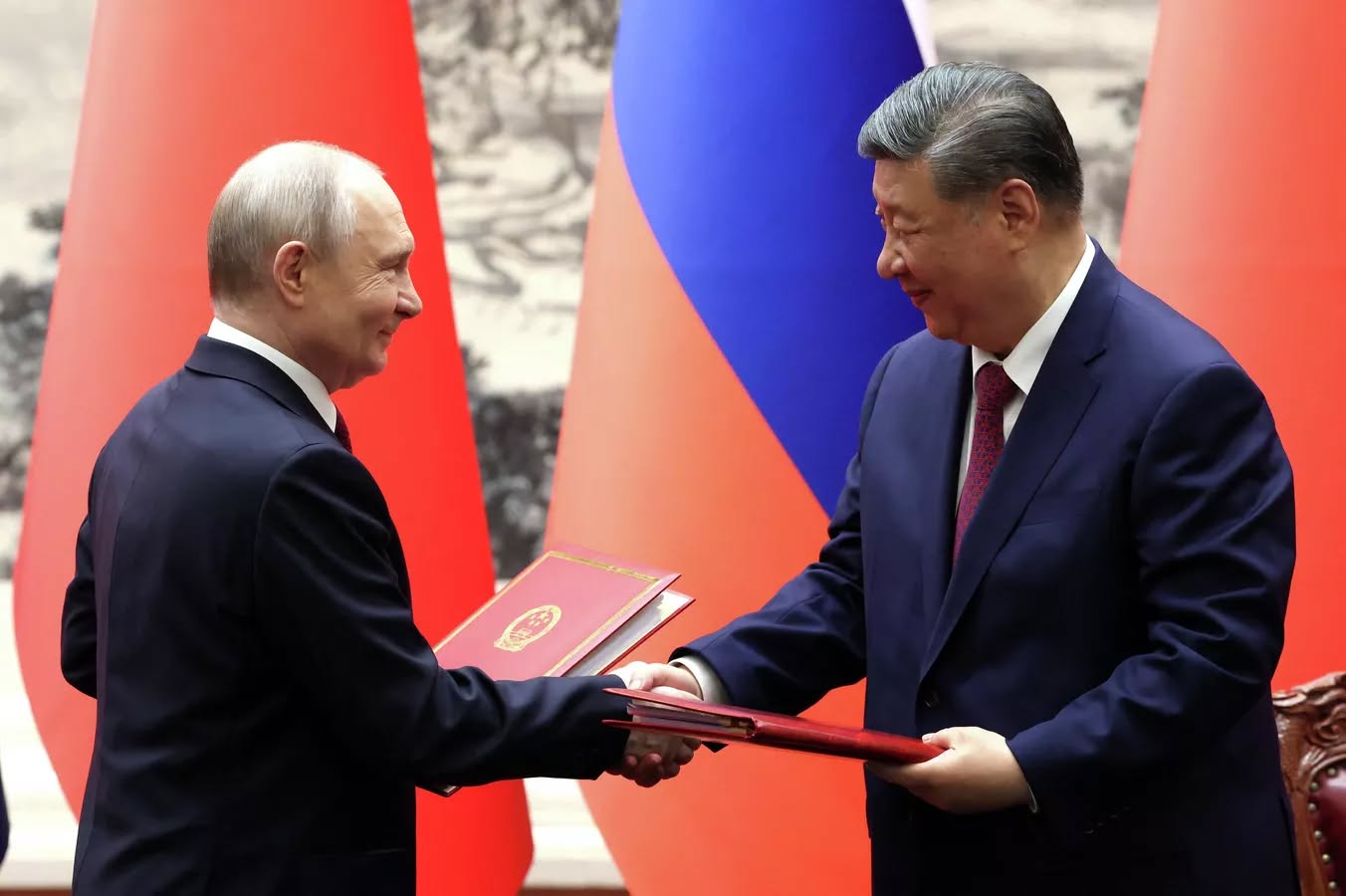
Chinese President Xi Jinping (R) and Russian President Vladimir Putin sign a joint statement on strengthening comprehensive strategic coordination and deepening good-neighborliness and friendly cooperation between the two countries at the Great Hall of the People in Beijing, China, May 20, 2026.
During Russian President Vladimir Putin’s visit to China, the two countries marked the 30th anniversary of their strategic coordination partnership and renewed the Treaty of Good Neighborhood and Friendly Cooperation. China has said that amid profound changes in the international landscape, the world risks falling back into “law of the jungle” dynamics. In this context, the two countries committed to respecting the spirit of the treaty and further strengthening their subsequent strategic coordination.
This statement goes beyond usual diplomatic rhetoric and reflects a profound adjustment in contemporary relations between major countries. Against the backdrop of current geopolitical crises, a new round of strategic recalibration of Sino-US relations, and the gradual weakening of the global arms control regime, Sino-Russian relations are evolving from a traditional partnership to a more stable and pragmatic strategic collaboration.
On the day of Putin’s visit to China, Russian newspaper Nezavisimaya Gazeta said that close strategic relations between Russia and China “play a vital stabilizing role in the international arena” and noted that both sides “do not act against anyone, but for peace and universal prosperity.” The sentiment echoes Beijing’s call for back-to-back coordination, underscoring the fact that both countries see each other as key strategic pillars in an ever-changing international landscape.
In relations between major countries, the destiny of a nation depends not only on the interdependence of security interests, but also on the depth of ties in non-military areas. Unlike the Cold War era, which emphasized military alliances, modern relations between major countries increasingly rely on long-term coordination capabilities and sustainable forms of global connectivity. To some extent, Sino-Russian relations reflect this broader transformation.
The treaty as a cornerstone
Signed in 2001, the Treaty of Good Neighborhood and Friendly Cooperation constitutes the institutional foundation of contemporary relations between China and Russia. The treaty enshrines several fundamental principles: lasting friendship, non-alignment, non-confrontation, not targeting third parties and mutual respect for sovereignty and development paths. Over the past decades, bilateral relations have maintained a notable degree of stability despite repeated international turbulence, largely due to this institutional framework.
Unlike traditional military alliances, China and Russia emphasize strategic coordination. This model preserves the independence of both sides’ foreign and security policies while reducing the risk of entanglement in each other’s conflicts. From Washington’s perspective, however, their deep strategic collaboration goes beyond a conventional partnership. In recent years, the U.S. strategic community has increasingly characterized China and Russia as significant rivals that limit America’s global strategic advantages.
Some major US media outlets interpreted Putin’s visit to China as highlighting Beijing’s balancing role in the Sino-US-Russian trilateral relationship. In discussions of the so-called new maritime Cold War, some American scholars argue that Sino-Russian relations have reshaped the global balance of power and pose a major challenge to the United States.
The foundation of contemporary Sino-Russian relations lies less in short-term exchanges of interests than in a common response to pressures from the international system. This structural underpinning explains why repeated U.S. efforts to drive a wedge between the two nations have yielded only limited results.
Expansion of coordination
The China-Russia Comprehensive Strategic Coordination Partnership represents an evolving extension of the spirit embodied in the original treaty. While Washington views the two countries as key strategic competitors, their collaboration is seen as a coordinated response to external pressures. From this perspective, it could serve to diffuse US strategic attention while enabling mutually beneficial cooperation between the two countries, without entangling them in each other’s conflicts. This is a strategic choice that adapts to the current international system.
Against the backdrop of the ongoing conflict in Ukraine, Russia is increasingly relying on this partnership, which helps ease wartime economic pressure and strengthen national resilience. A good example is the Power of Siberia 2 gas pipeline project. Having lost substantial access to European energy markets, Moscow has shown a greater willingness to move the project forward, seeking to more quickly finalize deals to stabilize its revenues and support its energy exports.
China, meanwhile, has taken a pragmatic and cautious approach, prioritizing prices, contract terms and long-term commercial sustainability. This highlights that Sino-Russian cooperation is not unlimited but rather is a realistic choice shaped by each country’s core national interests.
Putin has strengthened his commitment to bilateral relations through sustained personal diplomacy. He stressed that the Treaty of Good Neighborhood and Friendly Cooperation has laid a solid foundation for strategic relations and will continue to support the deepening of this partnership.
In a broader context, the deterioration of the international security environment is a key factor in the continued strengthening of Sino-Russian relations. Consequential coordination is not only a form of mutual security support, but also a mechanism contributing to strategic stability.
American strategic anxiety
Deepening Sino-Russian relations have added to the strategic pressures facing the United States. Its National Defense Strategy and Report on China’s Military Power presents China and Russia as a “simultaneous problem” and warns that their closer coordination could expand U.S. strategic resources across Europe and the Indo-Pacific.
Behind this concern lies a deeper problem: the steady erosion of the post-Cold War global arms control regime. From the gradual collapse of the Conventional Armed Forces Treaty in Europe to the formal termination of the Intermediate-Range Nuclear Forces Treaty and the expiration of the New Strategic Arms Reduction Treaty in February this year, the global arms control system faces its most serious crisis since the end of the Cold War. At the same time, European countries, NATO and Indo-Pacific countries are strengthening their military capabilities, bringing major powers back into a new round of security dilemma. Thus, Sino-Russian coordination should not be seen as an isolated phenomenon but as a response shaped by the growing turbulence in the international system.
The risk that the world will return to the law of the jungle is not an empty warning. While Sino-Russian strategic collaboration enhances bilateral strategic certainty, it reflects a broader trend where competition between major countries is becoming longer and more complex. Rebuilding mutual trust in a competitive context and reshaping the global arms control framework will therefore constitute a major test for China, the United States and Russia.
|
Sources 2/ https://www.chinausfocus.com/foreign-policy/coordination-reflects-shifts-in-relations The mention sources can contact us to remove/changing this article |
What Are The Main Benefits Of Comparing Car Insurance Quotes Online
LOS ANGELES, CA / ACCESSWIRE / June 24, 2020, / Compare-autoinsurance.Org has launched a new blog post that presents the main benefits of comparing multiple car insurance quotes. For more info and free online quotes, please visit https://compare-autoinsurance.Org/the-advantages-of-comparing-prices-with-car-insurance-quotes-online/ The modern society has numerous technological advantages. One important advantage is the speed at which information is sent and received. With the help of the internet, the shopping habits of many persons have drastically changed. The car insurance industry hasn't remained untouched by these changes. On the internet, drivers can compare insurance prices and find out which sellers have the best offers. View photos The advantages of comparing online car insurance quotes are the following: Online quotes can be obtained from anywhere and at any time. Unlike physical insurance agencies, websites don't have a specific schedule and they are available at any time. Drivers that have busy working schedules, can compare quotes from anywhere and at any time, even at midnight. Multiple choices. Almost all insurance providers, no matter if they are well-known brands or just local insurers, have an online presence. Online quotes will allow policyholders the chance to discover multiple insurance companies and check their prices. Drivers are no longer required to get quotes from just a few known insurance companies. Also, local and regional insurers can provide lower insurance rates for the same services. Accurate insurance estimates. Online quotes can only be accurate if the customers provide accurate and real info about their car models and driving history. Lying about past driving incidents can make the price estimates to be lower, but when dealing with an insurance company lying to them is useless. Usually, insurance companies will do research about a potential customer before granting him coverage. Online quotes can be sorted easily. Although drivers are recommended to not choose a policy just based on its price, drivers can easily sort quotes by insurance price. Using brokerage websites will allow drivers to get quotes from multiple insurers, thus making the comparison faster and easier. For additional info, money-saving tips, and free car insurance quotes, visit https://compare-autoinsurance.Org/ Compare-autoinsurance.Org is an online provider of life, home, health, and auto insurance quotes. This website is unique because it does not simply stick to one kind of insurance provider, but brings the clients the best deals from many different online insurance carriers. In this way, clients have access to offers from multiple carriers all in one place: this website. On this site, customers have access to quotes for insurance plans from various agencies, such as local or nationwide agencies, brand names insurance companies, etc. "Online quotes can easily help drivers obtain better car insurance deals. All they have to do is to complete an online form with accurate and real info, then compare prices", said Russell Rabichev, Marketing Director of Internet Marketing Company. CONTACT: Company Name: Internet Marketing CompanyPerson for contact Name: Gurgu CPhone Number: (818) 359-3898Email: [email protected]: https://compare-autoinsurance.Org/ SOURCE: Compare-autoinsurance.Org View source version on accesswire.Com:https://www.Accesswire.Com/595055/What-Are-The-Main-Benefits-Of-Comparing-Car-Insurance-Quotes-Online View photos

 |
 |
 |